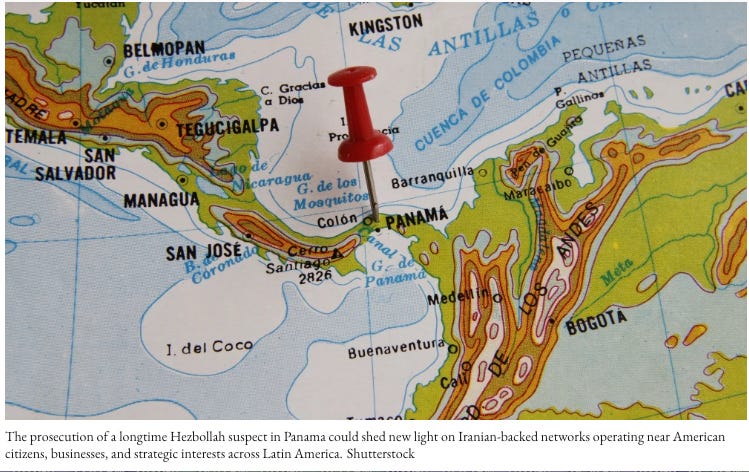
On July 19, 1994 Alas Chiricanas Flight 901 took off from Colón, Panama bound for Panama City. Shortly after takeoff an explosion tore through the aircraft and killed all 21 people aboard. Twelve were Jewish businessmen.
One day earlier, a suicide bomber had driven a van into the AMIA Jewish community center in Buenos Aires. Eighty-five people were murdered and hundreds more wounded in the deadliest terrorist attack in Argentine history.
Thirty-two years later Panama is prosecuting a suspect in the Flight 901 bombing, raising new questions about Iran and Hezbollah’s operations in Latin America.
AMIA wasn’t Argentina’s first encounter with this kind of terrorism. Two years earlier a bomb destroyed the Israeli Embassy in Buenos Aires killing 29 people. Mohsen Rabbani, the Iranian cleric who would become a central figure in the AMIA investigation, had been living in Argentina since 1983. Argentine prosecutors later described an Iranian network built through diplomatic, religious and commercial relationships.
Decades before Rabbani arrived, Argentina had become one of the world’s most notorious refuges for Nazi fugitives. Adolf Eichmann lived outside Buenos Aires. Josef Mengele lived there. Nazi propagandists published there. Neo-fascist organizations terrorized Argentine Jews. Later, Arab League representatives arrived and developed relationships with some of those Argentine nationalist circles.
The people and ideologies changed across the decades but Argentina kept appearing in the story.
Why?
When Nazi fugitives began arriving after World War II they were entering a country where Germany had already spent years building political, commercial and cultural infrastructure. U.S. archival records describe a German network involving businesses, shipping interests, banks, newspapers and political organizations. By the war years there were nearly 60,000 Germans in Argentina who belonged to the Nazi Party’s foreign organization.
After the war, Argentina became a major destination for Nazis and collaborators escaping Europe. Adolf Eichmann arrived under the name Ricardo Klement. Josef Mengele arrived in 1949 and lived openly enough to obtain Argentine identification. Erich Priebke, an SS officer involved in the Ardeatine Caves massacre in Italy, settled in Bariloche and remained there for decades. Argentina’s later investigations confirmed that at least 180 Nazi war criminals entered the country.
Some continued publishing and organizing, surrounded by sympathizers and other former Nazis. One of their most important publications was Der Weg, a German-language neo-Nazi magazine published in Buenos Aires. One of its writers was Johann von Leers, a prolific antisemitic propagandist who had worked within Joseph Goebbels’s propaganda apparatus.
Von Leers escaped Europe and made his way to Argentina where he wrote for Der Weg and circulated among former Nazis and sympathizers. He even met Adolf Eichmann in Buenos Aires in 1955.
Then an Egyptian military representative reportedly recruited him.
Declassified American intelligence records describe an Egyptian military representative recruiting von Leers while he was living in Argentina to participate in anti-Jewish propaganda work. Von Leers eventually left Buenos Aires for Cairo where he joined Egypt’s propaganda apparatus and developed relationships with Arab League officials and Haj Amin al-Husseini.