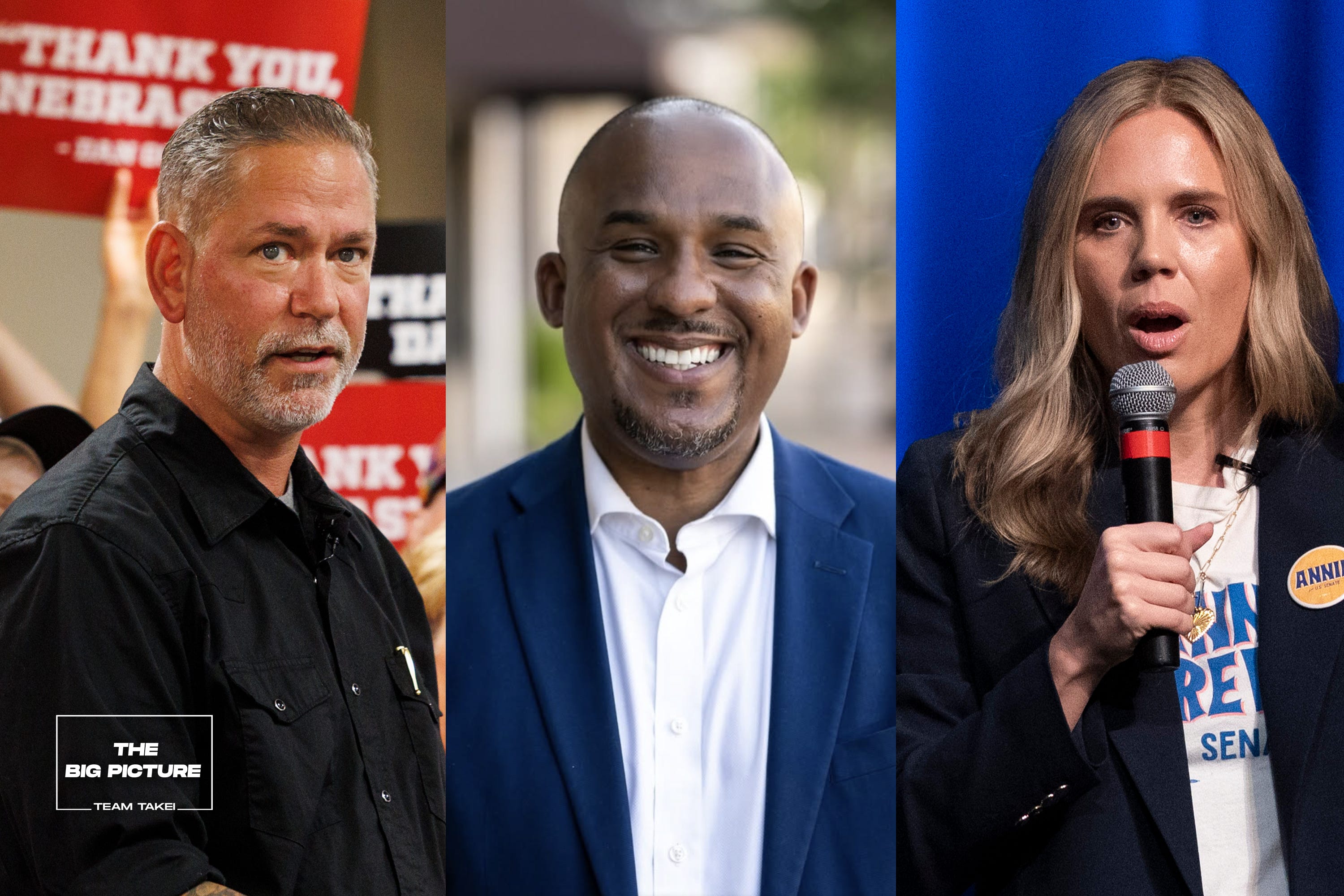
Last month, the Democratic Senate Campaign Committee, whose mission is to elect Democrats to the U.S. Senate, announced its Win The Senate program: a $40 million investment in ten battleground Senate races, seven of which are on offense and three of which are on defense.
Today, just a month later, The Silver Bulletin’s Deluxe model shows Democrats with a 55% chance of winning the Senate, with the Democratic candidate ahead in seven of the ten targeted races (Georgia, Michigan, New Hampshire, Maine, North Carolina, Ohio, and Texas), behind in two (Iowa and Florida), and a toss-up in one (Alaska). And that’s with more than two months until Election Day.
It wasn’t long ago that Democrats didn’t have much of a chance of flipping the Senate, so the trend is clear: As the war in Iran continues to rage, as Trump sends prices ever higher with an expanding trade war, and as the president’s approval plummets to new lows, the blue wave continues to build. And with that, Democrats’ target map is expanding.
But that too is happening at a shockingly swift pace.
Just in the last two weeks, five Senate races that seemed out of reach for Democrats have now begun to appear winnable if everything goes Democrats’ way. Which, to be fair, is a big if.
But if the story of the 2026 race for control of the U.S. Senate is about Democrats showing strength in deep red Trump country and eating into Republican support in areas where the GOP thought they had a stranglehold, that is doubly true for these five Senate races, which feature Republicans struggling to remain ahead in states Trump won by anywhere from 16 points (Kansas) to 30 points (Arkansas) in 2024.
Is 68 days enough to move these unlikely pick-ups from longshots to flips? Perhaps. But at the very least, as some of the DSCC’s initial target races now look more likely, some resources should now go to these longshot races, if only to make Republicans spend their own where they never thought they’d have to.
Back in March, Scott Colom, a seventh-generation Mississippian who has been elected District Attorney in a politically divided district three times, won the state’s Democratic primary for U.S. Senate.
By any measure, Colom is a long shot to win the seat. A Democrat hasn’t served as U.S. Senator from Mississippi since the 1980s, and Mississippi went for Trump by 23 points. But this year could be different.
In one of the reddest states in the country, Scott Colom is running as a different kind of Democrat. The front page of his website centers messaging about his Christian faith, his law and order career, as well as his MAGA-coded goal to put “Mississippi first.” He hopes to undercut any claim that he is a typical liberal running to be a rubber-stamp vote for Chuck Schumer.
As Colom told the ▶Longplay podcast earlier this month:
“What I’m offering the people is not to be just another Democratic Senator. I’m offering them to be Mississippi’s Senator, someone who fights to make their lives better. The conditions are perfect: We have corruption that is costing Mississipians, we have a Senator Cindy Hyde Smith who’s scared to show up and voting against our interests, and we have a candidate God willing that understands how to win.”
Smartly, Colom is taking a page from other Democrats running in red states, such as Jon Ossoff and James Talarico, who are laser-focused on affordability as a direct result of the corruption by the wealthy and powerful.
As PBS reported:
“I’m going to fight the corruption that we’re seeing in D.C. that’s making everything less affordable,” Colom said, zeroing in on Trump’s tariffs, the Iran war and the Republican-controlled Congress’ capitulation on both. “Our junior senator has totally given away our voice. She’s not worried about us at all.”
And his race is getting noticed. Just this week, Pete Buttigieg endorsed Scott, telling MSNOW:
“I’ve been paying a lot of attention to uphill races that we could actually win,” Buttigieg said. “And yeah, in almost any other year, and with almost any other candidate, a race like this would seem out of reach. But what I see in Scott Colom, and why I wanted to get involved in this race, is there’s a real chance here.”
Buttigieg, who has endorsed over 30 Democrats in races around the nation this cycle ahead of a likely run for president, is urging national Democrats to expand the map of winnable seats and not sleep on a candidate like Colom.
“I certainly hope that the committees and individuals who want to see us take back the chamber look at this race, because what’s clear to me is that you’ve got a candidate and a message that can win, but he’s got to have the resources to get the word out.”
Longtime Democratic strategist Jen Palmieri, co-host of the Longplay podcast, agrees. As she ▶told Morning Joe recently about Colom’s race,
“There’s a theory [in Mississippi] that you just have to get Black turnout up by four percentage points and have a quarter of white voters in the state vote for the Democrat and that’s the margin of victory there. Mississippi is just right there for the taking. It’s not an expensive state to win an election. Even in Mississippi, Trump is not popular. Colom is a very good candidate and Cindy Hyde-Smith is nowhere, not campaigning at all, just taking it for granted.”
At a moment when Trump is at record low approval in the state, Scott Colom is proving his mettle, having outraised the Republican incumbent in the second quarter.
In a press release announcing its Win The Senate program, the DSCC touted their investment in “State-run programs focused on outreach to Latino voters, Black voters, AAPI voters, Alaska Native voters and younger voters.” As more of their targeted races come off the board, and as a Democratic Senate majority looks more within reach, they could pivot to investing in a state like Mississippi, where Scott Colom could be the tip of the spear for the Democrats’ expansion of the Senate map.
Of all the states on this list, Kansas was the tightest race in 2024, going for Trump by a still formidable 16 points. Despite that spread, Kansas has elected four Democratic governors in the last 30 years. Democratic wins at the federal level have been more elusive, however. But could 2026 be the year Kansas elects a Democrat to the U.S. Senate for the first time since the 1930s?
In a cycle when Democratic candidate recruitment has been stellar, Adam Hamilton is truly one of Democrats’ top gets. Hamilton, who only launched his campaign for Senate in May, is the founder and senior pastor of not just the largest Methodist Church congregation in the greater Kansas City area, but in the country.
As The New York Times puts it:
Mr. Hamilton, for his part, is a
[credible fund-raiser]and a longtime community leader from a populous part of the state. He founded and leads a roughly 24,000-person congregation based in the suburbs of Kansas City, Mo., right across the state line in Kansas.It’s an area that once favored center-right Republicans, but
[shifted sharply away from the party during the Trump era], and has since become a crucial source of Democratic turnout.
Since launching in May, Hamilton proceeded to break a Kansas fundraising record, raising $3.66 million in the first three months of his campaign.
Like Colom, Hamilton is focused on fighting corruption, as he puts it on his campaign website:
Adam is running for Senate because he believes we need to stop the chaos and corruption in Washington by actually listening, and bringing people together to solve problems.
And in an anti-system year, Hamilton is very much running as an anti-system candidate, framing himself as an independent-minded leader ready to hold both parties accountable. As the welcome message to his campaign website reads:
“If you’re ready to change the status quo in Washington, flip this seat and send an independent-minded leader to the Senate, I hope you’ll chip in any amount right now to support my campaign.”
Former Senator Claire McCaskill (D-MO) 𝕏declared Hamilton a candidate to watch during an August 1 appearance on MSNOW, saying:
“The map is expanding every day. We now have a possibility of winning Kansas. We have a man running in Kansas that nobody’s heard of, his name is Adam Hamilton. But he actually is the pastor of the largest Methodist Church in the country. He got 16,000 contributions in the first 30 days he got in the race and raised $4 million. He is beloved in the Kansas City area. He is really a good man and he is going to be a very strong candidate against that nut Roger Marshall.”
Days later, Hamilton officially won the Democratic nomination.
And just days after that, Public Policy Polling had a poll in the field, whose results bore McCaskill’s bullishness for Hamilton out.
In the poll, not only is Senator Roger Marshall, the Republican incumbent, extremely underwater with a measly 38% approval rating in the state, but Hamilton is essentially tied with Marshall in a head-to-head match-up. And he had only just won the Democratic nomination at that point.
Notably, when respondents heard more about Hamilton’s biography, that result shifted toward Hamilton by two points, putting him ahead of Marshall by a point.
With a virtual tie as his starting point, Hamilton is in a strong position to turn this tie into a lead by November.
On July 11, Senator Lindsey Graham (R-SC) died suddenly at the age of 71, shocking the political world and possibly shaking up the Senate map.
Before his death, Graham was not seen as a terribly endangered Republican, even though the Democratic nominee Dr. Annie Andrews has been consistently polling within single digits of Graham, including as recently as June.
Andrews also outraised Graham in three consecutive quarters, with a whopping $6.4 million haul as of the second quarter of 2026.
Andrews is running as a political outsider with her own anti-system populist reform message.
Dr. Annie Andrews is a pediatrician and a mom, not a politician. She’s spent her entire career serving South Carolina families—not donors and lobbyists—and she’s running for Senate because kids and parents across the state are getting screwed by a system designed to work for the powerful, not the rest of us.
In the wake of Graham’s death, South Carolina Governor Henry McMaster appointed Graham’s sister Darline Graham to the seat, presumably as a place-holder to fill out the remainder of her brother’s term. But a week later, at the urging and full endorsement of Donald Trump, Graham declared she would run for the full Senate term, telling Sean Hannity, “I’m in!”
With Trump behind her, Graham proceeded to finish first in the August 11 multi-candidate special primary for the seat, and then officially became the Republican nominee after defeating Congressman Ralph Norman in the August 25 run-off by five points.
While it appeared that Graham’s shaky debate performance—in what Dan Pfieffer said “might be the single worst debate answer I have ever seen”—may have scuttled her run for the nomination, Trump invested $827k of his MAGA Inc. war chest to boost Graham ahead of the run-off. He also appeared with Graham at a rally on Friday to prove he still has the juice with the Republican base. And it worked, though barely. As Democratic strategist Chuck Rocha put it this week, “something’s going on when Donald Trump can only deliver 52 percent.”
In his latest MessageBox post, Pfieffer explains why Darline Graham winning the nomination on Tuesday gives Andrews the best shot to win this seat.
“First, she is thoroughly unqualified for the position” and “her lack of qualifications was on display for the whole world to see at a recent debate.”
“Second, the circumstances of her ascension are likely to rub voters the wrong way…Voters have never been more skeptical of politicians or angrier about a perceived culture of corruption.”
“Third, Trump is unpopular in South Carolina…Graham’s close affiliation with Trump will likely generate more opposition from Democrats and independents than it will turnout among Republicans.”
Add to that the fact that Graham is facing off against Andrews, who Pfieffer describes as
a political outsider who could be a vessel for frustration with the inside job that led to an inexperienced, unqualified insider as the GOP nominee.
And sure enough, in the wake of Graham’s win in this week’s South Carolina Senate run-off, the race is now all tied up.
As Pfieffer put it in the conclusion of his MessageBox piece:
“I am going to be keeping an eye on this race. Bad candidates lose in bad years, and Graham is a very bad candidate, running in what looks like a very bad year for Republicans.”
In 2024, Independent candidate Dan Osborn, a Navy veteran and industrial mechanic, lost his long-shot Senate challenge to Senator Deb Fischer (R-NE) by less than seven points. Now, two years later, with Nebraska’s other U.S. Senator Pete Ricketts up for reelection, Democrats are hoping to leverage a much more favorable environment (and Donald Trump’s absence from the ballot) to win the seat by backing Osborn.
For his part, Osborn has pledged not to caucus with any party and to remain truly independent:
“I don’t like either party,” he told me over pizza and beer in the town of Albion recently, after a morning of campaigning. “I think they both kind of suck.” His goal, as Mr. Osborn tells it, is to infiltrate the Senate and start breaking the unhealthy two-party death grip on the system.
Yet Democrats have done everything they coul…