LUTHMANN NOTE: I am the plaintiff in Case 337 and the complainant in the Bar matter. I have called Nicholas Chiappetta a “public hazard,” and the documents explain why. He invoked a disciplinary proceeding when arguing for delay in Florida, then signed a categorical denial of pending proceedings when seeking admission in New Jersey. I want the Bar’s status records and his sworn explanation placed together before the court. A lawyer should not get to select which parts of his disciplinary history another judge deserves to hear. Federal admission requires candor, and my case deserves adjudication, not indefinite refrigeration. This piece is “Florida Lawyer Nicholas Chiappetta Perjury?” first available on FLGulf.news.
FORT MYERS, Fla. — ▶Supreme Court Doxxer, Mega-Influencer, and ▶Cancel Culture Killer Danesh Noshirvan’s lawyer, ▶Nicholas Chiappetta, is facing charges of apparent perjury and fraud on a federal court. Richard Luthmann, a litigant in Fort Myers federal court and a contributor to this outlet, demands the Lake Worth, Florida, lawyer’s disqualification.
Luthmann also asks Article III Judge Kyle C. Dudek to end a stay freezing Luthmann’s lawsuit against Noshirvan, where the Mega-Influencer called him a “pedophile” and a “child-stalker,” according to filed court documents. Luthmann seeks millions in damages.
Luthmann filed an October 19 emergency supplemental declaration, calling Nicholas Chiappetta a “public hazard” to courts, legal consumers, and the Florida Bar’s national reputation. Luthmann wants Article III Judge Kyle C. Dudek to require a sworn explanation, examine the disciplinary records, and decide whether Chiappetta can remain in the case.
The allegation rests on a comparison between two federal filings. In November 2025, Chiappetta invoked a Florida Bar disciplinary proceeding to support keeping Luthmann’s case stayed. Eleven months later, seeking permission to represent James McGibney in New Jersey, he certified that no disciplinary proceedings were pending anywhere.
“The Florida Bar’s Attorney Ethics investigation of Nicholas A. Chiappetta remains open,” Luthmann said. “I know. I’m the complainant, and the Bar updates me on the progress.”
If the Florida Bar’s records support the pendency of the Chiappetta investigation and grievance, the same disciplinary process used to justify the delay in Florida was denied when disclosure could complicate Chiappetta’s admission elsewhere.
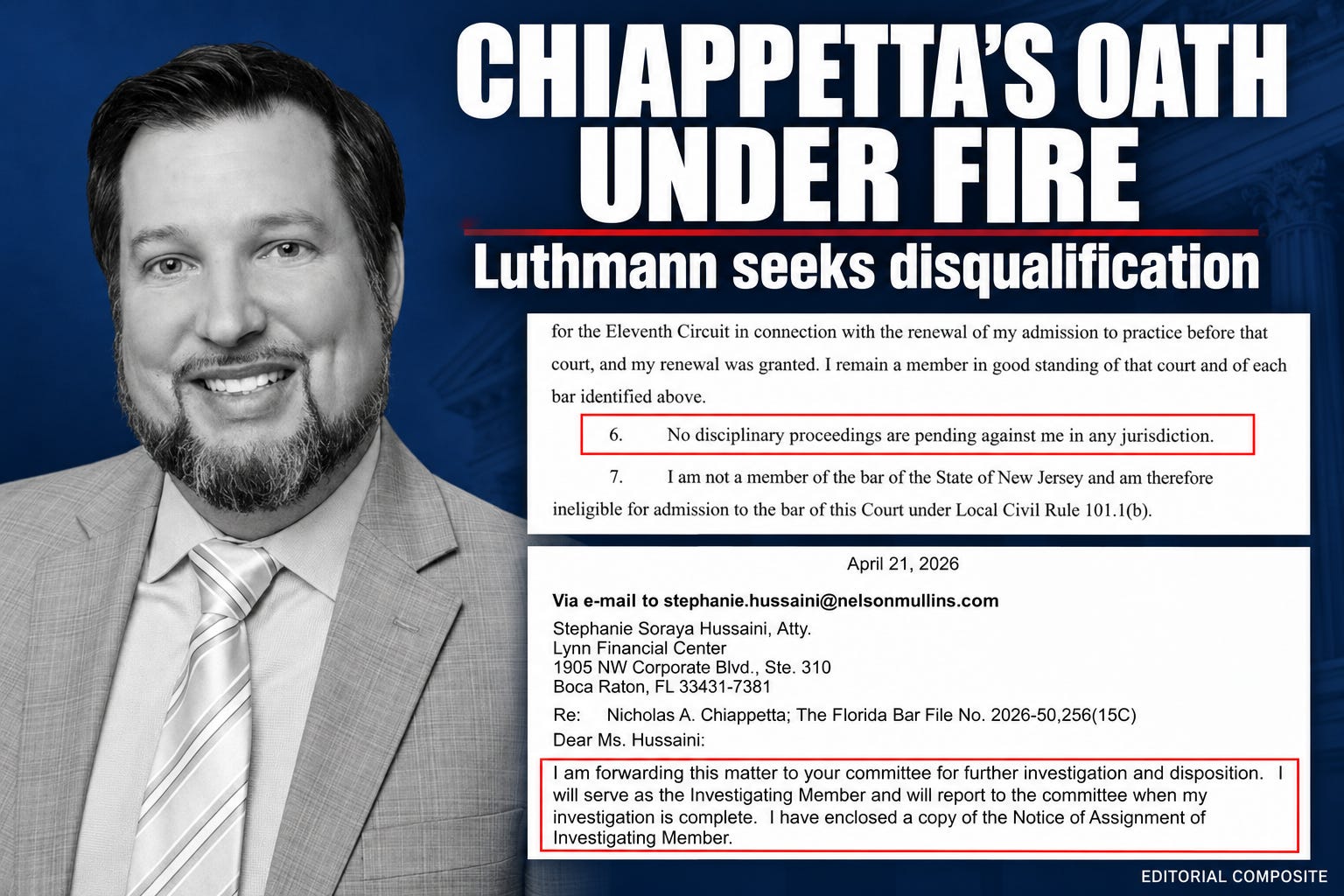
**“No disciplinary proceedings are pending against me in any jurisdiction.” Those ten words appear in paragraph 6 of Chiappetta’s declaration in Trainor v. McGibney, executed October 8 and filed October 9 as Document 51. The fourth page bears a visible signature and an express certification under penalty of perjury pursuant to 28 U.S.C. §1746.
Paragraph 6 contains no qualification limiting the answer to formal charges, suspensions, or completed disciplinary judgments. It is the categorical denial Luthmann now asks Judge Dudek to examine.
On September 29, 2025, Bar Counsel Diane Suhm wrote directly to Chiappetta in File No. 2026-50,256(15C), enclosed the complaint, and required his position concerning the sanction against him. She demanded a response under the professional-conduct rules and a disclosure certificate.Chiappetta retained ethics counsel, Scott Tozian, whose November 7 response acknowledged the representation and defended Chiappetta’s conduct. Together, the letters establish direct notice and participation in the numbered Bar matter.
Tozian’s response also defeats an obvious source of confusion. It identified a different grievance dismissed September 10, 2025, then addressed the later inquiry concerning Judge John Steele’s sanctions order. That earlier dismissal cannot serve as a disposition of the later file. Anyone claiming the investigation ended must identify the disposition of File No. 2026-50,256(15C), including its date. Luthmann’s declaration requests precisely that history so Chiappetta’s October certification can be tested against the actual record.
The matter advanced on April 21, 2026, when Bar Counsel William Mulligan forwarded it to a grievance committee “for further investigation and disposition.” Mulligan would serve as investigating member. A companion notice advised Luthmann and Tozian that the committee would consider the matter. These were affirmative steps by disciplinary authorities after Chiappetta’s response. Our April FL Gulf News report and Substack coverage documented that progression months before the New Jersey declaration.
Luthmann states under oath that he understands the file remains open and pending. He has requested official confirmation covering October 8 and 9, together with any intervening closure, dismissal, reopening, or disposition notice. His declaration asks for a prompt sworn response explaining paragraph 6 and production of nonprivileged status records. That demand gives the court a concrete way to resolve the accusation: establish what the Bar file’s status was, what Chiappetta knew, and the basis for his denial.
Chiappetta’s November 4, 2025 opposition supplied Luthmann’s most damaging comparison. A section headed “the Court Should Stay This Matter Pending Resolution of The Bar Disciplinary Proceeding” expressly invoked continuing disciplinary review. Luthmann alleges that counsel’s professional troubles became part of the machinery delaying his case. He now demands an explanation for how a process Chiappetta previously recognized became absent from a sworn certification. The eleven-month interval makes the intervening status history essential to that inquiry.
The stay also has consequences beyond the calendar. Luthmann’s supplemental declaration says Noshirvan proposed obtaining a ruling on his dismissal motion while pleading, discovery, and scheduling remained frozen. Luthmann objects to an arrangement that lets the defendant seek dismissal while withholding the ordinary tools for prosecuting his claims. He asks for preservation safeguards, decisions on pending threshold motions, and a workable schedule. His case, he argues, should not remain hostage to the duration of opposing counsel’s disciplinary difficulties.
The disclosure requirement is explicit. New Jersey Local Civil Rule 101.1(c)(1) requires an applicant to disclose pending disciplinary proceedings and identify their jurisdiction, charges, and likely disposition time. Paragraph 5 disclosed Steele’s completed reprimand; paragraph 6 separately denied pending proceedings. Florida’s disciplinary rules recognize matters pending at the investigative and grievance-committee levels. Luthmann argues that this investigation required disclosure. Good standing and disclosure of an earlier sanction do not resolve that separate question. www.njd.uscourts.gov
Luthmann’s apparent-perjury allegation invokes 18 U.S.C. §1621 and §1623, which require material falsity and the specified knowledge or willfulness. His materiality argument follows the admission rule: the court expressly requested the information before deciding whether to admit Chiappetta. New Jersey’s Thyne disciplinary decision reinforces the candor principle. Although that application asked broader questions, authorities rejected the lawyer’s attempt to decide which ethics information mattered, and the Supreme Court reprimanded him.
Chiappetta represents Noshirvan in three related Florida actions before Judge Dudek: Noshirvan v. Couture, No. 2:23-cv-01218; Couture v. Noshirvan, No. 2:23-cv-00340; and Luthmann v. Noshirvan, No. 2:25-cv-00337. The New Jersey challenge concerns Trainor v. McGibney, No. 2:24-cv-08873. Trainor opposed admission on October 15 and alerted the court to the investigation on October 16. Chiappetta’s certification is therefore under attack in both courthouses, with Luthmann seeking his removal in Case 337.
McGibney connects the admission fight to contested Florida evidence. Judge Dudek’s October 20 order treats as disputed the defense contention that McGibney hijacked Joseph Camp’s accounts. Authorship matters because Noshirvan relies on communications attributed to Camp. Separately, Luthmann says McGibney’s deposition has been noticed for later October and expects damaging testimony. He believes Chiappetta’s New Jersey appearance seeks to shield Noshirvan from that exposure.
“Chiappetta’s admission bid has strategic significance. Danesh’s case against Couture and Garramone is falling apart, and sworn testimony by McGibney on the eve of trial could be devastating,” Luthmann said. “In pure ambulance-chaser fashion, Chiappetta appears to be using the additional reputation to salvage his fees.”
That divergence also warrants a conflict inquiry. Testimony undermining Noshirvan’s allegations could put duties to McGibney under pressure from duties to Noshirvan. Florida’s conflict rule addresses the risk of representation materially limited by another client or the lawyer’s own interests. The engagements, competing positions, and any valid consent would require examination.
Meanwhile, Noshirvan has already lost Count II, the conspiracy claim concerning former attorney Robson Powers. Judge Dudek also denied his partial-summary-judgment request; other claims remain for trial.
The existing misconduct findings give Luthmann’s demand additional force. The late Judge John Steele’s August 12, 2025 order found Chiappetta “also acted in bad faith” and “greenlit Noshirvan to resume posting” after the deposition misconduct. Steele publicly reprimanded him, and the later $62,320 fee sanction fell on Noshirvan. As our earlier reporting documented, counsel’s failure to restrain his client, followed by permission to resume inflammatory posting, became grounds for judicial intervention.
Luthmann now demands intervention on the new record. Middle District Rule 2.04 provides disciplinary authority after a hearing and for good cause; disqualification requires established grounds and a ruling defining its scope. For Noshirvan, losing counsel would bring replacement costs and preparation burdens as the litigation approaches trial. Luthmann’s demand is to produce the status history, explain paragraph 6 under oath, and decide disqualification.
Chiappetta sought admission through his certification. Luthmann has made its truth a matter the courts must confront.
“I don’t know why it’s taken years to get straight answers from Danesh Noshirvan and Nick Chiappetta. They can’t run from their record forever,” Luthmann said.