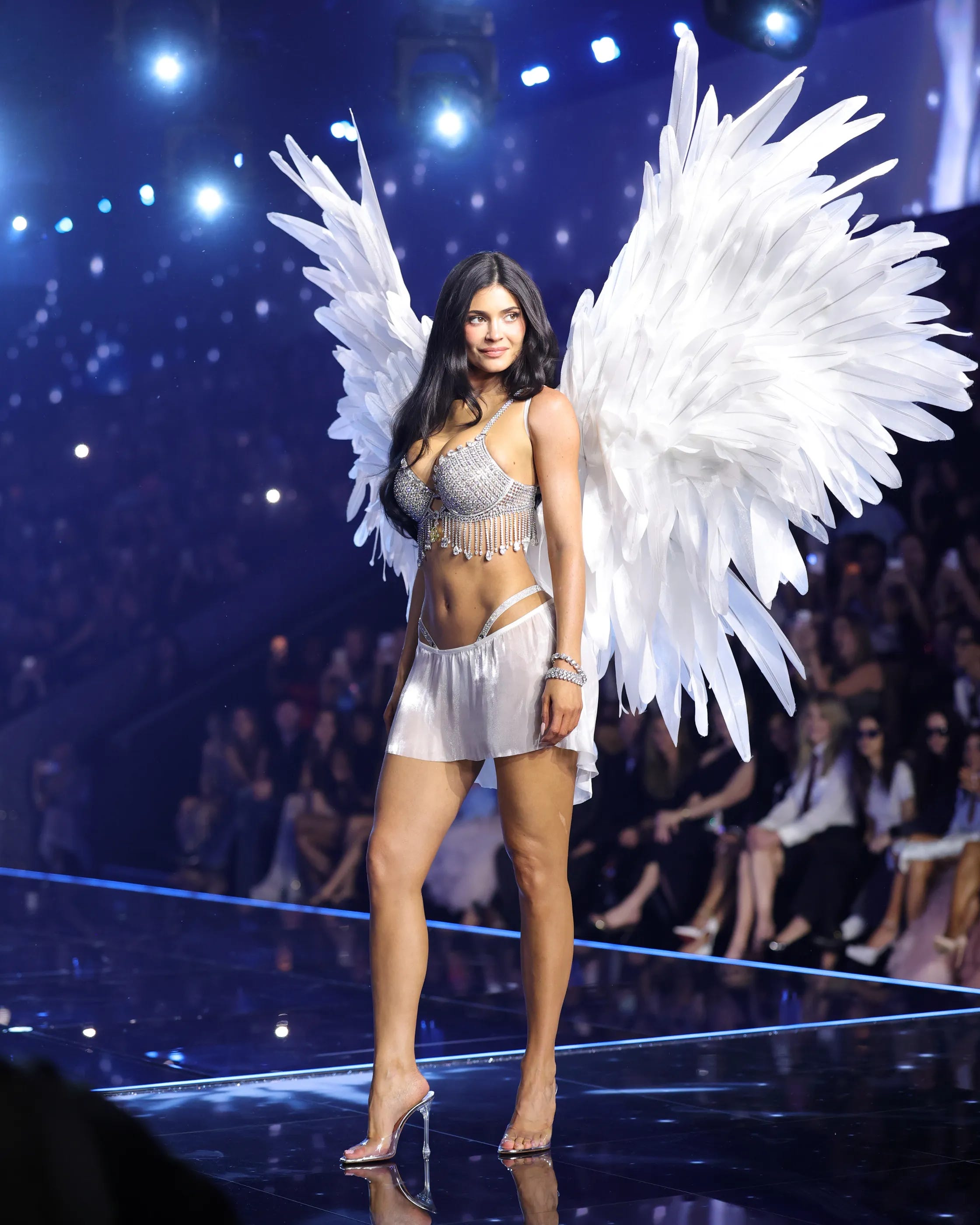
Kylie Jenner traipsed down the catwalk in an ill-fitting $50 million bra for the Victoria's Secret Angel runway as France was experiencing curfews after widespread student protests. Together, these two moments illustrate how foolish our moment is. But also how women often become the visual of corrupt systems.
Kylie Jenner wore the Fantasy Bra, which hadn’t been featured on the runway since 2018. One can only assume Victoria's Secret’s team had missed the last two years of the news. Bringing back such a luxury item during one of the worst cost-of-living crises in a century is either very ill-informed or, worse, incredibly apathetic about our current economic situation. While we are feeling the squeeze thanks to Trump’s tariffs and the Iran war, the uber-rich have gotten richer. This K-shaped economy means the wealthy are feeling great.
Did Kylie create this K-shaped economy? No, but she’s certainly profited considerably in this era. Many online have made her recent Victoria’s Secret appearance a talking point about the economy; however, take that with a grain of salt. Many of the people who have gotten us into this problem are men.
That said, Kylie is not absolved. She has many businesses that profit off the economy that pay people in disadvantaged nations less. Plus, she happily signed on to wear this symbol of wealth disparity. Like Victoria’s Secret, did she choose not to read the news? Or did she want to show that the news doesn’t affect her?
The bra features 4,410 natural diamonds surrounding a 75.54-carat radiant-cut Fancy Vivid yellow diamond. In a time when more people are looking to lab-made or vintage diamonds to ensure they don’t accidentally buy blood diamonds, here is a woman with 280-odd million followers prancing around in the blood of African people. The bra is also Victoria’s Secret's most expensive, $15 million more than the previous version. Fifteen people worked more than 1,000 hours to create this opulent, largely non-functional item. It’s all suffering, wealth, and excess, with a side of female objectification.
But to put the bra in context, the 2026 version costs 24 times as much as the 1996 one, even after inflation. The 2000 bra is the closest, at $29M in today's dollars. In the same period, Forbes 400 wealth rose about 15 times, and the richest person’s fortune more than 20 times, but median income only doubled. The top 1% hold about as much wealth as the middle 40% combined. The bottom half of households share less than 3%.
An average family (earning our national median (~$83k a year) would need to work 600 years to earn it. A person making minimum wage ($7.25/hr full-time) would need to work 3,330 years. While wages have stagnated, house prices have risen, with the median at about $410k (by the way, the bra is worth 120 houses). The average person will never have enough to buy one; it’s about ~0.01% of the average person's wealth, while the 1% hold about 120 times that amount.
So how does this wealth disparity compare to other times in history? Given that the French are protesting for better educational conditions and about the growing cost-of-living crisis, and also famously decapitated a King in the service of democracy, how do their economic conditions compare to ours?
Marie Antoinette was often depicted as wasteful and heartless in her spending. In reality, the King’s spending and fiscal mismanagement were particularly disastrous for the French economy. In addition, the cost of food was rising. Severe droughts decimated the harvests from 1785-1788. Bread had long been a staple food. By 1789, citizens were spending up to 90% of their income on bread. In 1788, the fairly peaceful peasant revolts brought no substantive change and likely helped precipitate the 1789 revolution. But as with many historical flashpoints, people focused on a woman under intense scrutiny rather than the root causes.
In the French Revolution, the top 10% of society had about 51% to 55% of total wealth. In their highly stratified society, this same group owned nearly 90% of property. Scholar Guido Alfani found that the level of disparity in 1790 was between .8 and .85. Economists use this coefficient to describe inequality. The closer to 1, the less equal a society is.
How do contemporary societies measure up? In the US, the top 10% of households control about 67% to 68% of total household wealth, but the Gini coefficient is around .41. Why isn't our coefficient higher? While Reaganomics has created many strictures that have helped the rich hoard wealth, we still have more social and economic mobility than in historic France. For comparison, France has a Gini coefficient of .31.
So what does this say for the future of these protests and our society? In 1788, when peasant revolts were publicized, the French Revolution didn’t feel imminent, and the aristocracy largely didn’t change its ways. But scores of other peasant revolts in European history didn’t lead to revolution. Similarly, other periods in European history saw much greater disparity. The story of revolutions doesn’t offer a simple "if X happens, Y will start a revolution" formula. And the stories of revolutions get rewritten afterward.
Marie Antoinette could not have said, Let them eat cake. That phrase also had little to do with cake. In actuality, the phrase ("Qu'ils mangent de la brioche") was written by the philosopher Jean-Jacques Rousseau in his autobiographical book Confessions, published in 1782 (referring to an event around 1765). Brioche is a bread enriched with eggs and butter, and so something peasants could scarcely afford. Conflating Marie Antoinette with the historic phrase, like happened nearly 50 years after the Austrian-born Habsburg Queen was executed, when French journalist Alphonse Karr falsely attributed the quote.
While Marie Antoinette didn’t say the phrase, I think Trump has come close many times, whether by claiming affordability is a made-up word or that he has the best economy ever. Today’s rich regularly claim people need to work harder, while they work hard to find ways to get tax breaks. Elon Musk’s wealth is largely based on government contracts, while he single-handedly cut numerous programs like USAID that killed millions of people. They’d happily snap up a diamond bra, eat cake, and trample on a copy of the Constitution if they thought it would give them more press.