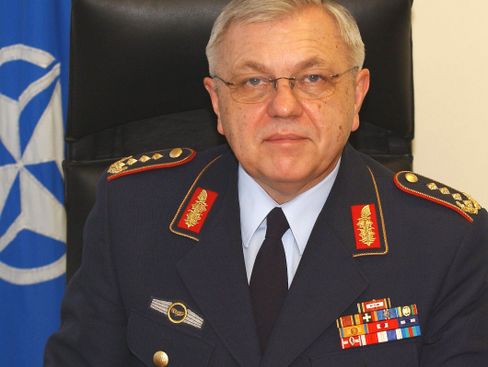
Harald Kujat, a retired German four-star general, former Chief of Staff of the Bundeswehr and former Chairman of NATO’s Military Committee, argues that the Ukraine war has been prolonged by a series of false Western narratives: that Russia’s invasion was unprovoked, that Moscow intended to conquer all of Ukraine, that Ukraine could achieve military victory, that Russia was unwilling to negotiate, and that continued Western military assistance would eventually change the strategic balance. These assumptions have obstructed diplomatic solutions, contributed to Ukraine’s destruction and brought Europe dangerously close to direct confrontation with Russia. This article outlines arguments made by General Kujat in a podcast last year, with a link below.
Relations between NATO and Russia initially improved substantially after the Cold War. Moscow sought closer cooperation, and mechanisms such as the NATO–Russia Founding Act and NATO–Russia Council established regular political and military dialogue.
Two developments fundamentally damaged this relationship. In 2002, the United States withdrew from the Anti-Ballistic Missile Treaty, undermining an essential element of nuclear strategic stability. Russia interpreted the decision as an American attempt to establish strategic superiority.
The second turning point came at NATO’s 2008 Bucharest summit, when Washington pushed for Ukraine and Georgia to become members.
Russia’s two principal strategic objectives have consistently been to avoid military confrontation with the United States and NATO. Moscow therefore sought a security arrangement that would prevent conflicts along its borders from escalating into direct confrontation. NATO’s expansion increasingly concentrated this problem on Ukraine.
The assertion that Russia’s February 2022 invasion was unprovoked disregards the preceding eight years.
The 2014 overthrow of Ukraine’s democratically elected president, Viktor Yanukovych, was followed by civil war in Eastern Ukraine and severe restrictions on the civil rights of its Russian-speaking population.
The Minsk II agreement of 2015 was intended to resolve this conflict by granting Donbass special constitutional status, protecting Russian language and culture within Ukraine.
Ukraine never implemented these constitutional provisions. Instead, its armed forces were modernised, expanded and rearmed with Western assistance.
Subsequent statements by Angela Merkel and François Hollande indicated that the Minsk process had served to buy time for Ukrainian rearmament rather than resolve the conflict. This constituted a clear act of deception.
In December 2021, Russia proposed security agreements with the United States and NATO. These efforts failed, and the security situation deteriorated into war.
Another central misconception is that Russia launched an all-encompassing war to occupy the entire Ukrainian state.
Approximately 170,000 Russian soldiers entered Ukraine against an army of more than 400,000 troops that had received extensive Western training and equipment. The Russian force was insufficient to conquer and occupy the entire country.
The initial objective was more plausibly to overthrow the Ukrainian government and install a pro-Russian leadership, potentially under Viktor Medvedchuk.
When this failed, Russia’s objectives changed. Moscow subsequently sought control of Donetsk, Luhansk, Zaporizhzhia and Kherson within their former administrative boundaries, alongside a broader security arrangement ensuring Ukraine would not become a platform for NATO military forces.
The Istanbul negotiations in spring 2022 presented a major opportunity to end the war.
By April 15, both sides had largely negotiated an agreement establishing Ukrainian neutrality and international security guarantees. Outstanding questions concerned the operation of those guarantees and the permitted size and equipment of Ukraine’s armed forces.
These differences were intended to be resolved directly between Presidents Putin and Zelenskyy.
The agreement’s conclusion was torpedoed by Western intervention. Boris Johnson’s April 9 visit to Kiev was particularly consequential, with the British prime minister communicating that Ukraine should continue fighting rather than conclude a settlement.
The strategic objective was subsequently articulated by the American defence secretary: Russia should be weakened politically, economically and militarily.
Ukraine thereby became the battlefield of a proxy war between the United States and Russia, with European governments increasingly assuming responsibility as Washington’s position changed.
Western governments repeatedly maintained that Ukraine could defeat Russia and recover Crimea and the territories in Eastern Ukraine. This was a strategic illusion from the beginning.
Senior military figures recognised the limitations. American General Mark Milley acknowledged that Ukraine had achieved what it could reasonably achieve militarily and should negotiate. Ukrainian commander-in-chief Valery Zaluzhnyi similarly identified enormous equipment requirements that Western countries were unable to fulfil.
Nevertheless, every new weapons system was presented as a potential game-changer. The political formula that Ukraine must not lose and Russia must not win substituted wishful thinking for military strategy.
The consequences were devastating. Opportunities to stop the killing and destruction were repeatedly missed, including Chinese and Brazilian peace initiatives and proposals advanced by German political and security figures.
Hungarian Prime Minister Viktor Orbán was harshly criticised for attempting to initiate diplomacy. European governments, meanwhile, made no serious independent effort to negotiate a settlement.
Russia’s willingness to negotiate has also been misrepresented.
At the June 2025 Istanbul discussions, Moscow submitted a memorandum outlining its proposals for a ceasefire and peace settlement. Ukraine rejected negotiations on that basis, restricting discussions to prisoner exchanges and abducted children.
Russia subsequently insisted that any presidential meeting must be carefully prepared through substantive preliminary negotiations. Ukraine demanded agreement on security guarantees before such a meeting.
These incompatible positions created a diplomatic deadlock, but they did not demonstrate that Russia was unwilling to negotiate.
Ukraine’s deteriorating military position has increased the danger of escalation. Attacks against Russia’s nuclear early-warning infrastructure, strategic bomber fleet and other sensitive targets risk expanding the war into a direct confrontation between nuclear powers.
European proposals involving Taurus missiles, NATO troops in Ukraine or a no-fly zone could similarly transform indirect participation into direct military involvement.
The November 2022 missile incident in Poland demonstrated the danger. Former Polish President Andrzej Duda subsequently described pressure from Zelenskyy to attribute the Ukrainian missile to Russia.
European leaders must recognise that expanding the war might prevent Ukraine’s isolated military defeat only at the cost of a potentially catastrophic European conflict.
Europe’s continued commitment to military victory also reflects an unwillingness to acknowledge its earlier strategic mistakes. Rather than supporting American efforts to negotiate, European governments have obstructed them while weakening their own defence capabilities and economies.
Military victory and political victory are fundamentally different. Russia has also suffered strategic setbacks, including Finland and Sweden joining NATO and declining Russian influence in the South Caucasus.
Moscow therefore has reasons to seek an end to the war, although its territorial objectives and the question of Ukraine’s neutrality remain central obstacles.
The essential task is not simply achieving a ceasefire. It is establishing a durable European security order that accommodates the interests of Russia and Ukraine, prevents renewed confrontation and restores strategic stability between the nuclear powers.
Europe must abandon the illusion that Russia can be defeated militarily, support serious negotiations and rebuild relations with Washington. Only a negotiated settlement can prevent further Ukrainian destruction and enable Europe to recover its geopolitical influence in an emerging multipolar world.
(This article has been written with the assistance of AI, based on the transcript of the conversation)