A while ago, I wrote a long piece providing a bunch of objections to inerrancy, the doctrine that the Bible is, in some sense, without error. I thought I’d provide four more. A lot of these strike me as pretty open and shut cases.
(Credit to Dustin Crummett on Facebook for this argument and responses to the standard replies).
Jude 14-15 reads:
Enoch, the seventh from Adam, prophesied about them: “See, the Lord is coming with thousands upon thousands of his holy ones14to judge everyone, and to convict all of them of all the ungodly acts they have committed in their ungodliness, and of all the defiant words ungodly sinners have spoken against him.”15
This is a quotation from first Enoch, a book not considered scripture except by some of the Oriental Orthodox. Different sections of the book were written at different times. The oldest portions were probably written between 300 and 200 BC; the latest portions around 100 BCE or later.
So it is very implausible that this was written by Enoch himself! For that to be the case, there would have to be a chain of continuous oral transmission for many thousands of years, of which we don’t have any record. And then why wouldn’t 1st Enoch be scripture, if it is written by the Biblical figure Enoch? It would also be really surprising if Enoch really did say this and it just so happened to correspond to the words written in 1st Enoch.
Could it be that Jude wasn’t intending to attribute the statements to the real Enoch? You might say “as Sherlock Holmes said…” without literally attributing the statement to a real man named Sherlock Holmes. But people at the time generally thought that Enoch had written 1st Enoch. His audience couldn’t have been expected to know the quote wasn’t from Enoch. And insofar as Adam was a real guy and Enoch was (as most Christians think), it would be inaccurate to attribute statements to Enoch that he never said. As Dustin put it:
If I quote the
[Vision of George Washington]and claim its prophecy is being fulfilled today, I am pretty clearly committing misattributing the statement to GW.
Now, you could think that Enoch was inspired but then corrupted. This, however, would be super weird. The book is full of all sorts of totally fantastical claims and it claims to have been written by Enoch. Presumably Enoch was not still writing in the year ~200!
So you have to think the following weird sequence of coincidences happened:
God decided to inspire 1 Enoch.
It then got badly corrupted in about a billion different ways, so it wasn’t counted as scripture.
Part of the corruption included who it was authored by. This description of authorship appears
right beforethe prophecy Jude quotes. So while Enoch really said these words, the text somehow changed “Enoch said such and such” into “The words of the blessing of Enoch, wherewith he blessed the elect and righteous...Concerning the elect I said, and took up my parable concerning them.” And note the third person speech at the beginning is standard in prophetic texts, even ones claiming to be first person.Jude attributes these to Enoch when the plain takeaway from any normal person at the time would have been that Jude thought Enoch wrote the book of Enoch.
Similar complaints will apply to the idea that God only inspired that particular passage from 1st Enoch. It would be weird to inspire one random passage in an otherwise apocryphal book, just so it can be quoted by Jude—even though it’s a pretty generic sentiment and Jude could have quoted it even if it hadn’t appeared in 1st Enoch.
In contrast, the errantist has a perfectly good explanation of this. 1st Enoch was held in high regard by the Jews at the time, believed often to be scripture. Thus, Biblical authors might quote it like any other piece of scripture.
Thus, seems like a pretty clear error!
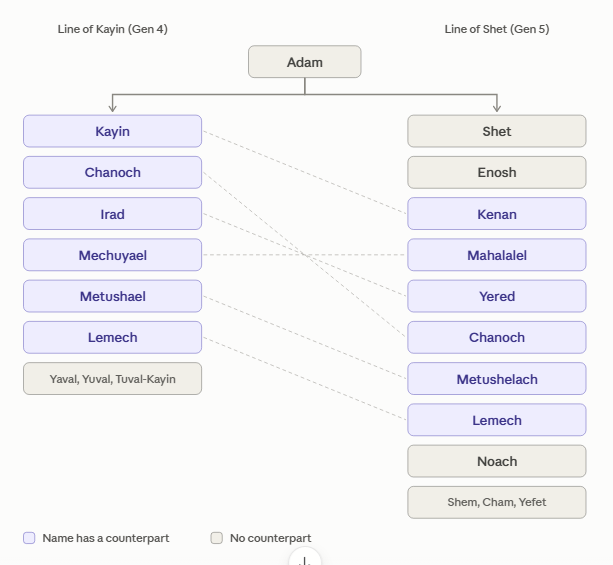
Biblical genealogies often conflict. To take one example, Genesis 4 and 5 give similar but slightly conflicting genealogies. Note the mostly preserved order and the near-complete overlap.
Conflicts between genealogies are totally ubiquitous. There are about as many cases of genealogies conflicting as converging. Here is a (hopefully exhaustive though I don’t have all the genealogies memorized, so I’m trusting Claude here, while vetting its answers with Chat GPT) list of all the genealogies that agree.
And here is the list of the genealogies that agree but with only subtle name variations:
As for the genealogies that conflict:
The last list includes repeats like the ones between Genesis 4 and 5.
This means that of the overlapping genealogies that are present in the Bible, around half of them have some conflicts. Note that you would actively expect this if inerrancy is false. It’s pretty difficult to find genealogies that stretch through the distant past. In contrast, while perhaps it wouldn’t be shocking if there were slight differences in genealogy given different literary styles, the sheer degree of divergence is strong evidence against inerrancy. If you want to see more analysis of the divergence between Matthew and Luke concerning Jesus’s genealogy, I discussed it here.
Paul seemed to think that taking communion would kill you or cause you to become very sick if you take it unworthily. In 1st Corinthians 11, he writes:
For as often as you eat this bread and drink this cup, you proclaim the Lord’s death till He comes.26Therefore whoever eats this bread or drinks27thiscup of the Lord in an unworthy manner will be guilty of the body and[a]blood of the Lord.But let a man examine himself, and so let him eat of the bread and drink of the cup.28For he who eats and drinks29[b]in an unworthy manner eats and drinks judgment to himself, not discerning the[c]Lord’s body.For this reason many30areweak and sick among you, and many[d]sleep.
(Sleep is often used to refer to death).
Paul’s view seems to be that if you take communion unworthily, you will get sick or die. Presumably this isn’t true—if those who took communion unworthily developed serious bodily afflictions, presumably we’d have noticed by now. So how might we explain this passage?
You might think this only occurred in the relevant time and place. So perhaps only people in the congregation at corinth died when they took communion unworthily. Two problems:
This seems immoral! Sure, maybe it’s not great to take communion unworthily, but should God really have been killing people for doing it?
The passage seems universal in scope. It’s not just talking about those in the Corinth Church. It says “for he who eats and drinks in an unworthy manner eats and drinks judgment to himself…” and “whoever eats this bread or drinks
thiscup of the Lord in an unworthy manner will be guilty of the body and[a]blood of the Lord.” It just seems clear that this is the plain reading!Maybe something about the genre means that this is not asserted. But it’s not clear why. He just outright says it! It’s not like he’s giving some aside when making a larger point.
This isn’t the only time in the Bible when God kills people somewhat capriciously. In Acts, he kills Ananias and Sapphira for falsely claiming to have given the proceeds from a field they sold to the Church. Now, maybe that’s a somewhat bad thing to do, but should it merit immediate death? Other examples include the killings of Nadab and Abihu for offering the wrong kind of fire, the prophet from Judah for being tricked into thinking it was God’s will to eat food, and various others.
Numbers 5:11–31 describes the treatment of a suspected adulteress: she’s supposed to drink water mixed with dust and ink, and if guilty her abdomen swells and she miscarries, while an innocent woman is unharmed and will be able to have children. And various other examples could be given.
A few potential responses:
You can think that these cures used to work by God’s divine powers but don’t any more. I grant that this is possible. But isn’t it way more likely that the Israelites got some stuff wrong about biology—very much like other primitive folklore—than that God did a great abundance of miracles to vindicate random advice that resembles standard folklore?
You can think that these aren’t inerrant. Inerrancy is supposed to be interpreted in a way that’s genre relative. The genre is giving ritual purity laws, not telling about biology. But still, the ritual purity norms make
absolutely no senseunless the underlying medicinal claims are correct. Why should you drink water with dust and ink if this is going to be totally ineffectual?
I’m not aiming to present anything like a comprehensive list. But after reading these passages, plus the other ones I cited, I basically think that an inerrancy that has any meaning is impossible to seriously maintain. If there were just a few problematic passages, that would be one thing, but the errant biblical passages cover many different areas: authorship, history, medicine, genealogy, and more. It’s just so difficult to believe that all of these many apparent errors are somehow resolvable given that they are both common, straightforward, and apparently decisive.