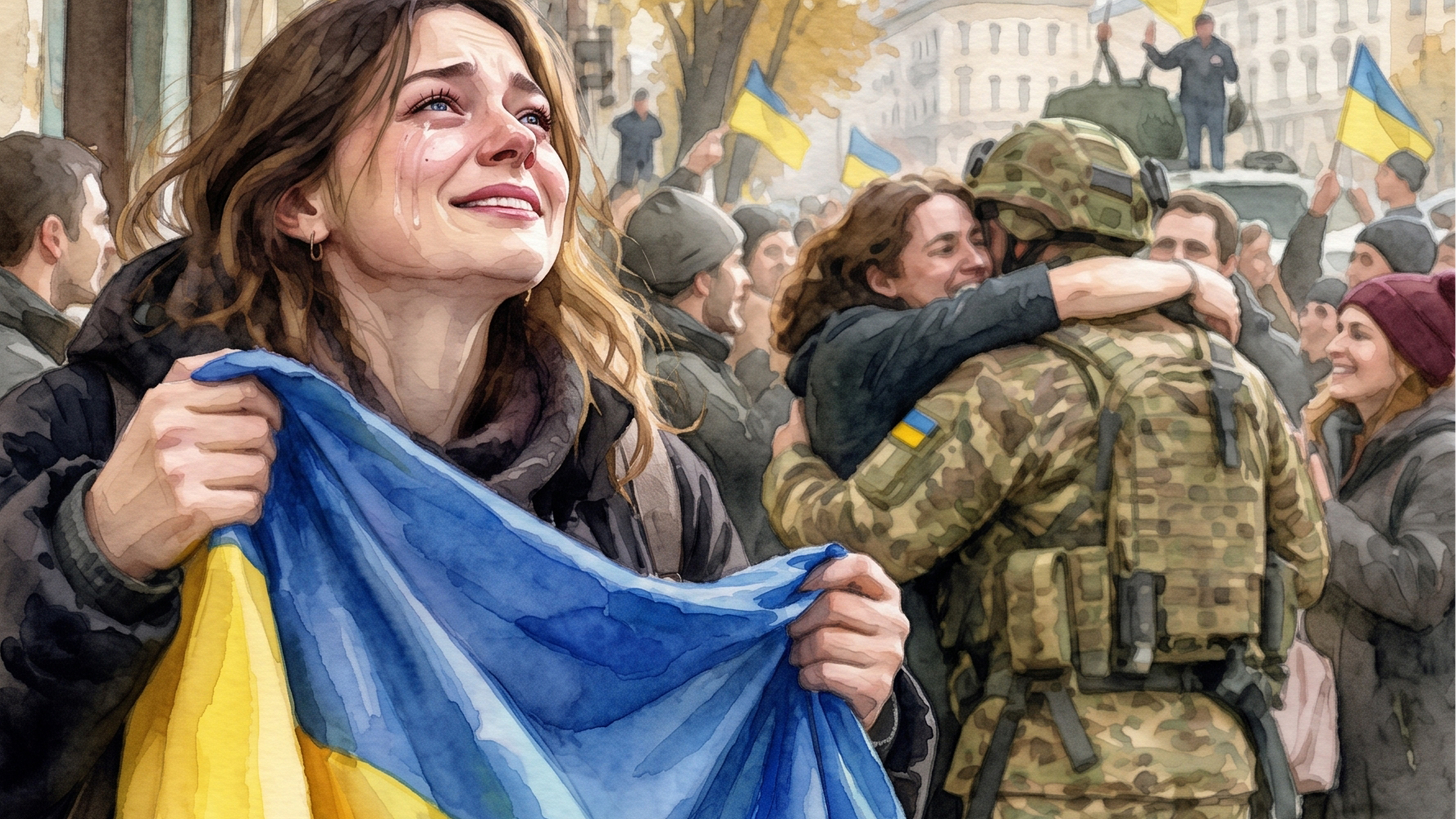
**BERLIN—**Four years ago today, September 30, 2022, Vladimir Putin declared the Ukrainian region of Kherson part of Russia. Six weeks later, on November 11, Ukrainian soldiers entered Kherson city, the only regional capital Russia had captured since its full-scale invasion. Few moments in this war have stayed with me as vividly. Kherson was never just another battle won or another flag raised over another city. It was one of those rare moments when propaganda collided with human reality so violently that all the speeches, maps, and geopolitical theories suddenly became secondary.
We publish this newsletter every day at 9:05am NYC time / 4:05pm Kyiv.Your subscription fuels our work.
Kherson was supposed to become Russian. According to the Kremlin’s own conception of the “Russki Mir,” a term that means both “Russian peace” and “Russian world,” it should have been almost perfect territory for absorption: a southern Ukrainian region with deep historical and cultural ties to Russia, a population in which Russian was widely spoken, Crimea immediately to the south, and networks of collaborators that Moscow could use after the occupation. For years Russian propaganda had insisted that Russian-speaking Ukrainians were essentially Russians who had somehow become trapped inside an artificial Ukrainian state and were waiting to be reunited with their supposed motherland. Then Russian soldiers actually arrived, capturing Kherson in the first days of March 2022, and reality began tearing that theory apart.
People walked into the streets carrying Ukrainian flags, sang Ukrainian songs and stood in front of armed Russian soldiers and military vehicles, sometimes shouting at them in the very Russian language Moscow claimed to have come to protect. Some essentially told the soldiers: Yes, I speak Russian. Now go home. We are Ukrainians. I remember watching those scenes in 2022 as someone who, before the invasion, had almost no personal connection to Ukraine, and being struck by something extraordinarily simple: language was not loyalty. These people could speak Russian at home, have relatives in Russia, share Russian culture and history and nevertheless regard Ukraine as their country, because national identity is ultimately something deeper than the language in which a man orders his coffee or speaks to his grandmother.
On September 30, Vladimir Putin proclaimed Kherson part of Russia. Six weeks later, the Russian army abandoned it.
When the protests did not disappear, the occupation became harsher. The UN subsequently documented arbitrary detention, torture, ill-treatment and enforced disappearances under Russian occupation, including in Kherson region; public protest was suppressed, Ukrainian institutions were replaced, Russian passports were distributed, and eventually Moscow organized its September 2022 annexation “referendum”, after which occupation authorities announced that 87.05 percent had supposedly voted to join Russia. Whatever genuine pro-Russian sentiment existed in the region — and it would be dishonest to pretend that none existed — a referendum conducted under military occupation could hardly establish how freely the population would have voted, and the subsequent events would provide a rather more spontaneous measure of public feeling.
On September 30, Vladimir Putin proclaimed Kherson part of Russia. Six weeks later, the Russian army abandoned it.
And then came November 11.