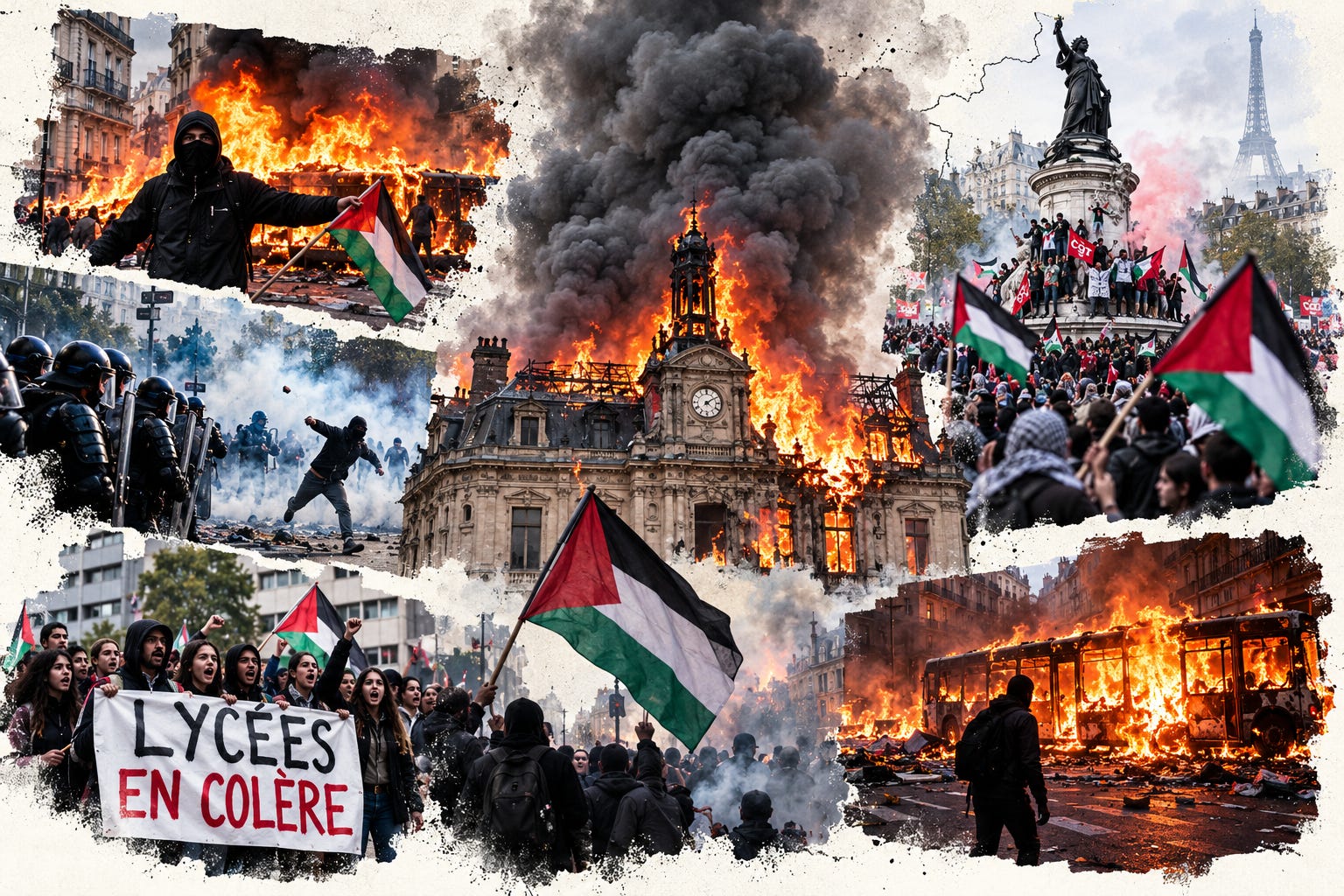
News out of France is dominating the headlines. Fires, riots, looting, police battling masked protesters in the streets, and Palestinian flags waving above the chaos.
What began as protests over school conditions and rising living costs has turned into something much bigger. And the Palestinian flags appearing in the middle of it all raise a question worth investigating: Who’s bringing these movements together, and why?
On October 17 in Limoges, France, rioters set fire to a municipal police vehicle parked directly outside city hall. Masked protesters smashed windows and forced their way into the building, where several fires had already started and were spreading. Firefighters worked for exhaustively for hours trying to contain the flames, but the fire reached the roof. The clock tower collapsed, taking much of the roof with it. The historic building had stood in the center of Limoges since 1883.
The chaos wasn’t limited to Limoges, though. Hundreds of thousands of people had turned out across France to protest rising living costs, problems with public services, and conditions in schools. In Paris, rioters also smashed shop windows and looted businesses while police chased more hooligans through the streets. Vehicles burned, public buildings were damaged, and arrests grew throughout the weekend. Police officers and demonstrators were both counted among the injured.
Photographs from the demonstrations not only showed all the destruction, burning vehicles, broken storefronts, and rioters facing off with the police. There were also French flags, communist banners, and the yellow vests that became familiar during the protests of 2018.
The Yellow Vest movement began over a proposed increase in fuel taxes. Protesters wore the fluorescent safety vests French drivers are required to keep in their cars. What started as anger over gasoline prices grew into months of demonstrations against President Emmanuel Macron, rising living costs, and government policies. Some protests turned violent, particularly in Paris, where shops were looted and cars set on fire.
And, of course, there was the all-too-familiar Palestinian flag, waving among the crowds. In France, sometimes right next to those red banners of the country’s radical-left organizations. What Palestine had to do with broken French schools or the price of gasoline was anyone’s guess. Macron had recognized a Palestinian state in September 2025. One has to wonder whether he ever imagined he’d be seeing so many Palestinian flags flying over protests about problems in his own country.
On September 7, a young TikTok creator known as V2 called on people across France to take to the streets on October 17 to protest rising fuel prices. He wanted to revive the Yellow Vest movement and chose a Saturday so more people could participate. So thoughtful. Unsurprisingly, the idea caught on. Within days, other TikTok accounts were circulating posters promoting October 17, some made with AI also featuring that yellow vest.
Journalists at Le Monde looked into the campaign and found about a dozen TikTok accounts that had been created or renamed on September 9…and they were all promoting the October 17 demonstrations. One called itself “Representative of the Yellow Vests” and posted nothing but AI-generated graphics. Its posts received thousands of likes. The accounts had appeared almost simultaneously, used similar imagery, and pushed the same protest date. Nobody could identify who was running them. French authorities found little evidence of foreign involvement, and some accounts appeared to be chasing followers they could eventually monetize. France’s foreign-interference monitoring agency, Viginum, found no significant evidence of foreign involvement. V2 eventually backed away from the demonstration he’d proposed, but by then he had sparked a fire that burned out of control.
Meanwhile, at Lycée Saint-Exupéry in Créteil…suburb southeast of Paris, teachers were fed up with conditions at their school. On September 17, they protested over staffing shortages and a building completely falling apart and in desperate need of repairs. The school has 1,500 students, but it had a shortage of teachers and other staff, including a nurse. Parents had been complaining about leaking roofs, broken windows, toilets that didn’t work, and classrooms that became unbearably hot. For families with children who needed medical attention during the school day, having no nurse was problematic.
The students joined the parents protest following morning. They organized through Snapchat, showed up early with signs, and blocked the school entrances. They wanted the more staff hired and their school repaired. On September 21, Louis Boyard, a member of parliament from La France Insoumise (LFI), visited the school and actually encouraged the students to keep protesting.
Other LFI politicians began turning up at schools where students were holding similar demonstrations. The Union Syndicale Lycéenne, a national high-school union, called for protests over missing teachers, overcrowded classrooms, deteriorating school buildings, and the university admissions system.
By September 28, the French government was reporting protests erupting at 180 schools. Three days later, that number had climbed way up to over 1,000 schools, with 222 of them reporting blockades. Some students had serious complaints about staffing and maintenance. Others were protesting bad cafeteria food, school rules, or what awaited them after graduation.
On September 28, the Paris police intelligence directorate prepared a report that looked at 27 protest actions in Seine-Saint-Denis, north of Paris. Le Monde got hold of the report and published its findings on earlier this month. Police had identified people who weren’t students at the schools turning up at several of the demonstrations. (Oh, so shocking)
On September 23, eight students from Paris 8 University distributed Communist Youth leaflets near Lycée Suger in Saint-Denis. The following morning, about ten Paris 8 students arrived at Lycée Maurice-Utrillo in Stains chanting for Macron to resign. High-school students joined them. At Lycée ENNA in Saint-Denis, police observed three outsiders encouraging a blockade, including someone recognized from an earlier university occupation.
LFI lawmaker Éric Coquerel visited Lycée Marcel-Cachin in Saint-Ouen on September 24. Police also identified an activist associated with Le Poing Levé, a student organization connected to the revolutionary socialist group Révolution Permanente. He worked at a school as an educational assistant and was filming protest activity for the organization’s social-media accounts.
Prime Minister Sébastien Lecornu accused radical-left organizations of manipulating the students. The police report identified outside activists or elected officials at six of the 27 incidents examined. It didn’t identify who had initiated every blockade, but it named university activists, a revolutionary socialist organization, and LFI politicians who were turning up at the schools.
The students at Saint-Exupéry had wanted teachers, a nurse, and repairs to their building. At other schools, Communist Youth leaflets were being handed out and university activists were chanting for the president’s resignation.
On October 1, students gathered outside Lycée Blaise-Cendrars in Sevran, a northeastern suburb of Paris. Palestinian flags were waving next to French flags, and students were chanting against the far right. One student, Mohamed, had wrapped himself in the French tricolor. Someone had questioned whether he was French, and he told Le Monde that he was born in France and had every right to be there.
The Palestinian flags showing up at a protest over French schools…not exactly apropos, but they’d become exhaustingly expected at student demonstrations. In April 2024, students at Sciences Po in Paris had occupied parts of the university and blocked access to buildings while protesting the war in Gaza. Palestinian solidarity campaigns were already well established among France’s left-wing student organizations.
One of the larger coalitions bringing these organizations together is the Collectif National pour une Paix Juste et Durable entre Palestiniens et Israéliens, or National Collective for a Just and Lasting Peace Between Palestinians and Israelis. Its participating organizations include the Association France Palestine Solidarité and the Union Générale des Étudiants de Palestine.
The coalition’s published signatory list also names La France Insoumise, the CGT, the Union Syndicale Lycéenne, UNEF, Solidaires, the Union étudiante, the French Communist Party, and the Nouveau Parti anticapitaliste.
Some of those names should be familiar by now. The Union Syndicale Lycéenne had been calling students into the streets over school conditions. LFI lawmakers were visiting the blockades. The CGT was helping prepare the October demonstrations.
The CGT had also been publishing the Palestinian coalition’s campaign materials on its website, including statements demanding sanctions against Israel. One of those statements listed the Union Syndicale Lycéenne among its signatories. These organizations had been collaborating on Palestinian solidarity campaigns long before the school protests began.
On October 9, LFI called on its supporters to attend a Palestinian solidarity demonstration in Paris the following day. The coalition wanted France to impose sanctions on Israel, stop arms transfers, protect UNRWA, and support Palestinian political demands. Its statement accused Israel of “genocide,” “apartheid,” and “colonization.” Of course it did. It also criticized Western governments for failing to intervene.
The October 10 march was scheduled to leave from Place de la République, where left-wing organizations regularly hold demonstrations. LFI was promoting that march while its lawmakers were visiting school blockades. The CGT and student unions were participating in the Palestinian coalition while helping mobilize demonstrations over French domestic problems.
These weren’t strangers who happened to bump into each other at the same protest. Their organizations had signed the same political statements, promoted the same campaigns, and called people into the streets over their hatred of Israel.
And they were busy doing all of that while French students were protesting missing teachers and decrepit schools.
By mid-October, the school protests and demonstrations over rising living costs were coming together. The CGT had instructed its local organizations to help prepare for October 17, encourage members to participate, and make union facilities available for meetings. Student unions, Yellow Vest supporters, LFI, and other left-wing organizations were promoting the demonstrations.
The government estimated that 550,000 people demonstrated across France on October 17. Organizers claimed 800,000. People marched over wages, school conditions, public spending, and the cost of living. In Paris, protesters gathered around train stations and public squares, while other groups moved through the streets outside the planned demonstration routes.
There were chants against Macron, capitalism, and the police. Yellow vests appeared next to union banners and communist flags. At Place de la République, hundreds of students gathered around the monument, with Palestinian flags flying among the red banners.
Make no mistake. This is what “globalize the intifada” looks like. Mass chaos, devastating destruction, historic buildings going up in flames, monuments defaced, businesses looted, and entire streets left looking like battlegrounds. Police confronting masked rioters, residents watching their neighborhoods being torn apart, and shopkeepers returning to find their livelihoods in ruins. All while Palestinian flags wave above crowds protesting everything from fuel prices to missing teachers.
The violence spread beyond Paris. In cities including Lyon, Marseille, and Bordeaux, businesses were attacked, windows smashed, and vehicles set on fire. Police pursued masked rioters through neighborhoods, and demonstrators were injured during confrontations with officers. The government blamed radical-left militants and groups of rioters for much of the destruction.
The CGT had plenty of resources to help organize the October 17 demonstrations. As one of France’s largest trade unions, it had offices, meeting rooms, paid staff, and local branches across the country. Union leaders encouraged members to participate and instructed local organizations to help prepare for the protests.
In Paris, the CGT made rooms available at the Bourse du travail for Paris × Banlieue, a student coordination group that had been meeting there for several weeks. Le Monde reported that about fifty students returned on October 19, two days after the riots, to discuss what they would do next.
La France Insoumise was also promoting the demonstrations, while student unions encouraged students to join. French political parties file financial accounts with the country’s political-finance regulator. Trade unions collect membership dues, and student associations can receive donations, membership fees, and other financial support.
There was online fundraising, too. A website called Mobilisation 17 octobre published information about demonstrations and asked for donations to support high-school students. The site described itself as an independent collaborative platform and acknowledged that events submitted by visitors weren’t systematically verified.
It asked for financial support without publicly identifying who would receive the donations, how much money had been collected, or how it would be spent.
On October 20, French police arrested a man in Val-d’Issoire, about 31 miles from Limoges, in connection with the city hall fire. Arson. Officers from France’s RAID tactical police unit took part in the arrest, which was confirmed by the prosecutor’s office.
French reporting described the suspect as associated with ultra-left activism and previously known to security services. Reports differed about his age, and his organizational affiliations hadn’t been made public. France’s anti-terrorism police subdivision became involved, although the national anti-terrorism prosecutor hadn’t taken over the case as of October 20. The man was arrested on suspicion of involvement in the arson and remains presumed innocent.
On October 19, the French Senate’s Law Committee announced an inquiry into the violence of October 17–18. The committee plans to look into how the unrest developed, inadequate police preparations, and the response of public authorities.
Meanwhile…those students who began protesting over their schools haven’t disappeared. Some staffing complaints have been addressed, but organizers say conditions remain inadequate.
On October 19, about fifty students met over at the Bourse du travail near Place de la République. Outside, the streets weren’t cleaned up of damage from the weekend. A traffic light had burned, a wine merchant’s windows and door had been destroyed, and graffiti covered parts of the old building.
Inside, those students were discussing how to keep their protests and riots going during the school holidays.
Some sources: