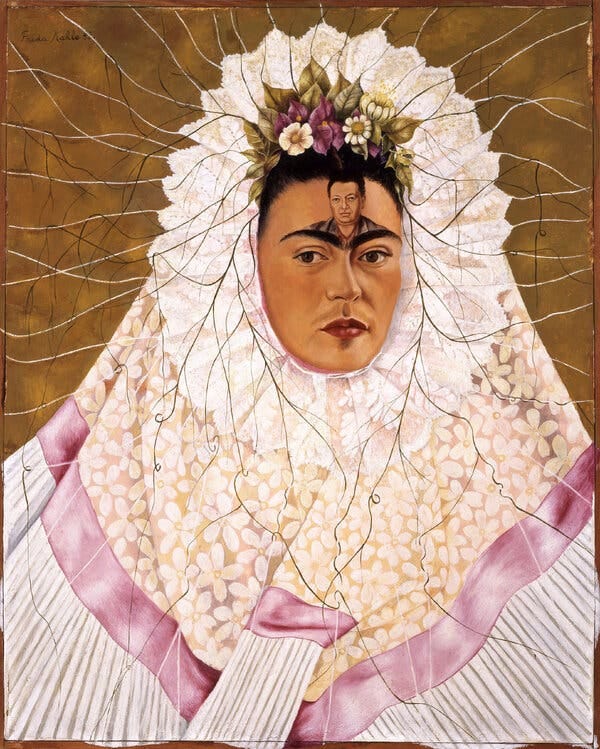
How many Frida Kahlos are Mexican? It seems like a simple question, but it’s actually one that helps us understand what capitalism has done to creativity, joy, and community—and why we all feel so hollowed out.
The story starts in St. Petersburg in the early 1900s. Jacques Gelman was born into a wealthy Jewish family, and around the time of the October Revolution in 1917, they fled to Germany with much of their money. After finishing his education, he worked as a photographer and eventually became a distributor of French films. Like many Jewish intellectuals living in Europe just before World War II, he escaped to the Americas, landing in Mexico in 1938. Once in Mexico City, he returned to film distribution and quickly found success. One of those films premiered at Cannes in 1946, the first festival after the war.
These post-war years in Mexico City were an optimistic time for the arts. Many artists were decamping from Europe, and Mexican artists were gaining acclaim worldwide. (I’ve previously written about the three witches who were active in the art scene during this period.) It’s in this vibrant cultural moment that Gelman and his wife, Natasha, start collecting art. They’re hobnobbing with artists and amassing a collection all at once. In 1943, for example, Gelman commissioned Diego Rivera to paint a portrait of Natasha, the now-famous one showing her surrounded by calla lilies. Eventually, the Gelmans would amass a collection of around 300 artworks, of which 160 are by Mexican artists. The treasure comprised paintings by Diego Rivera, David Alfaro Siqueiros, María Izquierdo, Rufino Tamayo, Carlos Orozco, Juan Soriano, and Gunther Gerszo, among other great artists. They had the largest single holding of Kahlo's works, at 18.
Marcel Mauss, in The Gift (1925), argued that for most of human history, objects didn't move through markets. Mauss saw objects as connecting the buyer and the seller. By purchasing from Frida Kahlo herself, the Gelmans both had the object and the memory. In the middle of the 20th century, there was no promise of an exponential return on your investment. Instead, they bought and enjoyed the objects for the joy of experiencing art.
The art market emerged alongside the roots of capitalism. Newly wealthy collectors needed to show off their wealth, and artists helped them do so. Thorstein Veblen saw this before when writing in 1899 in The Theory of the Leisure Class: "Conspicuous consumption of valuable goods," he wrote, "is a means of reputability to the gentleman of leisure." Class is constantly being negotiated. Social capital can’t be bought, but art sure can. In each era of capitalism, the newly wealthy start collecting as a way to exert their class. Pierre Bourdieu & Alain Darbel in The Love of Art argued that art is particularly efficacious as a performance of social status. The object reinforces class membership and also brings you into community with of other collectors. It’s both an entree to a certain class and a credential of validity to be there.
Gelman died in 1986 during heart surgery in Houston. After that, his widow, Natasha, loaned the collection to the Centro Cultural Arte Contemporáneo de Televisa in 1992, and it stayed there until her death in 1998. By that point, the cultural center had closed.