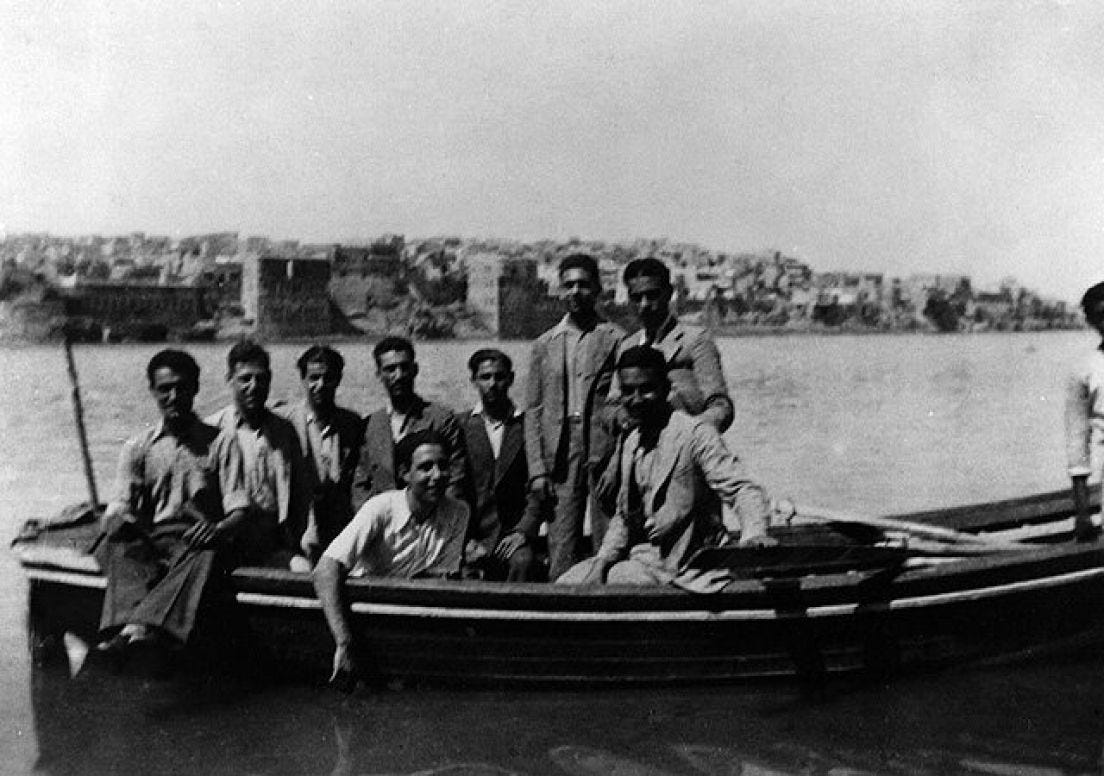
The Jewish community in Iraq didn’t arrive with a suitcase and permission slip. They were there before the word “Iraq” existed, before Islam, before Christianity. Their roots in Babylonia stretch back to the 6th century BCE to the destruction of the First Temple and the deportation of Judeans by Nebuchadnezzar II. By the 20th century, Iraq’s Jews numbered more than 135,000. In Baghdad they made up roughly a sixth of the city’s population. They weren’t a minority living in the outskirts. They were woven into the city’s commercial, intellectual, and civic life.
The unraveling started in June 1941. A pro-Nazi regime had briefly taken power in Baghdad. When it collapsed, what followed wasn’t a peaceful transition. It was a pogrom.
On June 1 and 2, 1941, mobs attacked Jewish neighborhoods across Baghdad during the Jewish holiday of Shavuot. By the end of two days, there were at least 180 Jews dead, hundreds more were injured, and thousands of Jewish homes and businesses had been looted and destroyed. The attack is known as the Farhud, an Arabic word meaning violent dispossession. The Iraqi Jewish community had never experienced anything like it. The sense of safety they’d built over centuries was gone.
The community tried to recover. Many did. But the Farhud had ended something that couldn’t be rebuilt.
Israel declared independence in May 1948. Iraq responded by going to war against the new state and declaring Zionism a capital offense inside its own borders. Jews were fired from government positions. Arrests and persecution accelerated. In September 1948, a prominent member of Baghdad’s Jewish community was publicly executed on charges of treason.
The community that had survived 2,600 years in Mesopotamia was now living under open threat. Emigration had been banned since 1948, but Jews were already leaving illegally, with an estimated 1,000 per month being smuggled out through Zionist underground networks by 1949.
In March 1950, the Iraqi government passed a law with a one-year window allowing Jews to emigrate legally. The conditions were brutal. Anyone who left had to renounce their Iraqi citizenship permanently. They couldn’t take their wealth with them. Property had to be sold before departure, and when Iraq later froze Jewish assets entirely, many people sold everything they owned for a fraction of its value just to qualify for an exit visa. The state would keep what was left.
Iraq expected maybe 8,000 people to register.
The reality of what happened stunned everyone. Fifty thousand Jews signed up in the first month. Two months later, 90,000 had registered. The demand overwhelmed the organizers and alarmed the Iraqi government, which hadn’t anticipated losing the people who ran significant portions of the country’s administrative and commercial infrastructure.
Israel had been preparing. In response to the new emigration law, the Israeli Ministry of Aliyah launched an operation led by Mordechai Ben-Porat, an Iraqi-born Jew who had made aliyah in 1945. Israeli emissaries, working undercover inside Iraq, began registering Jews to leave. The flight logistics were organized on the ground by the Jewish Agency and the American Jewish Joint Distribution Committee.
The operation was named Ezra and Nehemiah, after the biblical figures who led the Jewish people home from exile in Babylonia in the 5th century BCE. It was also known internally as Operation Ali Baba. The naming wasn’t accidental. This was the same return, twenty-five centuries later from the same land.
The first flights left Baghdad for Cyprus in mid-May 1951, routing around Iraqi restrictions that banned direct travel to Israel. Several months later, the flights ran directly from Baghdad to Lod Airport. The aircraft were primarily Douglas DC-4s operated by El Al and the Near East Air Transport Company. Most of the $4 million cost of the operation was financed by the American Jewish Joint Distribution Committee.
By early 1952, when the operation ended, between 120,000 and 130,000 Iraqi Jews had landed in Israel.
After the airlift, approximately 6,000 Jews remained in Iraq. The communities that had existed in Baghdad, Basra, and Mosul for longer than most nations have existed were essentially gone.
The story didn’t end there. Iraq’s government continued tightening its grip on the Jews who stayed. By 1968, only 2,000 remained. On January 27, 1969, nine Jews were publicly hanged on charges of spying for Israel. Most of those still in Iraq fled after that.
Today, fewer than ten Jews are believed to remain in the entire country.
Operation Ezra and Nehemiah was one piece of a far larger displacement. An estimated 850,000 Jews were expelled or forced to flee from Arab and Muslim countries in the decades surrounding Israel’s founding. They lost property, businesses, citizenship, and in many cases their entire communal histories.
They received no permanent UN refugee agency. There’s no multi-generational refugee status attached to their descendants. The Iraqi Jews who arrived in Israel built lives, raised families, and became citizens. Their story became part of Israel’s founding history and largely disappeared from international discussions about displacement in the region.
The Iraqi government used Israel’s founding as justification to strip its Jewish population of citizenship, seize their assets, and expel them from a country their ancestors had called home for nearly three millennia. The operation that brought them to Israel was named for men who made the same journey from the same place 2,500 years earlier.
The names were chosen well.
References:
Jewish Virtual Library
https://jewishvirtuallibrary.org/operation-ezra-and-nehemia-the-airlift-of-iraqi-jewsIsraeli Government Archives
https://www.gov.il/en/pages/the-aliya-story?chapterIndex=8U.S. National Archives and Records Administration, Iraqi Jewish Archive
https://www.archives.gov/exhibits/ija/exhibit/after-milleniaWorld Zionist Organization Archives
http://www.zionistarchives.org.il/en/datelist/Pages/ezra-and-nehemia.aspxCenter for Israel Education
https://israeled.org/airlift-iraqi-jews-begins/Middle East Forum
https://www.meforum.org/middle-east-quarterly/book-reviews/the-jewish-exodus-from-iraq-1948-1951