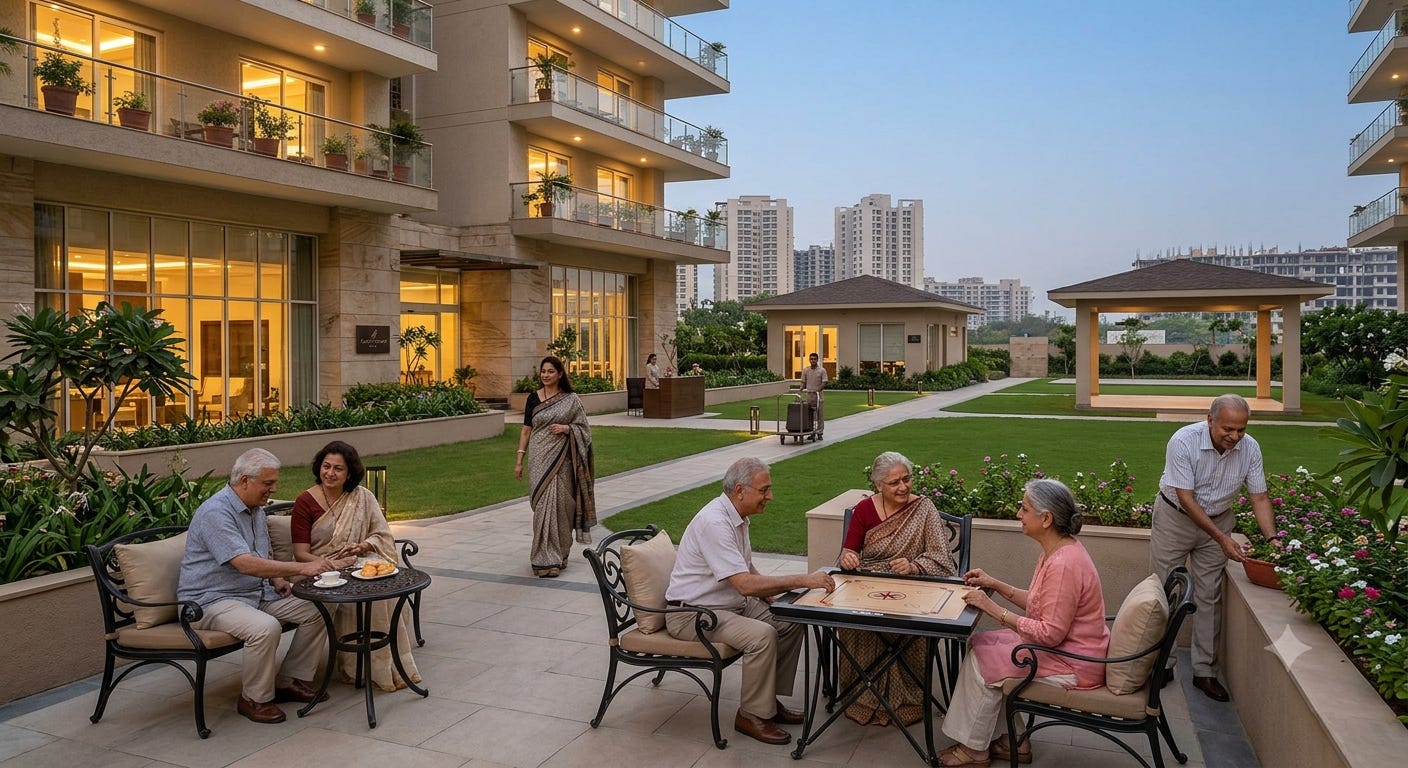
From DLF’s ₹1,985-crore sellout to planned launches by Krisumi and Signature Global, senior living is gaining traction in Gurugram. An ageing population, affluent buyers and changing retirement preferences are drawing developers to a segment that combines real estate, healthcare and hospitality.
DLF began the month by announcing a complete sellout of its luxury retirement project in Gurugram, The Aureva. Krisumi Corporation announced this week that it is preparing to enter the segment, while Signature Global is also understood to be exploring an offering with senior living operator Manasum.
The growing interest signals a shift in how affluent Indians are approaching retirement. Rather than viewing senior living as a last-resort housing option, buyers are increasingly treating it as a planned lifestyle choice that combines independent living with healthcare support, wellness facilities, security and a built-in community. Senior living is clearly the flavour of the season.
Gurugram is well placed to capitalise on this trend. The city has a large pool of senior corporate executives, entrepreneurs, business owners and high-net-worth individuals who want to maintain their independence after retirement without compromising on space, privacy or amenities. For developers, the appeal lies in a customer base willing to pay for a specialised residential offering. For buyers, it is about securing a home that can accommodate changing needs as they age, while remaining close to family, doctors and familiar social networks.
The buyer profile extends beyond retirees purchasing homes for immediate occupation. Repeat customers of developers, non-resident Indians (NRIs), and senior executives planning their retirement years in advance are emerging as important segments. Some buyers are securing homes for their own future use, while others are purchasing professionally managed accommodation for ageing parents. These customers straddle the roles of end-users and investors, with decisions driven as much by long-term living needs as by property ownership.
DLF’s Aureva offers a glimpse into this demand. On October 4, the company announced sales of ₹1,985 crore from 172 units at the project in Sector 63, Gurugram. At an investors’ call on October 18, group CFO Badal Bagri reiterated that the development had received an extremely strong response and was completely sold out.
“We launched Aureva, the luxury retirement housing address, which received an extremely strong response with a complete sellout,” Bagri said.
DLF managing director and chief business officer Aakash Ohri was quoted as saying that 25% of Aureva’s buyers are NRIs. Of the remaining Indian buyers, 65% came from Delhi-NCR and 10% from other parts of the country.
The project’s positioning also reflects how the category is evolving. Luxury, healthcare and lifestyle amenities are increasingly being brought together in a single offering, rather than treated as separate considerations.
DLF’s sellout has coincided with growing interest from other real estate players.
Signature Global is understood to have partnered with Manasum Senior Living, although the developer has not publicly confirmed its proposed entry. Manasum has acquired the rights to sell and manage more than 160 units at Signature Global’s Sarvam development at DXP Estate, Gurugram. The arrangement includes dedicated senior living towers, including Varishta, within the wellness-themed project.
Krisumi Corporation, the Indo-Japanese real estate joint venture, is also preparing a senior living project focused on health, wellness and support for age-related conditions, including arthritis and dementia. Chairman Ashok Kapur said last week that the idea had been on his mind for two decades and that the company was now preparing to take it forward. Media reports have also pointed to a partnership with Japan’s Temari Group for the proposed Gurugram project.
The interest is not confined to the National Capital Region. Boman Irani, chairman and managing director of Keystone Realtors, which operates under the Rustomjee Group, told Hindustan Times Real Estate last year that the company planned to expand into Tier-2 cities with senior living and plotted development projects.
India’s senior living market is expanding as demographic shifts, smaller family structures, migration and greater financial independence reshape retirement preferences. In cities such as Bengaluru and Mumbai, some seniors are moving into managed communities after their children relocate for work, often overseas. In smaller cities, the pattern can be reversed: children settled in metros or abroad may arrange accommodation for parents who prefer to remain close to their hometowns and established social networks.
India’s senior housing market is estimated to reach $4.31 billion in 2026, according to a Square Yards report released last week. While Bengaluru, Hyderabad, Pune and Chennai remain key markets, smaller cities such as Coimbatore, Vadodara, Nashik, Kochi and Mysuru are attracting attention. Spiritual destinations, including Ayodhya, Varanasi, Haridwar and Tirupati, are also emerging as potential retirement and second-home markets.
Square Yards’ report, Expanding Horizons: The Next Growth Markets for Senior Living in India, released this week, highlights the appeal of Tier-2 cities, where relatively affordable housing, improving healthcare infrastructure and a slower pace of life can attract retirees. Spiritual centres offer an additional draw through cultural familiarity, community and retirement aspirations.
However, affordability and location alone will not determine the success of these projects. Healthcare partnerships, emergency response systems, reliable operators and transparent service models will be critical to building confidence among seniors and their families.
A separate report by Colliers India identifies Coimbatore, Kochi, Mysuru, and Visakhapatnam in the south, and Jaipur, Chandigarh, Mohali, Panchkula, and Dehradun in the north as promising Tier-2 markets. Goa, Bhubaneswar, Siliguri, Guwahati, Indore and Nagpur are among the other potential destinations.
Colliers’ report, The Future of Ageing and Longevity Economy in India, 2026, describes a sector moving beyond a one-size-fits-all model towards an integrated longevity ecosystem that combines housing, healthcare, hospitality, and community living.
Tier-1 cities are better suited to premium offerings targeting high-net-worth individuals, affluent retirees, former CXOs and NRI families. These buyers may be willing to pay more for convenience, access to healthcare, and quality of life. Offerings can include concierge services, personalised dining, smart-home features and round-the-clock clinical support.
Tier-2 cities, meanwhile, offer lower land costs and less congestion, alongside access to quality tertiary healthcare in some locations. Their target customers include upper-middle-class households, successful local professionals and seniors returning to their hometowns after years in larger cities.
For these buyers, affordability and value remain important, particularly because ongoing service charges and healthcare expenses add to the initial cost of purchasing a home.
“Senior living in India is at an inflection point similar to what organised retail or co-living saw a decade ago. For investors and developers, the opportunity is significant, but it demands a fundamentally different underwriting approach, one that prioritises micro-market readiness, operating capability and long-term trust over land economics and development margins,” said Digbijay Das, senior director, valuation, advisory services, Colliers India.
Senior living is a more operationally intensive business than conventional residential real estate. Its success depends not only on the quality of homes but also on the reliability of healthcare partnerships, emergency response systems, wellness programmes, social engagement and day-to-day management. That is where the real test for developers lies. Selling homes may establish initial demand, but retaining residents’ confidence requires consistent service delivery and transparent long-term costs.
There is also a regional gap to bridge. Southern Indian cities such as Chennai, Coimbatore and Bengaluru account for nearly 60% of India’s estimated 20,000 senior living units, compared with 20% in the north, 16% in the west and around 4% in the east.
As more developers enter the segment, the question is whether Gurugram and other northern markets can replicate the more established southern model, and how quickly senior living can gain traction across other regions. The recent announcements suggest that senior living is moving up the real estate agenda. Whether this translates into a sustainable market will depend on developers’ ability to look beyond construction and sales and build communities that meet residents’ everyday needs as they age.
This newsletter is written by Vandana Ramnani. You can reach her at vandana.ramnani@htdigital.in