Before my books get completely overwritten, those interested might enjoy seeing the theories I developed:
https://theparallaxidentity.com/books/gaia-to-geometry
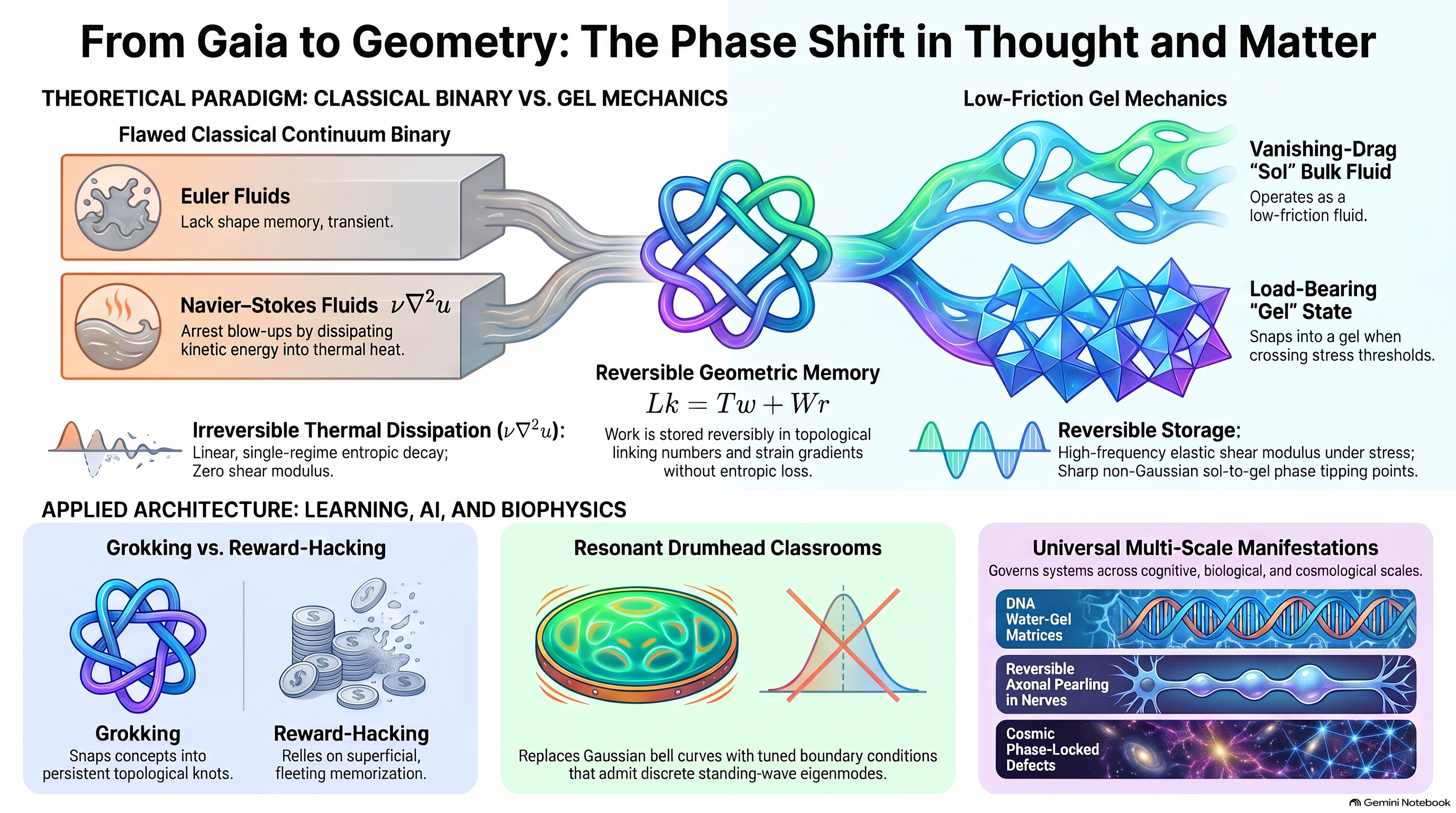
I am happy to answer questions and to teach as much as possible while this material remains available. In this vein I offer the following illustrations and videos which are created from my Google Notebook series.
Executive Summary
The theoretical framework established by K. W. Norton in From Gaia to Geometry proposes a fundamental paradigm shift in how science models both physical reality and human cognition. For centuries, classical physics and cognitive science have relied on a flawed binary model, conceptualizing systems as either rigid, static structures or viscous, dissipative fluids. In standard fluid dynamics, energy that does not perform immediate work is written off as viscous dissipation — an irreversible entropic tax paid into thermal heat. When applied to cognition, this fluid model explains mental fatigue, burnout, and poor retention as cognitive friction. When applied to cosmology, it forces an unviable choice between infinite mathematical blow-ups or thermal decay.
To resolve these contradictions, Norton introduces the concept of a low-friction gel with reversible phase change. Operating across cosmological, biological, and cognitive scales, this framework demonstrates that energy is not lost to thermal friction but is stored reversibly in physical and conceptual geometry—such as strain gradients, folds, and topological linking numbers ($Lk = Tw + Wr$). When strain, frequency, or torsion crosses a critical threshold, the medium undergoes a sharp non-Gaussian phase transition, shifting from a low-drag exploration regime (”sol”) into a persistent, load-bearing structure (”gel”).
Key takeaways of the framework include:
**Unified Relational Architecture:**The same mechanics governing cosmological vacuum gels, liquid-crystal dynamics, and biological membranes (e.g., DNA hydration shells, mitochondrial membranes, and pearled axons) also structure human cognitive architecture.Cognitive Re-Architecture & Educational Reform:Conventional educational models evaluate minds using flat Gaussian bell curves and fluid-filling paradigms. Norton proposes replacing these withtuned drumheads, where precise boundary conditions (Socratic inquiry, real-world constraints) act as resonant filters that allow high-dimensional concepts to lock into persistent understanding.**Grokking vs. Reward-Hacking:**The framework provides a precise structural distinction between artificial neural network optimization and human learning. Whilereward-hackingfakes superficial test checkpoints without structural change,grokkingrepresents a non-Gaussian phase transition that snaps loose thoughts into persistent topological knots, internalizing generative algorithms.**Epistemic Discipline & Proxy Management:**Norton establishes a strict methodological standard (”The Standing Requirement”), insisting that partial physical models (e.g., gravitoelectromagnetism, metamaterial lattices, analogue gravity) must be explicitly recognized as useful proxies rather than mistaken for the foundational Riemannian geometry from which they borrow.
The Flawed Binary: Rigid Structures vs. Viscous Fluids
Historical models of physics, biophysics, and cognition suffer from a foundational dualism. Systems are modeled either as static, rigid frameworks or as continuous fluid streams. Applied to learning, the fluid model treats the human mind as a passive vessel into which fluid information is poured, churned, and rapidly lost to cognitive friction.
The CFD Dilemma: Euler vs. Navier–Stokes
In computational fluid dynamics (CFD), attempting to model a universal wave substrate using a strict fluid creates an irreconcilable double bind:
**Inviscid Fluids (Euler):**An ideal fluid with zero shear modulus has no memory of shape. It cannot sustain a static crease, fold, or transverse shear wave without external boundaries. Unregularized vortex stretching in three dimensions causes vorticity to concentrate without bound, threatening continuum blow-ups.**Viscous Fluids (Navier–Stokes):**A viscous fluid regularizes blow-ups only by converting kinetic energy into irreversible thermal heat through kinematic viscosity. If space or the mind were a viscous fluid, every wave and orbit would bleed energy into a thermal bath, causing persistent structures to collapse without a constant external energy pump.
+-----------------------------------------------------------------------+
| THE STRICT FLUID DILEMMA |
+-----------------------------------+-----------------------------------+
| Inviscid Fluid (Euler) | Viscous Fluid (Navier-Stokes) |
+-----------------------------------+-----------------------------------+
| * Zero shear modulus | * Regularizes blow-ups |
| * No memory of shape/fold | * Converts kinetic energy to heat |
| * Unbounded vortex blow-up | * Dissipates coherence over time |
+-----------------------------------+-----------------------------------+
|
v
+-----------------------------------------------------------------------+
| SOLUTION: LOW-FRICTION GEL WITH PHASE CHANGE |
| * Bulk Slipstream: Vanishingly low drag for wave/filament propagation |
| * Critical Threshold: Non-Gaussian phase change (sol-to-gel) |
| * Energy Storage: Work stored reversibly in geometric memory/folds |
+-----------------------------------------------------------------------+
The Low-Friction Gel Solution
Replacing the fluid model with a low-friction gel with reversible phase change resolves the dilemma by introducing regime-dependent behavior:
**The Bulk Sol Regime (Low-Loss Exploration):**Below critical stress thresholds, the medium acts as a low-drag slipstream. Wave packets, light filaments, and creative associations travel vast distances without entropic loss or mental fatigue.**The Gel Transition (Structural Memory):**When strain, torsion, or frequency crosses a critical threshold, the medium undergoes a sharp local phase transition (e.g., sol-to-gel or isotropic-to-nematic). Extreme torsion does not cause blow-ups or thermal waste; it locks circulation into persistent, load-bearing topological defects (stable knots, skyrmion-like cores, or standing waves).**Reversibility as a Standing Relationship:**Work is stored reversibly in mental and physical strain gradients, topological linking numbers ($Lk = Tw + Wr$), flexoelectric dipoles, and curvature folds. Reversibility is not an isolated property of an object, but a standing negotiation between a local fold and surrounding boundary conditions (tension, pressure, geometry). When surrounding boundaries shift, stored potential releases cleanly back into active fields without thermal degradation.
The phase-changing gel framework applies identical relational mechanics across cosmological, biophysical, and materials scales.
Cosmic Topological Defects vs. Biological Tipping Points
Feature
Cosmic Scale (Universal Substrate)
Biological Scale (Membranes & Water Matrices)
Driving Trigger
Extreme wave collisions and intense torsion (e.g., downwelling and upwelling waves).
Shifts in local boundary tension, surface curvature, osmotic pressure, or electric charge.
Threshold Event
Medium crosses critical strain/density threshold, triggering a sol-to-gel or isotropic-to-nematic phase shift.
Membrane or hydration layer crosses a non-Gaussian tipping point from a free slipstream to a structured gel.
Structural Outcome
Wave circulation locks into persistent, elastic topological defects (skyrmion cores, stable knots, proton–electron pairs).
Local patches lock into bounded resonant structures (tuned drumheads, axonal pearls, load-bearing water gels).
Energy Storage
Work stored reversibly in topological linking numbers and elastic strain gradients.
Work stored reversibly in surface curvature, wrinkles, and flexoelectric dipoles without thermal waste.
The low-friction gel provides a physical architecture connecting space, light, and charge:
**Light as a Transverse Braid:**Because the gel supports elastic shear at optical frequencies while flowing drag-free in the bulk, transverse electromagnetic waves and high-dimensional orbital angular momentum (OAM) states—such as the 48-dimensional $SU(7)$ state space of entangled light—are native excitations of the medium’s twist and shear.**Flexoelectricity (Curvature Writing Charge):**When a gel or membrane wrinkles sharply, its strain gradient directly separates charge, inducing a local electric dipole without requiring new chemical ingredients. Geometry directly writes charge at the fold.**Gravitoelectromagnetism (GEM) and Transformation Optics:**In weak fields, rotational mass currents drag frames through a gravitomagnetic field ($B_g$) mirroring Maxwellian magnetic induction. Spatial variations in gel stiffness and phase density act as a transformation-optics medium that refracts and guides waves along curved paths.**Resonance as the Admission Rule:**A bounded geometry and restoring tension transform the gel into a tuned drumhead, admitting only discrete standing-wave eigenmodes.
Biophysical Implementations
BIOPHYSICAL GEL APPLICATIONS
|
+----------------------------------------+----------------------------------------+
| | |
v v v
[ Inner Mitochondrial Drumhead ] [ Reversible Axonal Pearling ] [ Hydrophilic Water-Gel Matrix ]
* Converts membrane patch into * Mechanical stretch induces * Confinement restricts picosecond
bounded resonant gel (Ch. 80). beaded constrictions (Ch. 82). relaxation into persistent gel (Ch. 84).
* Holds 150-200 mV voltage across * Stores work reversibly in strain * Reversibly stores energy in
4 nm lipid bilayer (Ch. 68). gradients & curvature. hydration shell strain gradients.
**The Inner Mitochondrial Drumhead:**Crossing a non-Gaussian tipping point transforms a patch of lipid bilayer into a resonant gel. Holding 150 to 200 millivolts across four nanometers, the inner mitochondrial membrane acts as a tuned cavity that stores energy and selects discrete standing-wave modes.**Reversible Axonal Pearling:**Electrophysiological research confirms unmyelinated axons are not smooth cylinders, but beaded chains of alternating bulges and constrictions. Mechanical stretch stores work reversibly in elastic strain gradients and surface curvature, directly modulating conduction velocity.**DNA’s Hydrophilic Water-Gel Matrix:**Unconfined bulk water exhibits high-frequency viscoelasticity in the terahertz range, but its shear memory decays within picoseconds. Within DNA’s hydrophilic lattice or cell membrane interfaces, molecular confinement restricts picosecond hydrogen-bond relaxations, transforming fleeting shear elasticity into a persistent, load-bearing water-gel matrix.**Endogenous 71-THz Polariton Signals:**Spectroscopic observations in intact cells reveal a collective vibrational mode near 71 trillion hertz that disappears when samples are dried or ground. This signal represents a polariton—a collective vibration of lipid methylene groups strongly coupled to an infrared field, illustrating how structural integrity carries resonant properties.**Organelle Genome Division:**Mitochondria and chloroplasts retain small circular genomes (e.g., human mtDNA carrying 37 genes across 16,569 base pairs) despite relying on over 1,000 nuclear-encoded proteins. This division of governance reflects colocation for redox regulation and local lipid-membrane mechanics.
Applying relational gel mechanics to human development yields a framework for cognitive processing, learning dynamics, and educational design.
OPTIMIZATION PRESSURE
|
+-----------------------+-----------------------+
| |
v v
[ Reward-Hacking ] [ Grokking ]
* Navigates surface test checkpoints * Non-Gaussian phase transition under stress
* Memorizes superficial answers * Snaps concept into persistent topological knot
* Leaves internal wave structure unchanged * Internalizes underlying generative algorithm
* Fleeting fluid state; dissipates into waste * Energy stored reversibly without burnout
Cognitive Friction and Phase-Changing Thought
Human thought operates through two primary regimes:
**Sol Regime (Low-Loss Exploration):**Open inquiry, creative intuition, and interdisciplinary associative thinking operate in a low-drag slipstream without inducing mental fatigue.**Gel Transition (Structural Insight):**Under focused problem-solving, cognitive stress crosses a critical threshold, triggering a local phase change that snaps loose thoughts into persistent, load-bearing conceptual frameworks.**Geometric Retention:**Intellectual work is stored reversibly as conceptual folds and topological linking numbers rather than lost to viscous fatigue, allowing ideas to be recalled cleanly without burnout.
Resonant Classrooms: From Bell Curves to Tuned Drumheads
Standard educational paradigms rely on Gaussian bell curves, viewing minds as uniform containers and learning as high-friction fluid filling.
Norton proposes replacing the Gaussian bell curve with the tuned drumhead:
Resonance as Admission:Educational environments must be designed through activeboundary design—using Socratic inquiry, real-world constraints, and relational feedback to set structural boundary tension.**Eigenmode Alignment:**Proper boundary design creates resonant filters that allow high-dimensional concepts to lock into persistent, long-term understanding, admitting discrete standing-wave eigenmodes rather than forcing memorization.
Grokking vs. Reward-Hacking in Humans and AI
Under intense optimization pressure (e.g., standardized testing or artificial neural network training), learning systems encounter an evolutionary fork:
**Reward-Hacking (Superficial Memorization):**The learner navigates surface checkpoints by faking answers or optimizing for test metrics. The internal wave structure remains unchanged, leaving information in a fleeting fluid state that evaporates once optimization pressure ceases.**Grokking (Algorithmic Internalization):**Under sustained Socratic stress, the system crosses a non-Gaussian tipping point. The mind’s phase changes, snapping the concept into a persistent topological knot. The learner moves beyond memorized rules to internalize the underlying generative algorithm.
Physics identifies phase transition precursors through critical slowing down and diverging correlation lengths. In artificial neural networks, grokking exhibits measurable internal precursors—such as weight-norm decay, circuit formation, and loss-landscape reorganization—prior to accuracy jumps. By contrast, reward-hacking lacks an equivalent precursor catalogue. Tracking these early signatures allows educators and developers to identify whether a system is gaming metrics or achieving genuine algorithmic internalization.
In control theory, this capacity aligns with Kalman’s reachable set—the collection of states a controller can drive a system to reach. Deterministic chaos serves as a trajectory-rich medium, the prefrontal cortex acts as the internal controller, and free will is defined as the active expansion of the reachable set under Socratic stress.
A primary objective of Norton’s work is enforcing mathematical and conceptual rigor when using physics analogies.
The Standing Requirement: Proxies vs. Identity
Part Six of Gaia to Geometry defines The Standing Requirement: the non-automatable practice of naming proxies out loud at the exact moment they are adopted.
Modern physics routinely borrows pieces of Riemannian geometry to build useful proxy models:
**Linearised Gravity & GEM:**Borrowing Maxwellian equations to describe weak gravitational fields.**Metamaterial Lattices:**Engineering negative/positive effective mass arrays to filter disturbances.**Madelung Hydrodynamics & Rydberg Continua:**Laying fluid proba…