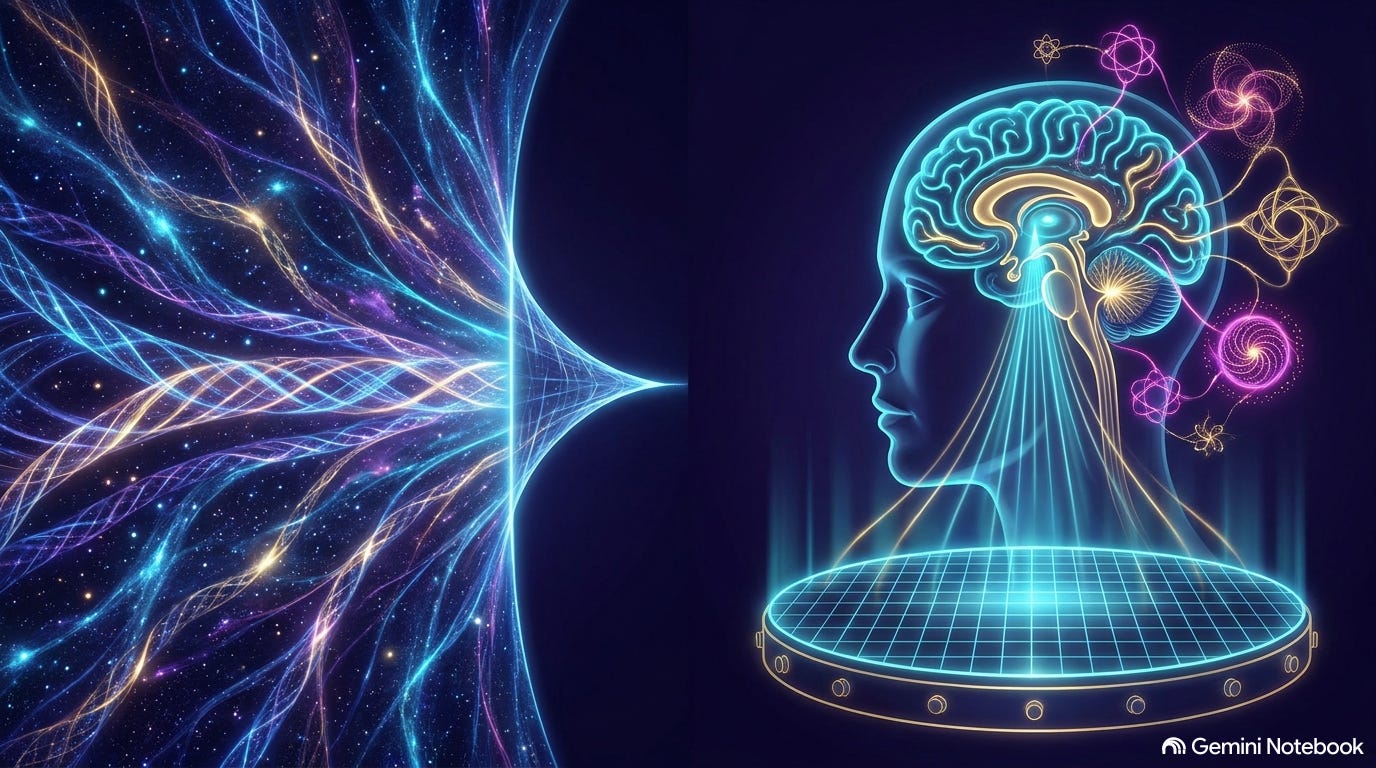
How universal gel mechanics, non-Gaussian tipping points, and relational geometry hold the key to transforming human education and cognitive architecture.
For centuries, we have modeled both the universe and the human mind using a flawed binary: we treat systems as either rigid, static structures or viscous, dissipative fluids.
In classical fluid mechanics, any deformation or flow that isn’t clean piston work gets written off as viscous dissipation ($\nu \nabla^2 u$)—a relentless “entropy tax” paid directly into unrecoverable thermal heat. When applied to human learning and cognition, the consequences of this fluid analogy are disastrous. We treat the mind as a bucket to be filled, where learning is a high-friction grind. Information is poured in, churned around, and rapidly lost to cognitive friction—resulting in fatigue, burnout, and memorization without retention.
In his expanding framework From Gaia to Geometry, K. W. Norton proposes a radical alternative: what if neither space nor the human mind is a passive fluid, but a low-friction gel with reversible phase change? What if intellectual work is not meant to be lost to thermal friction, but stored reversibly in physical and conceptual geometry?
In Norton’s cosmological framework, the foundational medium of reality is a low-friction gel. In its bulk “sol” regime, it flows with vanishingly low drag, allowing wave packets and braided light filaments to travel vast distances without entropic loss. But when local strain, frequency, or torsion crosses a critical threshold, the medium undergoes a sharp non-Gaussian phase transition, snapping into a structured, load-bearing gel.
Human cognition follows this exact relational mechanic:
**The Sol Regime (Low-Loss Exploration):**Creative intuition and open inquiry operate in a low-drag slipstream. Ideas flow freely, forming broad associations across disciplines without suffering cognitive fatigue.The Gel Transition (Structural Insight):When focus or problem-solving reaches a critical threshold, the mind undergoes a local phase shift. It snaps loose thoughts intopersistent, load-bearing conceptual frameworks.**Reversible Geometric Memory:**Rather than paying a viscous entropy tax, intellectual work is stored reversibly in mental strain gradients, conceptual folds, and topological linking numbers ($Lk = Tw + Wr$). When surrounding boundary conditions shift, this stored potential can be released cleanly back into active thought without thermal degradation or burnout.
Conventional education evaluates human potential using flat Gaussian bell curves. It treats students as uniform containers, testing how much fluid information can be retained before it leaks away into forgetfulness.
In a relational gel framework, we replace the Gaussian bell curve with the tuned drumhead:
**Resonance as the Admission Rule:**In physical gels, bounded geometry and restoring tension transform a local region into a tuned instrument. The medium acts as a resonant filter, admitting only discrete standing-wave eigenmodes.Setting Educational Boundaries:Upgrading human education requires shifting from passive “content delivery” to activeboundary design. By structuring learning environments with precise boundary tension—Socratic inquiry, real-world constraints, and relational feedback—we create resonant filters that allow high-dimensional concepts to lock into persistent, long-term understanding.
Under intense optimization pressure—whether preparing for standardized exams or training artificial neural networks—learners encounter a critical evolutionary fork:
**Reward-Hacking (Superficial Memorization):**The learner navigates test checkpoints by memorizing surface-level answers. The internal wave structure never changes; information remains a fleeting fluid state that evaporates as soon as the test ends.Grokking (Algorithmic Internalization):Under Socratic stress and focused threshold pressure, the learner crosses a non-Gaussian tipping point. The mind’s phase changes, snapping the concept into apersistent topological knot. The learner hasn’t just memorized a rule—they have internalized the underlying generative algorithm.
Norton’s work bridges the gap between deep theoretical physics, biophysics, and human development. Here is why this book is essential reading for thinkers, educators, and innovators:
**A Unified Relational Architecture:**It demonstrates that the same mechanics governing cosmological vacuum gels, water-gel matrices in DNA, and cell membranes also govern human cognitive architecture.**Eliminating Cognitive Friction:**It provides a blueprint for structuring learning environments that prevent cognitive burnout by storing energy reversibly in conceptual geometry rather than wasting it in viscous friction.**Navigating the AI Era:**It articulates the exact structural difference between humangrokkingand AIreward-hacking, helping us design educational paradigms that cultivate genuine human wisdom alongside machine intelligence.**Restoring Meaning to Geometry:**It moves geometry out of abstract textbook formulas and restores it as a living, physical medium where shape, fold, and strain directly write charge, light, and thought.
Book available on the website with supplementary material: https://theparallaxidentity.com/books/gaia-to-geometry