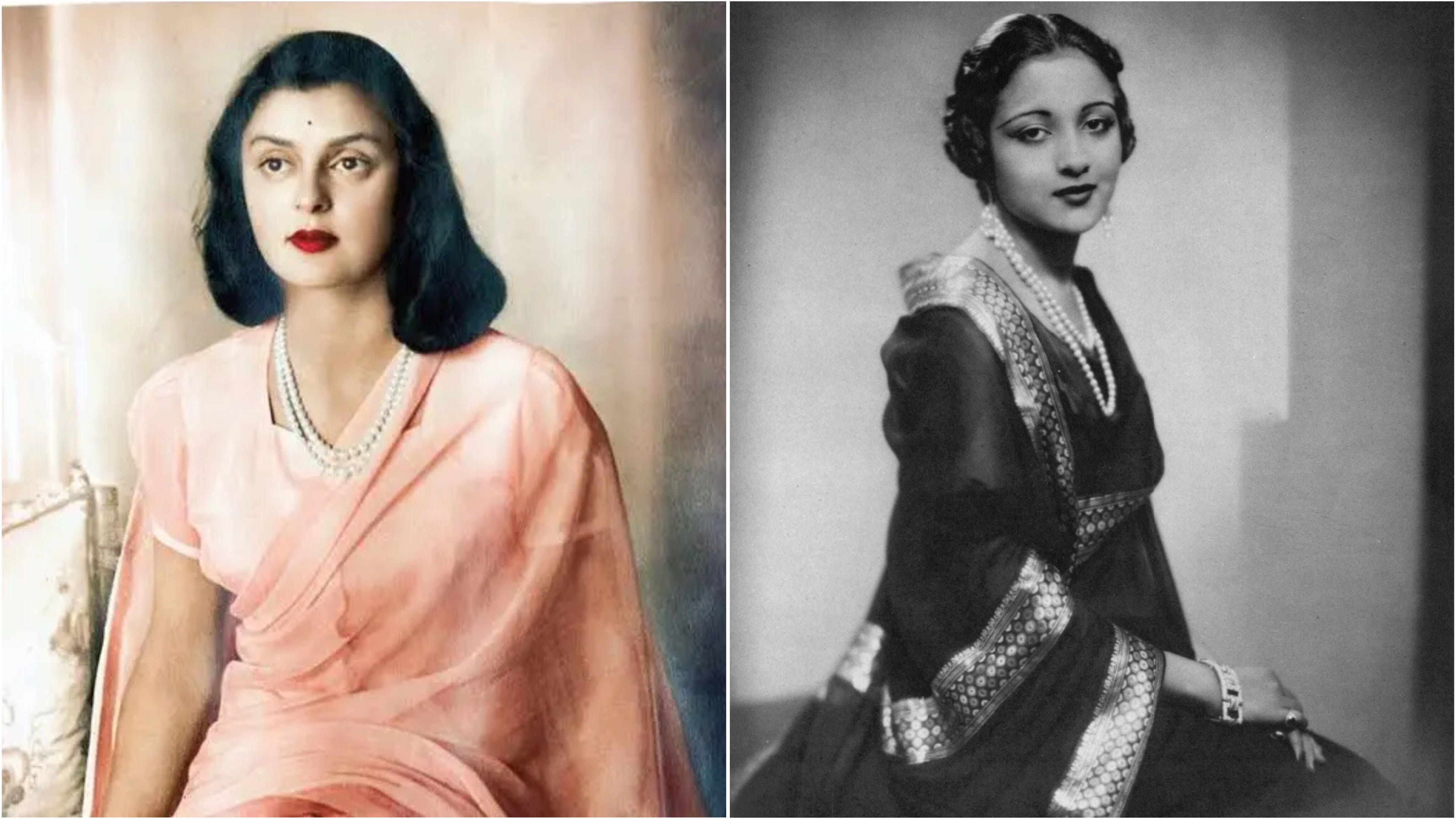
“Long before Bollywood celebrities, fashion influencers and Instagram IT-girls became style arbiters, Indian princesses and maharanis were experimenting with couture, jewellery, textiles and silhouettes that often blurred the lines between Indian tradition and global fashion.
From Maharani Gayatri Devi’s dreamy chiffon sarees and pearls to Princess Karam of Kapurthala’s Parisian couture connections, these royal women were more than patrons of luxury. They were fashion influencers of their time, introducing new fabrics, embracing international designers and creating distinctive personal styles that continue to inspire designers today.
Few Indian royals have had a fashion legacy as enduring as Maharani Gayatri Devi. Born Princess Gayatri Devi of Cooch Behar, she married Maharaja Sawai Man Singh II of Jaipur in 1940 and became one of the most recognisable faces of Indian royalty.
Her signature combination of feather-light chiffon sarees, pastel colours, pearls, emeralds and oversized sunglasses created an aesthetic that was glamorous without being excessive. Her mother, Maharani Indira Devi, had already popularised French chiffon, but Gayatri Devi made the fabric central to her own style.
Her international appeal was significant too, with appearances and photographs in Vogue and other international publications. In 2026, her granddaughter Princess Gauravi Kumari wore a Prabal Gurung-designed Met Gala gown incorporating one of Gayatri Devi’s pink chiffon sarees, paired with pearls and Jaipur jewellery, bringing an archival royal garment to a contemporary global stage.
Princess Karam of Kapurthala offers one of the clearest examples of Indian fashion influencing European couture.
Her appearance in Paris wearing a saree reportedly caught the attention of Elsa Schiaparelli. Around the same period, Vogue Paris featured illustrations of couture influenced by the saree, including a taffeta coat whose draping and head covering evoked the saree and its pallu.
Schiaparelli’s 1935 “Stop, Look and Listen” collection subsequently featured garments constructed around the body through dramatic draping. One black rayon design, with colourful embroidered borders, was commercially produced and sold at Bergdorf Goodman in New York.
Karam’s own wardrobe was equally cosmopolitan. She wore sarees with elaborate Indian jewellery but also embraced European couture, including creations by Madeleine Vionnet, Jeanne Paquin, Coco Chanel and Jeanne Lanvin. American Vogue photographed her over the years, cementing her reputation in international society.
Her significance lies in the direction of influence: she was not simply an Indian princess adopting European fashion. Her Indian way of dressing was itself becoming a source of inspiration for European designers.
Princess Brinda, daughter-in-law of the Maharaja of Kapurthala, belonged to the same cosmopolitan royal family but had a distinctly dramatic style.
During the 1920s and 1930s, she moved in European aristocratic and artistic circles, socialising with figures such as King Alfonso of Spain and Queen Marie of Romania. Contemporary descriptions of her jewellery speak of enormous emeralds and long diamond necklaces — pieces that reflected the extraordinary gemstone collections associated with Indian royalty.
Yet she also embraced European silhouettes. One memorable look consisted of a white satin Parisian tunic with flowing trousers and ropes of pearls. Her approach became an early example of Indo-Western dressing: Western clothing combined with the grandeur of Indian jewellery.
Her playful attitude towards fashion was equally memorable. She once reportedly revealed that an enormous emerald ring that drew admiration was actually a faux stone from Paris, suggesting that, for her, style was as much about personality as it was about preciousness.
Maharani Indira Devi played an important role in introducing French chiffon into Indian royal dressing. At a time when the translucent fabric was largely associated with Western lingerie, she transformed it into elegant sarees, often pairing floral chiffon with traditional gold or silver borders.
Her influence extended to footwear. She reportedly ordered more than 100 pairs from Italian shoemaker Salvatore Ferragamo, including velvet shoes embellished with pearls and another pair featuring a diamond buckle. She also collaborated with European textile makers to experiment with fabrics for the Indian market.
Her chiffon sarees would become an important precursor to the glamorous chiffon saree aesthetic later associated with her daughter Gayatri Devi and, eventually, Hindi cinema.
Maharani Sanyogita Devi of Indore belonged to a royal household that embraced the modernist spirit of the early 20th century. Married to Maharaja Yashwant Rao Holkar, she was part of a couple celebrated for their interest in art, architecture and European culture. Their Indore palace, Manik Bagh, became famous for its striking Art Deco interiors, reflecting the same modernist sensibility that appeared in their wardrobes.
Sanyogita could move between a traditional Indian saree and European couture with ease. In one portrait, she wears a vivid green nauvari saree; in another, she appears in a white satin Madeleine Vionnet dress with an embellished waist and a dramatic emerald-and-diamond necklace by Mauboussin.
Her style showed that Indian royalty did not have to choose between tradition and modernity; a saree could coexist with European couture, and Indian jewellery could transform a Western silhouette.
Maharani Chimnabai II approached jewellery with the eye of both a collector and a patron.
During her travels through Europe, she often took an Indian craftsman or Baroda’s court jeweller with her. This allowed Indian artisans to observe European jewellery-making techniques and settings first-hand.
Her association with Cartier became particularly important. She became a familiar presence at the Paris atelier and invited Jacques Cartier to Baroda in 1911, strengthening the relationship between the jewellery house and the Baroda royal family.
Her own appearance reflected the grandeur of Indian royal jewellery, with historical accounts describing white silk-and-gold sarees, pearls and enormous emeralds. Her story shows how royal patronage could connect Indian craftsmanship with European luxury.
If Gayatri Devi represented understated elegance, Maharani Sita Devi of Baroda embodied maximalist royal glamour.
Her relationship with European jewellery houses was legendary. She frequently worked with Van Cleef & Arpels, providing gemstones from the Baroda royal treasury to be transformed into elaborate creations.
One of the most famous was the Hindu necklace, commissioned from Jacques Arpels in 1950. The extraordinary piece contained more than 150 carats of gemstones, including 13 Colombian emeralds, arranged around a lotus-inspired central motif.
Her jewellery became the centre of her fashion identity, demonstrating the extraordinary scale and craftsmanship associated with Indian royal collections.
Royal influence on fashion was not always about couture and jewels. Maharani Ahilyabai Holkar’s contribution lies in her patronage of indigenous craftsmanship.
During her 18th-century reign, she encouraged weavers to settle in Maheshwar, helping establish the town as a centre for Maheshwari handlooms. The resulting saree is known for its lightweight silk-and-cotton weave, distinctive borders, stripes, checks and zari work, with motifs influenced by the Narmada and Maheshwar’s architecture.
Her legacy represents another side of royal fashion: using patronage to strengthen local craft and create a textile tradition that survives centuries later.
What makes these royal women fascinating is not simply the luxury they had access to. It was the way they used fashion to create identities and, in some cases, influence an entire industry.
Their wardrobes reveal that the relationship between Indian fashion and global luxury is far older than today’s celebrity collaborations. Indian royal women were travelling, collecting, commissioning and experimenting at a time when Paris was becoming the centre of international couture.
Today, their style codes, chiffon, pearls, emeralds, couture, Art Deco, Indo-Western dressing and indigenous handlooms, continue to appear in contemporary fashion.
Their greatest legacy may be that they did not simply follow the trends of their time. They helped create them.