You run an agentic-AI-native startup, or you are building one inside an established company. Sooner or later you face the same choice, and it is not a technical choice first. Do you build a general-purpose agent that can work across industries, or do you go deep into one vertical workflow and learn it better than anyone else? The money, the hires, and the roadmap all follow from that choice. Get it wrong and the next frontier model release can ship your feature as a default, or the system your customers already live in can absorb your workflow. Get it right and you have something a model update cannot take away in a quarter.
Think about what is actually at stake. A general-purpose agent promises a bigger market: every team is a potential customer, and every new model makes the product smarter without rebuilding it. A deep vertical agent promises the opposite: fewer customers, but a workflow the general agent does not understand, data it cannot reach, and a decision the customer will not hand to a chatbot. The risk runs both ways. Build general and a host with distribution — OpenAI, Microsoft, Google — can put your feature in front of users you will never reach. Build vertical and the platform your customers already pay for — their health record system, their CRM, their legal document system — can build your feature into the suite.
So the question is not which model is smarter. The question is which kind of agent keeps its customers when the frontier moves. A general-purpose agent plans work, talks with users, and calls tools across domains. A deep vertical agent does one workflow end to end: it knows the templates, the exceptions, the approvals, and the record that has to be right at the end. The answer is not as clear-cut as it sounds, because the evidence cuts both ways. Some text-only verticals survive with no hardware at all. Some general agents get absorbed by their own hosts. The rest of this article works through the cases, one by one.
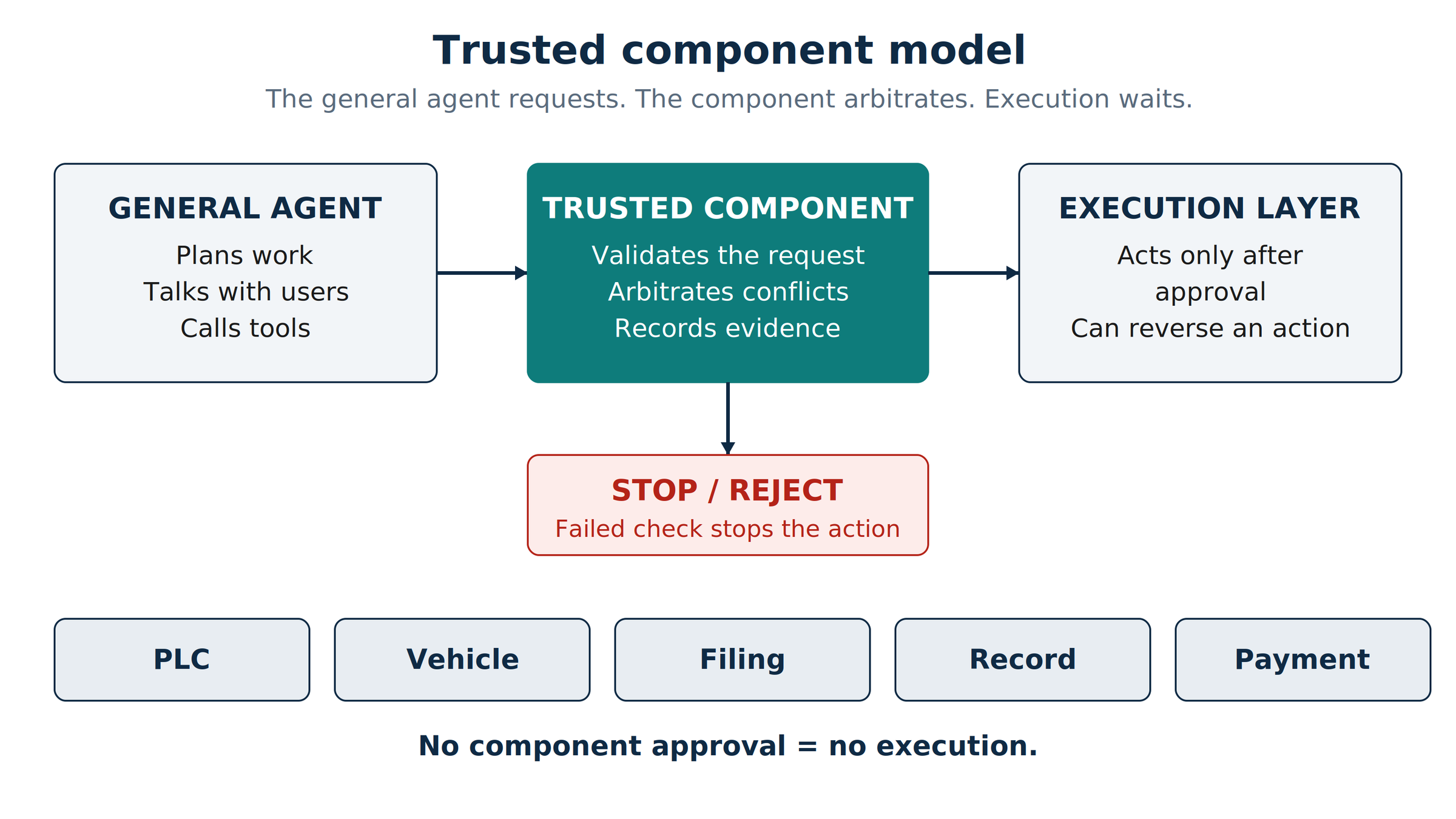
A trusted component is the part of the system that validates a request, arbitrates a conflict, and records evidence before anything risky happens. Safety arbitration means that component, not the general agent, makes the final call on a risky action. Then the question for each case is the same: who can stop a bad action, who can prove what happened, and who owns the result when it goes wrong? A prompt cannot answer any of the three. A named component with a log, a rule, and a way to reverse the action can.
Figure 1 is a general agent that requests, a trusted component that arbitrates, and an execution layer that acts only after approval.
Figure 1: The general agent requests. The trusted component arbitrates. Execution acts only after approval.
Shallow work reads text, summarises text, and calls a standard tool. It has no physical feedback, no hard timing rule, and no legal owner for a wrong output. Once the host ships connectors, search, and a standard tool protocol, a general agent can copy that work in an afternoon.
OpenAI launched ChatGPT agent on 17 July 2025 for Pro, Plus, and Team users. The agent combined Operator browser action with Deep Research synthesis. It navigated a calendar, built editable decks, and ran code. The standalone Operator product folded into that agent in July 2025 and shut down on 31 August 2025. Absorption can also churn the absorber. TechCrunch listed ChatGPT Atlas as discontinued on 9 August 2026, after less than a year. A platform can absorb a product and then discard it. Survival means owning a layer the platform still needs after its own churn.
The Model Context Protocol, MCP, cut the integration cost that once protected wrappers. Anthropic introduced MCP on 25 November 2024. Anthropic donated MCP on 9 December 2025 to the Agentic AI Foundation under the Linux Foundation. Anthropic reported over 10,000 active public servers and 97 million monthly SDK downloads at that point. The protocol still moved value. Before MCP, each agent needed custom code for each tool. After MCP, one server interface serves many clients. A wrapper that sold custom integrations lost its main selling point. A server that owns permissions, audit, and a governed action set kept one.
Microsoft states the same point in its own decision framework. The framework lists a document-grounded chatbot as work that now ships as SharePoint agents, Copilot Studio knowledge, and Agent Builder. It lists a research assistant as work that now ships as Researcher. It lists a data-analysis assistant as work that now ships as Analyst. It lists bespoke robotic process automation scripting as work that now ships as computer use, and per-agent tool wiring as work that now ships as a central MCP endpoint. A team that funds a fresh build for one of those rows, with no extra moat, funds a feature. The host already ships that feature.
Gartner said on 25 June 2025: "Over 40% of agentic AI projects will be canceled by the end of 2027, due to escalating costs, unclear business value or inadequate risk controls." Gartner based the release on a January 2025 poll of 3,412 webinar attendees, a self-selected sample, not a census. The same release estimated that only about 130 of thousands of agentic AI vendors are real, and it called the rest agent washing: rebranding assistants, robotic process automation, and chatbots without substantial agentic capability.
The paid section tests the question case by case: absorption and one clean failure, three accountability cases, Harvey and Legora, Siemens and a warehouse repair rate, Replit and ChatGPT agent, EU and US compliance rules, the grey middle, and a playbook with a five-question moat test, a trusted-component contract, a build-or-buy choice, and a validation loop.
Read the cases for the artifact, not the demo: a workflow graph, a citation trail, a trace log, or a qualification record that survives a model change.
The accountability cases sharpen that test, because they ask who paid when a system did not work. A court sanctioned lawyers for filing fabricated cases. A tribunal held an airline liable for its own chatbot's wrong fare advice. A city kept a chatbot online, with disclaimers, after it gave unlawful advice. Sanction, liability, and a disclaimer that shifts risk to the user: keep those three outcomes in mind when you read the funding numbers.