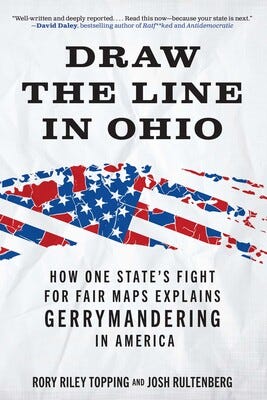
Who drew your congressional district, and who were they trying to keep in office? On The Unknown Podcast, Richard Luthmann and Michael Volpe put the mapmakers under the microscope with Rory Riley Topping, coauthor with Josh Rultenberg of Draw the Line in Ohio.
Topping explains how a television assignment that was supposed to last a couple of weeks became a years-long fight over maps, courts, and the rules Ohio voters thought they had settled.▶00:00:00 Welcome to The Unknown▶00:01:00 Draw the Line in Ohio▶00:06:00 The Illinois map and why district shape matters▶00:10:29 Safe seats and the power of primaries▶00:11:43 From veterans policy to election law▶00:16:28 What makes a congressional map fair?▶00:20:07 Why the mid-decade map wars broke out▶00:25:00 California and the independent commission▶00:27:21 Did Florida Republicans overplay their hand?▶00:30:03 The 2026 wave and the “dummymander”▶00:32:35 DeSantis’s case for the Florida map▶00:34:53 Staten Island, Nicole Malliotakis and NY-11▶00:37:08 Forum shopping in map litigation▶00:39:36 Callais and majority-minority districts▶00:45:17 Chicago wards and communities of interest▶00:51:03 What Congress could change▶00:53:12 Would a compactness rule work?▶00:58:39 Why add more members of Congress?▶01:01:58 The Wyoming Rule▶01:04:28 What voters can do
Volpe puts an Illinois district on screen and asks why someone living inside those lines should care. Topping takes it down to street level. Which communities does a representative have to serve? How far apart are they? And if the general election is a foregone conclusion, whose votes actually decide who goes to Washington? That question takes the conversation from the shape of a district to the people who have to live in it.
Luthmann presses Topping for her strongest example of Democrats manipulating the process. She picks California and takes aim at the decision to sideline its independent commission for congressional mapmaking. Florida gets the next round. Luthmann asks whether Republicans overplayed their hand. Topping looks at what happens when districts drawn using President Trump’s 2024 results meet a different electorate. She explains the “dummymander,” the risk a party takes when it spreads its supporters so thin that a strong swing puts several seats in play. She also discusses Governor Ron DeSantis’s argument that the new lines may have protected seats Republicans would otherwise have lost.
Then the fight moves into court. Luthmann brings in Staten Island’s NY-11 dispute and Marc Elias’ challenge to the district represented by Nicole Malliotakis. The three discuss why lawyers fight over which court hears a case, how state and federal rules intersect, and what the Supreme Court’s Callais decision means for the debate over race and representation. Volpe proposes a simpler compactness rule. Topping explains why even a tidy shape can leave difficult questions about which communities belong together.
The sharpest exchange comes when Topping makes the case for expanding the U.S. House. Luthmann asks why a country frustrated with Washington should hire another hundred or two hundred politicians. Topping argues that smaller districts could make it easier to serve constituents and run for office. She walks through the Wyoming Rule as one possible formula. From Ohio’s courthouse battles to the 2026 midterm results, the episode asks how much control voters have once the people running for office have drawn the lines.
Follow The Unknown Podcast on YouTube, Rumble, and Spotify, and tell us which rule you’d apply in all 50 states.
Rory Riley Topping and Josh Rultenberg’s book: https://www.simonandschuster.com/book...
Project No Cap:
Michael Volpe:
Richard Luthmann: https://linktr.ee/rluthmann
Thank you to everyone who tuned into my live video! Join me for my next live video in the app.