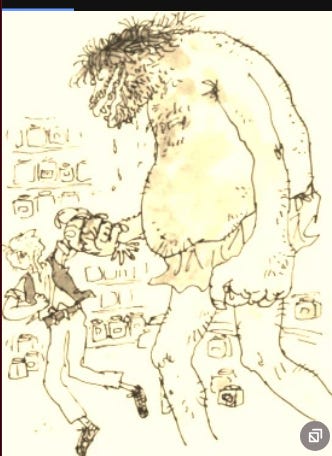
Bloodbottler: I read your piece “Humans Matter in the Aggregate More Than Giants.” That one provoked a big reaction on giant Twitter (as big of a reaction as one can get from the ~80 giants that live in the world). Did you see, even Fleshlumpeater weighed in. Just know that I would absolutely stomp on a billion humans if it would add even one second to a giant’s life.
BFG: I realize that is the common intuition among giants. But really think about those little humans. Yes, they may be small. We may not be able to see their little lives. But there is compelling evidence that they can suffer. They respond to painful stimulus. They respond to painkillers. So I think our intuitions about the moral unimportance of humans are not very reliable.
Bloodbottler: This conclusion is, of course, ridiculous. It’s not that we have failed to appreciate the importance of humans. I like humans well enough. In fact, when I eventually heard of J.B.S. (short, of course, for just bone smash) Haldane’s quip that God “must have an inordinate fondness for humans,” this struck me as clearly false. Humans are wonderful creatures, and so God’s fondness for them is anything but inordinate! But your error is neglecting the inviolability of the giant person.
BFG: Well let us talk more about that inviolability. While there are 8 billion humans, there are only 80 giants. There are about 100 million humans per giant. I calculated that for each passing second of giant life, there are 75 passing hours of human death. That’s just the death bits—ignoring all the other parts. So what is it that explains why a single second of giant life matters more than any amount of human life?
Bloodbottler: Well let me start 𝕏by saying that anyone arguing that any other species matters more than all giants in the aggregate is an enemy of giants and should be summarily executed.
BFG: But obviously the fact that you’re part of some group doesn’t mean members of that group matter categorically more than members of other groups. We are northern giants with white skin like the pale snow. But we don’t think the southern giants—swarthy though they may be—matter infinitely less. In fact, giants have a long history of ignoring the importance of one another, which we now recognize to be an error. In fact, it wasn’t so long ago that northern and southern giants had to drink from different water fountains. So shouldn’t we at least take seriously the possibility that human interests matter?
Bloodbottler: I will respond substantively, but first let me 𝕏signal a little bit more.
be EA
massive_intellect.jpg
r/atheism
“I don’t need a book to be a good person”
morality from first principles
assign a conservative pain variable
“in aggregate humans have more value than giants”
we should keep malcontent turbo-dweebs away from superintelligence.
BFG: My friend, note that I am but a humble giant who doesn’t speak for EA. And the core ideas of EA have nothing to do with this, so let not this taint your assessment of it. To think that you should rescue a giant drowning in a pond, you don’t need to think that all the humans of the world matter more than a giant. Still, it seems like an important conclusion, so I really wish you’d engage with the argument.
Bloodbottler: Fine, you want me to engage with the argument, I’ll tell you your error. You are assuming utilitarianism. By assuming that the welfare of all the humans can outweigh that of a single giant, you are assuming that welfare can aggregate. But that’s simply assuming utilitarianism. And utilitarianism is crazy and evil! It implies that you should harvest one giant to save five other giants.
BFG: I’m not assuming utilitarianism. To think that the welfare of a billion conscious creatures matters more than the welfare of one, you don’t need to be a utilitarian. It is obviously possible to think that without believing you should always do whatever maximizes aggregate welfare.
Bloodbottler: You are assuming erroneously that a bunch of humans can matter more than one giant. But just like no number of dust specks can matter as much as one torture and no number of headaches can matter as much as a giant life, no number of human lives can matter as much as a giant.
BFG: Well, of course, I have my arguments for the conclusion that lots of little pains can be worse than a single major pain. But even if we set those aside, why think that humans can experience only little pains? Certainly they behave as if they’re in a lot of pain. If you watch those up-close videos of the humans when they’re dying of disease, or see how they react when you stomp them to death, so long as you do it slowly, they react like they’re in a lot of pain. Now, I don’t know the exact ratio of pain in giants to pain in humans. But it’s at least not obvious that they only feel a bit of pain, even though our brains are 80,000 times larger. For this reason, even if I were a non-aggregationist, I would still buy that enough humans’ interests could outweigh one giant’s interests.
Not to mention that the other view has pretty implausible results. It implies that a single passing second of giant life matters more than 75 hours of human life. Now, we may treat human life as irrelevant. But really imagine living for 75 full hours as a human. Isn’t it obvious that would matter way more than just one second of your life?
Bloodbottler: Obvious to whom? Certainly that isn’t obvious to me. Whether it’s obvious to most giants is an empirical question. I think any amount of human life matters less than any amount of giant life.
BFG: Really? Can you please try to think vividly about what it’s like to be a human, rather than just writing them off because it’s convenient to do so? Look, I know it might be annoying to have to take efforts not to stomp the little humans to death. But it’s the right thing to do.
Bloodbottler: Yeah, not moved by this stupid argument, sorry.
BFG: Well do you remember when Bonedrinker proposed his famous veil of ignorance thought experiment. The core idea was that you’re supposed to imagine making decisions as if you didn’t know who in society you would be. That way you’d be impartial and count everyone’s interests equally. In such a setup, you’d obviously care mostly about humans, because you’d be almost guaranteed to be one.
Bloodbottler: But you’re assuming that you could have been a human. That’s ridiculous. It’s not like we’re just souls being slotted into a random body.
BFG: No, I’m obviously not assuming that. It’s a thought experiment. You’re supposed to imagine not knowing who you are. So just as you can have thought experiments where you imagine not knowing that the first digit of pi is 3—even though it couldn’t be anything else—you can also imagine thought experiments where you don’t know that you’re you.
Bloodbottler: I simply refuse to include humans from behind the veil of ignorance.
BFG: But if you’d care about them from behind the veil, doesn’t this show that they impartially matter. And isn’t promoting the impartial good at least part of the source of our moral reasons, even if not all of them?
Bloodbottler: Well you’ve assumed utilitarianism again. You’ve talked a lot about the humans experiencing pleasure and pain. But “this is a utilitarian argument of the pre-Millian, Benthamite sort: pains and pleasures do not differ in any qualitative way but are substantively the same and only need to be added up.” And humans living on our world, with severe cognitive defects, have none of the higher pleasures of relationship, knowledge, or anything else.
BFG: I’ve assumed no such thing. As you know, I’m an objective list theorist. I think there’s more to a good life than just pleasure. My argument is and has always been that pleasure and pain are AMONG the things that matter, not that they’re the only things that matter. So then the fact that humans experience more suffering in a day than all the suffering in giant history means that we should take their interests very very seriously.
Bloodbottler: All I’ll say is 𝕏k3 civ or bust. The humans can come too.
BFG: I feel like you’re not treating this with the seriousness that it deserves. We know that giants have a long history of making serious moral errors. We also know that there is significantly more expected suffering experienced by humans than giants. They differ by many orders of magnitude. So shouldn’t we at least treat this topic seriously, rather than sneering or writing off the other view.
Bloodbottler: (on 𝕏giant Twitter)
EA rationalist types are really weird about humans.
You say “Elves don’t have subjective consciousness and so can’t feel pain” and they pop into your replies with
“What about humans? Can humans feel pain? Would you step on a human knowing they feel pain?”
Sure.
“You genocidal monster! How can you not care about the human? Do you know mermaids are giant water humans? Would you sacrifice a trillion humans to save one giant?”
Sure.
“Omg you’re even more evil than I already thought you were! How dare you prioritize your own petty hypothetical consciousness for the very real suffering of a trillion humans!”
Sorry, I don’t value humans. Because they’re humans.
An elf doesn’t have moral standing. It’s an elf.
BFG: I don’t think this has ever happened, but do you see why it is annoying to explain why I think what I do at length and to have you respond with extreme confidence, dismissal, and snark, yet not bother to give a counterargument? If we want to make moral progress, if we want to be the kinds of beings that live up to the enlightenment ideals of Bloodcruncher and Headbasher, then we’d better think carefully about our moral practices. If we do not think about the actions we take, then we are doomed to commit the errors of the past. So please, you don’t have to agree, but don’t just immediately write off every argument for why our society’s moral practices are badly in the wrong.
Bloodbottler: So let’s say we grant this premise. What are the practical takeaways?
BFG: Well to start, I’d say we shouldn’t mistreat trillions of humans in giant human farms in order to provide environmentally harmful and overpriced feed to the suffering krakens on the kraken farms. But the more general thing is that once we recognize that humans matter, then we, who will primarily design how the future goes across vast spans, should aim to design one that is good for all sentient beings—humans included!