Submitted by QTR's Fringe Finance
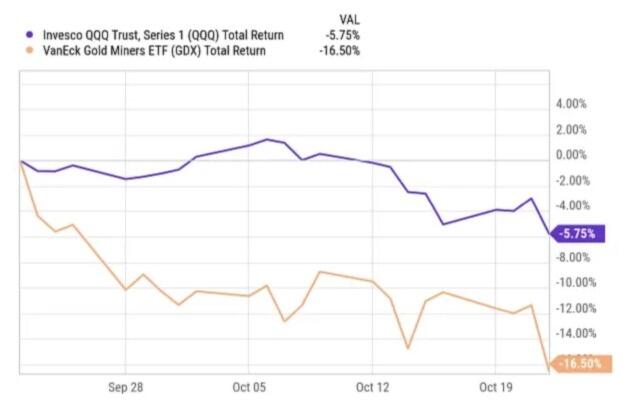
Markets have been volatile over the last several weeks, with selling pressure spreading across tech stocks and speculative assets. Gold and miners have been no exception, with the latter getting caught up in the broader liquidation and suffering significant selling pressure of their own.
While still beating the NASDAQ by about 6% over the last 3 months, miners are down -16.5% in the last month, plunging far more than the QQQ’s which are down just -5.75% in comparison.
I thought it would be a good time to take a few minutes this morning to explain that personally, this is precisely the type of environment I have been anticipating for years (gold and miners plunging alongside a risk selloff), and it does nothing to change my longer-term bullish outlook on gold and gold miners.
What we’re seeing is entirely consistent with the thesis I’ve been laying out over the last few years, though the thesis is far from being proven right.
For years, I’ve said that if we experience a genuine market crash, I expect gold to sell off alongside equities, and I expect gold miners to get hit even harder. The reason is simple: when markets begin deleveraging in earnest, investors don’t sell what they want to sell. They sell what they can sell.
Margin calls need to be met. Leverage needs to be reduced. Cash needs to be raised. And in that environment, even fundamentally attractive assets can get thrown overboard indiscriminately. Gold is not immune to this process, and gold miners, which are ultimately equities with operating leverage to the underlying commodity, are even more vulnerable…they’re easier to sell than physical bullion.
In my August piece, * My Favorite Investment In The World Right Now*, I wrote:
“During the first phase of a true liquidity crisis, nearly everything gets sold. Investors do not carefully distinguish between good inflation hedges and bad businesses while they are meeting margin calls or trying to raise cash. Gold can decline. Gold miners can decline even more.”
I went on to explain that miners could easily suffer drawdowns of 20%, 30% or more, even while the longer-term investment case remained intact.
And just days ago, in my market dashboard, I reiterated essentially the same point:
“My ideal scenario isn’t necessarily for miners to march straight higher from here. In fact, I wouldn’t be surprised if GDX got absolutely crushed during a broad market liquidation.”
The important part of my thesis has never been what happens during the initial liquidation. It’s what happens afterward.
I’ve thought for a while that the next major financial crisis could produce a two-stage move in precious metals. First comes the deflationary shock, when leverage unwinds, asset prices collapse and investors scramble for dollars. Then comes the policy response, when the Federal Reserve and Treasury are eventually forced to confront the consequences of a financial system that has become hopelessly dependent on cheap credit and abundant liquidity.
That second stage is where I believe the real opportunity lies.
I’ve said repeatedly, including in recent interviews, that I would not be surprised to see gold fall toward $3,000 or $3,500 per ounce during a sufficiently violent market crash. But I’ve also said that I could envision gold subsequently making a beeline toward $7,500, or potentially even higher, quickly over the following months and years if the Federal Reserve responds with aggressive rate cuts, renewed asset purchases, liquidity facilities or other forms of monetary accommodation.
That all remains to be seen if we were to crash now…because inflation has the Fed’s policy responses somewhat hamstrung. But they would figure out a way to make an excuse to print or otherwise ease.
The sequence is what matters. Just earlier this month, during my October 6 appearance on the Macro Dirt podcast with Tony Greer and Jared Dillian, I said:
“I think gold will get clobbered with it and I think miners will probably overshoot gold to the downside in percentage terms.”
I then described the possibility of gold moving from deleveraging lows around $3,000 to $3,500 toward $7,500 or even $10,000.
That would represent a 150% advance from $3,000 to $7,500, or roughly 114% from $3,500. And because miners have operating leverage to the gold price, the upside in mining equities could be substantially greater, provided their balance sheets, production costs and underlying businesses remain sound.
Of course, none of this is guaranteed. The Fed could remain restrictive longer than I expect, a crash could damage miners’ fundamentals, and the recovery could take substantially longer to materialize. But those risks have always been part of the thesis.
What I find particularly interesting is that the very forces capable of creating the initial crash could ultimately force the policy response that benefits gold.
A credit event, disorderly bond market, severe equity drawdown or broader liquidity crisis would put enormous pressure on policymakers to intervene. And given the United States’ enormous debt burden, persistent fiscal deficits and growing interest expense, I continue to believe the political and economic incentives overwhelmingly favor intervention over sustained austerity.
In other words, the same financial instability that could temporarily crush gold and miners may ultimately provide the catalyst for their next major move higher.
And whenever I start questioning the thesis because of the latest ugly trading session, I find it helpful to zoom out.
Gold was trading around $1,900 per ounce five years ago. Even if it were to fall all the way back to $3,000 during a major liquidation, it would still be up approximately 58% over that period. That’s hardly the destruction of a secular bull market. It’s a reminder of just how far the metal has already come, and how much nominal purchasing power has been lost along the way.