Google ships the closest gateway to the AWS Cedar model in this series, and Google still cannot judge intent at that gateway. Article 1, AWS Agentic Security, established a central Cedar gateway and one rule: routing decides coverage. Article 2, Microsoft Agentic Security Tooling, Mapped to MAESTRO: Policy Lives in Four Places, established the opposite split: policy lives in identity, content, connector, and framework controls, and no one control sees every tool call. Google sits between those two conclusions. Google Agent Gateway enforces deterministic identity, destination, and tool-name policy for gateway-bound traffic, with default-deny. Google still needs a custom engine or developer code for argument-value semantics, and Google Semantic Governance Policies remain Preview and LLM-judged. That combination is the thesis of this article. Google gives a team a real gateway and the strongest agent identity in the series, and Google leaves the same three gaps as Articles 1 and 2: no native retrieval or memory provenance control, no public signed agent registry, and no runtime drift halt.
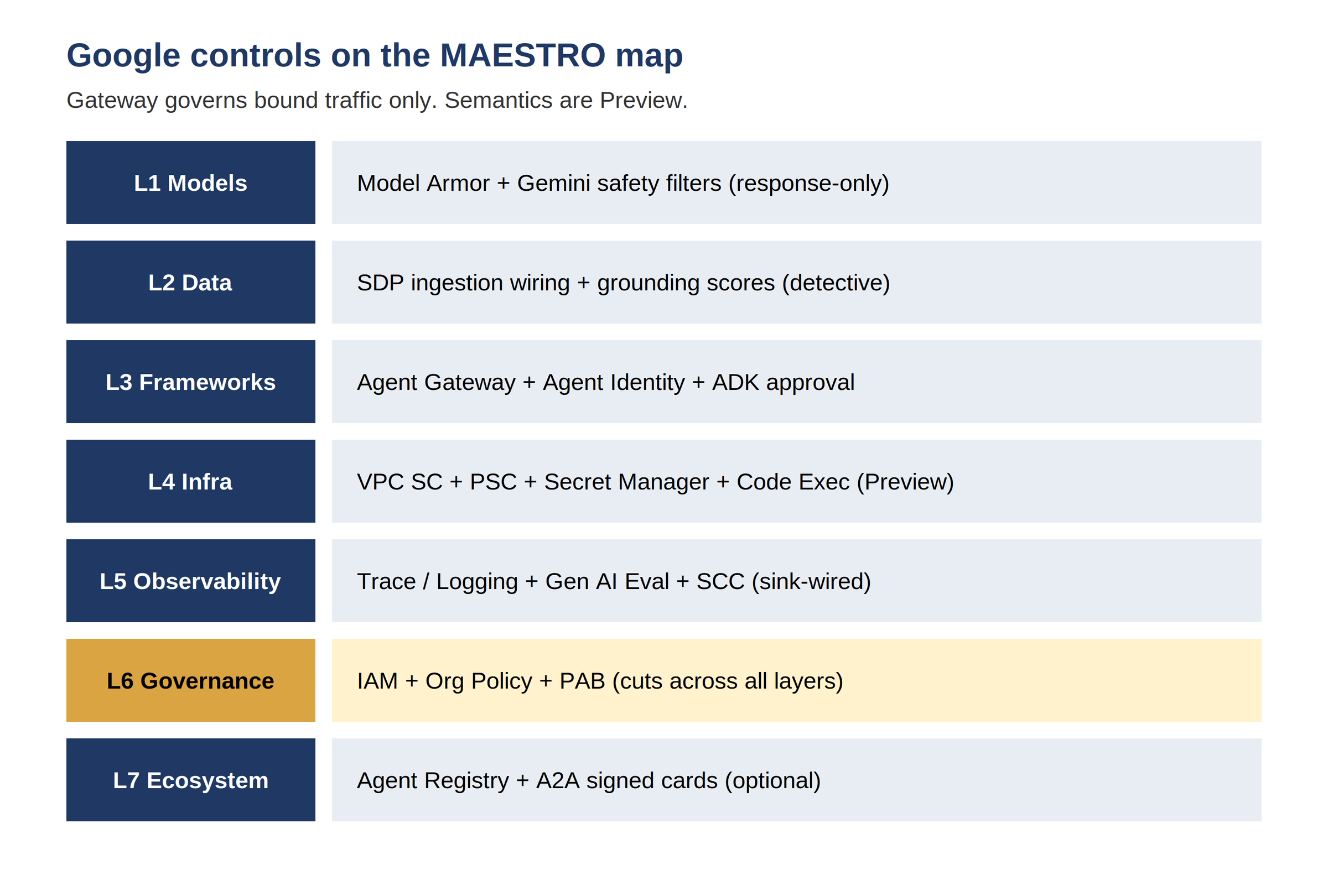
Figure 1 is the Google stack on the MAESTRO map: gateway and identity carry L3, and L6 cuts across all layers.
Figure 1: Google controls map to MAESTRO layers, with L6 cutting across all layers. The gateway governs bound traffic only.
Google Agent Identity gives each agent a SPIFFE identity, a 24-hour certificate, and certificate-bound tokens. Google Admin Activity logs sit in a 400-day required bucket, while Data Access logs default to 30 days. Those two numbers show the pattern of this article in miniature: Google builds strong primitives, and Google leaves the last step to customer configuration. A team that checks the primitive name alone will overstate coverage. A team that checks routing, binding, and retention will see the real coverage.
L1 Foundation Models — the stake is model output. A model can follow a harmful instruction with fluent, confident text. Output alone never proves safety. The paid L1 section states what Model Armor blocks, what Model Armor only scores, and what Gemini safety filters cannot do on prompts.
L2 Data Operations — the stake is retrieved text. A document, a memory record, or a tool result can carry an instruction. Retrieval turns untrusted text into model context. The paid L2 section states what Sensitive Data Protection can wire into ingestion, what grounding scores prove, and what no Google control validates.
L3 Agent Frameworks — the stake is tool action. A plan becomes real impact only when a tool runs. Tool permission decides that impact. The paid L3 section states where Agent Gateway enforces, where argument semantics need a custom engine, and where approval remains developer-owned.
L4 Deployment and Infrastructure — the stake is runtime privilege. An agent process runs with credentials. Those credentials decide lateral movement. The paid L4 section states how VPC Service Controls, Private Service Connect, Secret Manager, and the Preview code sandbox fit together.
L5 Evaluation and Observability — the stake is proof. Traces, logs, and evaluations show what an agent did and why. Missing logs remove that proof. The paid L5 section states which audit defaults run 400 days, which run 30 days, and which immutability settings need explicit configuration.
L6 Security and Compliance — the stake is identity separation. User identity, agent identity, and tool identity must stay distinct. One shared role hides who acted. The paid L6 section states the three identity patterns, the Principal Access Boundary ceiling, and the lifecycle gap after deletion.
L7 Agent Ecosystem — the stake is peer trust. A peer agent or a tool server needs vetting, registration, and scoped credentials. Registration alone never proves trust. The paid L7 section states what Agent Registry does, what A2A signing does and does not do, and where peer trust remains unbuilt.
Five cross-layer attack chains — the stake is the chain, not one step. Each chain shows the step where a Google control breaks it, and the step where a gap lets it pass. The paid chain section gives a test for each chain in a reader's own environment.
Three-way comparison, control gaps, reference architecture, and builder playbook — the stake is reuse. The paid closing sections cite Articles 1 and 2 at each point where Google differs from or shares a gap with them, name each gap plainly, and give a copy-ready identity, gateway, and approval pattern teams can apply on day one.
Start a review with routing and binding. List every tool the agent can call, and mark each tool as gateway-bound or not gateway-bound. Mark each Agent Runtime deployment as managed runtime, GKE, Cloud Run, or cross-cloud, and check whether the gateway covers that deployment today. Mark each Model Armor setting as Inspect and block or Inspect only, and mark each setting as floor setting, template, or absent. A review that skips that inventory cannot judge coverage. A review that completes that inventory can see the gaps before it reads any policy text.
Continue a review with identity. List every agent, and list the identity pattern for each tool that agent can call. Mark each tool as Agent Identity, user-delegated, or shared service account. Check whether downstream logs show the user, the agent, or only a shared role. Check whether deleted agents left IAM bindings behind. Check whether a replacement agent inherited the old bindings or received a new principal. An identity review that finds one shared service account has found a real finding, not a paperwork issue. An identity review that finds orphaned bindings has found a lifecycle finding that no gateway can fix.
Finish a review with a chain test. Pick one chain from the paid section. Run the chain in a test environment with test data, test documents, and test tools. Record the step where a control stopped the chain. Record the step where no control ran. Record whether the gateway denied the destination, whether Model Armor blocked or only scored, whether approval stopped the destructive tool, and whether the tool arguments appeared in the audit dataset. A chain test gives a team evidence, not an opinion. A chain test also gives a team a repeatable check for the next release.
The paid section maps each layer in turn. The paid section gives the five attack chains, the three-way comparison, the control gaps, the reference architecture, and the builder playbook. The paid section keeps every claim tied to a primary source. The paid section drops any claim we could not source. The paid section also names each preview limit that affects a production decision. A reader must not place a preview control on a critical path without knowing the limit. The paid section also states, plainly, where Google offers no native control at all. Those gaps are not a criticism of one product. Those gaps are the work a team must plan, fund, and own. A team that plans that work early ships a safer agent. A team that discovers that work after launch ships a delay. A team that completes routing, identity, and chain testing before launch will know its real coverage. A team that skips any of those three checks will learn its coverage from an incident instead.