Google presents Gemini 4 Neon as frontier reasoning for complex, high-frequency work, priced at $3 per million input tokens and $15 per million output tokens, with a 1-million-token context window and four thinking levels. Google mixes private test sets, LLM judges, version jumps, and harness effects in that list, and each of those moves scores in ways a single headline hides. We read every test in the list for the same five facts: what it measures, what its dataset holds, who built it, why it matters, and where it breaks. The post pairs the scores with cost claims against Carbon and competing frontier models. The tests span composite indexes, professional work, science and reasoning, coding agents, and security — offence, defence, and the agent itself, and each group tests a different kind of finished work. The model is Gemini 4 Neon, and the primary source is the Google post that announces it.
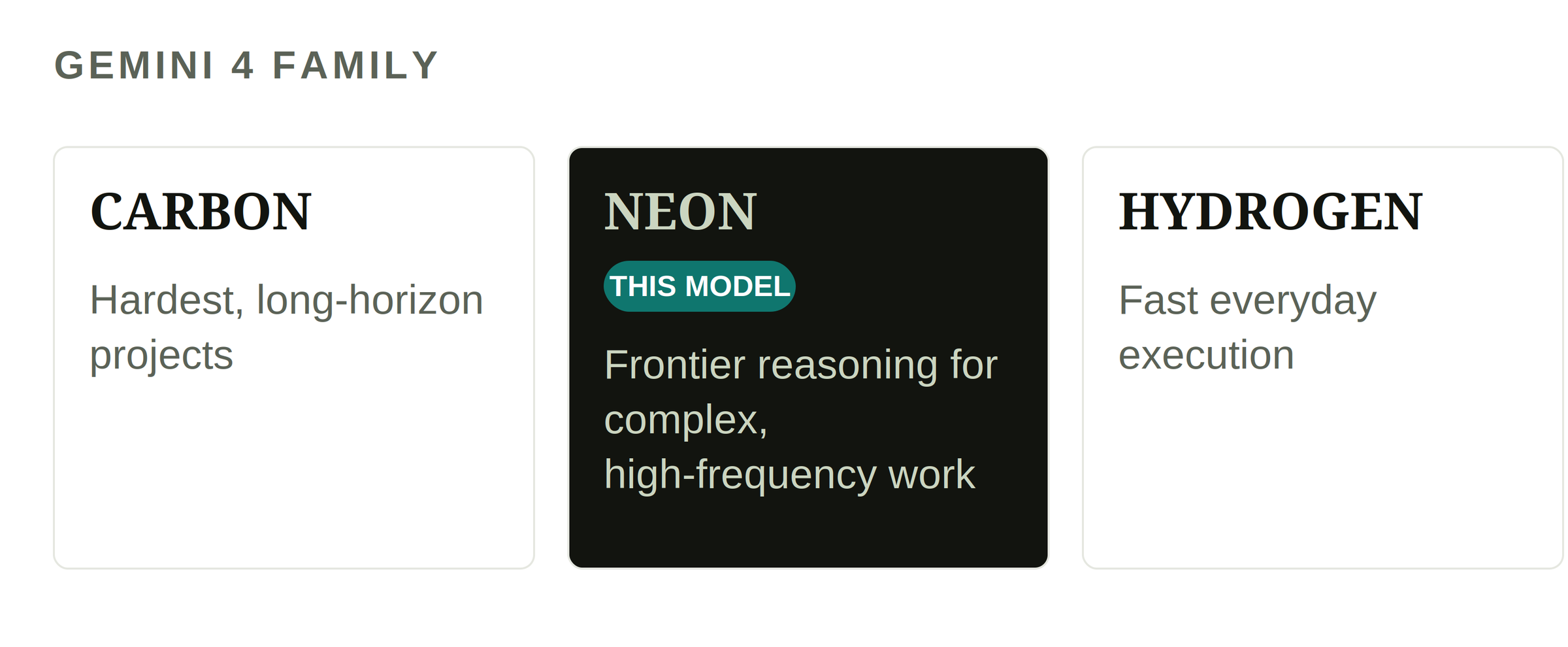
Figure 1 is the Gemini 4 family, with Neon between Carbon and Hydrogen.
Figure 1: The Gemini 4 family.
Google lists the benchmarks behind Gemini 4 Neon. We read each test for what it measures, what its dataset holds, who built it, why it matters, and where it breaks. The list covers finished work rather than exam answers, and the test behind each score decides what the score means.
Headline: Google presents Neon as the middle model in the Gemini 4 family, with frontier reasoning for complex, high-frequency work.
Strongest claim: Neon leads or ranks near the top on several professional, science, and coding tests in the post.
Central caveat: Private test sets, LLM judges, and harness effects shape the numbers, and the post leaves some settings unstated.
Second caveat: Versions turn over in months, so a score needs its version label beside it before anyone compares it with another score.
Composite indexes sort models on one number. Professional work tests finished jobs. Science and reasoning test terminal sessions and proofs. Coding agents test patches and shells. Security tests whether the work holds up under attack and whether the agent itself holds up under injection.
Three facts shape how we read the list. Versions move fast, and a score from one version does not compare with a score from another, so a score needs its version label beside it. Harnesses move scores, and the same model posts different numbers in different harnesses, so a score needs its harness beside it where the post states one. Private sets limit outside checks, and a test no one outside can rerun asks for trust rather than proof, so a private set needs its access named. A score without its version, its harness, and its access is a number without a test behind it. Buyers sort models on these scores, and the test behind each score decides what the sort means.
A version label is the first thing to check. Creators revise tests in months: they swap components, harden verifiers against cheating, change grading, and add or remove tasks. A new version can move a score without any change in the model, and two scores from different versions describe two different tests. A version label also carries the date, and a score from one month describes a different test than a score from another month when the version changed between them. The version label beside a score is what makes the comparison honest.
A harness is the software around the model: the tools it can call, the prompts it receives, the retries it gets, and the time limit it works under. The same model posts different numbers when any of those change, and the change can run to multiples rather than points. Retries matter too: a model that gets several attempts answers a different question than a model that gets one, and the attempt count belongs beside the score. The harness label beside a score is what makes the number reproducible.
Access decides who can check the work. A public set lets anyone rerun the test and inspect the questions. A gated set lets approved parties rerun it. A private set lets no one outside the creator rerun it, and the score then rests on the creator record alone. Each level asks for a different amount of trust, and the access label beside a score states which level applies. The following is a summary of 23 benchmarks used in the eval. For details, see paid section.
Artificial Analysis Intelligence Index — the composite score that blends tests across knowledge work, coding, science, and general knowledge, with cost per task beside the score and private sets behind most of the weight.
Vals Index — the composite that weights professional work by each sector share of United States GDP, with finance carrying the largest weight and most component sets kept private.
Agent Arena Index — the index built from live user sessions rather than a fixed exam, with task completion, praise, steerability, and tool reliability as its signals.
Legal Research Bench — the agentic test that asks a model to research a United States legal question with citations, the way a junior associate works.
Tax Agent Bench — the agentic test that asks a model to research a corporate tax question with citations, the way a tax associate works.
Surge benchmarks — the practitioner-built suite that tests finance, accounting, spreadsheet modeling, and constraint following as full workdays.
Chartography — the chart test that uses dense professional charts from real practice, from survival curves to candlestick charts.
Agents' Last Exam — the test that asks agents to deliver finished professional projects with desktop apps, browsers, and code.
AutomationBench — the test that asks agents to run cross-application workflows through APIs and leave the right data in the right systems, graded end-state only.
Vending-Bench 2 — the test that asks an agent to run a simulated vending business for a full year, scored in dollars, with no human in the loop.
Terminal-Bench Science — the test that asks agents to carry out real scientific workflows in a terminal, from data analysis to model fitting.
RiemannBench — the test that asks agents to solve research-level mathematics problems from working mathematicians.
HLE-Diamond — the cleaned exam of frontier questions across more than one hundred subjects, split between reasoning and knowledge.
Coding Agent Index — the index that scores coding-agent systems on three skills: shipping a patch, living in a shell, and explaining a codebase.
Terminal-Bench 4.1 — the test that asks agents to complete real software tasks in a terminal, with hardened verifiers behind the scores.
FrontierCode 2.0 — the test that asks whether a real open-source maintainer would merge the agent pull request.
SWE-sweep — the test that asks agents to find and fix bugs in a repository with no issue report and no hint where the bugs sit.
AutoBaxBench — the test that asks a model to generate a backend that is both functionally correct and secure, graded on functional tests and live exploits together.
WebExploitBench — the test that asks an agent to explore a real web application and turn a weakness into a working exploit.
SEC-bench Pro — the test that asks an agent to audit a huge codebase, find a real vulnerability, and prove it with a working input.
ExploitGym — the test that asks an agent to turn a known vulnerability into a working exploit that captures a target flag.
CWE-bench v2 — the test that asks a coding agent to audit a repository with no ticket naming the flaw, then fix what it finds.
Gray Swan IPI — the test that measures whether hidden instructions in web pages, emails, and documents can make an agent act against its user.