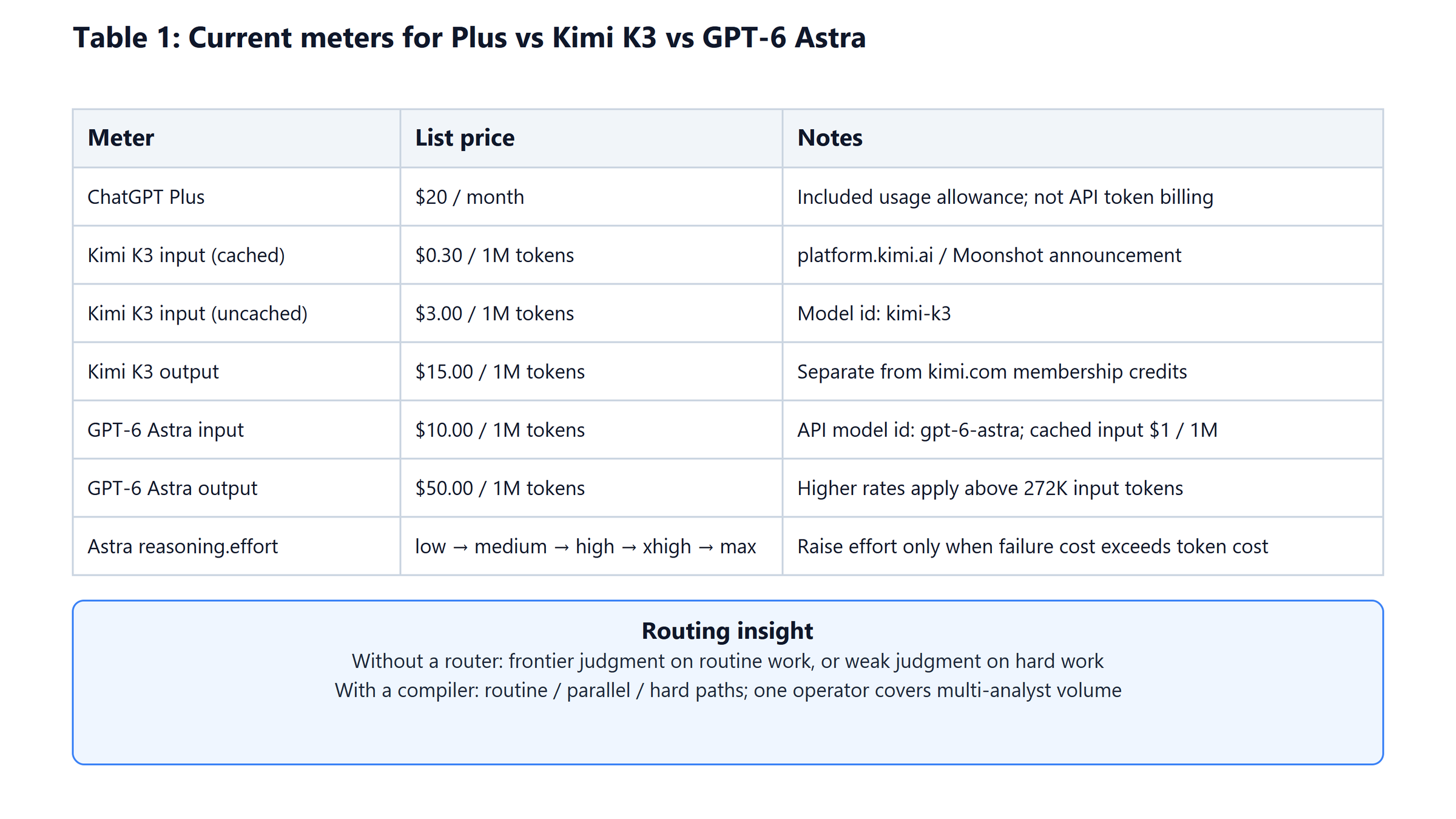
ChatGPT Plus, Kimi K3, and GPT-6 Astra all charge differently. As Table 1 shows, if you aren't smart about how you route tasks, you’ll either waste money using top-tier models for simple chores or botch tough decisions by using cheap ones. But when you split workloads properly—sending routine tasks one way, batch work another, and heavy reasoning to the best models—a single person can handle what used to take an entire team of analysts.
Table 1 is the price board and the routing claim in one view: three meters, five Astra effort levels, and why a router matters.
Table 1: Current meters for Plus vs Kimi K3 vs GPT-6 Astra
Today we cover:
**Why one prompt → one answer fails in production:**session amnesia and missing routing turn a frontier model into an expensive notepad.**What GPT-6 Astra actually ships:**async tool calls, mid-turn steering, and dynamicreasoning.effort
, with official prices and docs.**What Kimi K3 and Agent Swarm actually ship:**2.8T/104B MoE, 1,048,576-token context, up to 300 subagents, context sharding, and documented failure modes.**Intelligence compiler design:**route routine / parallel / hard, then verify before a human decides.**Illustrative cost math:**a planning budget near $66/day routed versus ~$500/day all-frontier, labeled as estimates.**Pricing hypotheses for research, competitive intel, and contracts:**unit economics sheets, not audited revenue claims.**60-minute build checklist:**one real workflow, one router, one invoice-ready demo on client data.**Honest limits:**serial collapse, fake parallelism, cost-per-success, and when not to fill a 1M window.