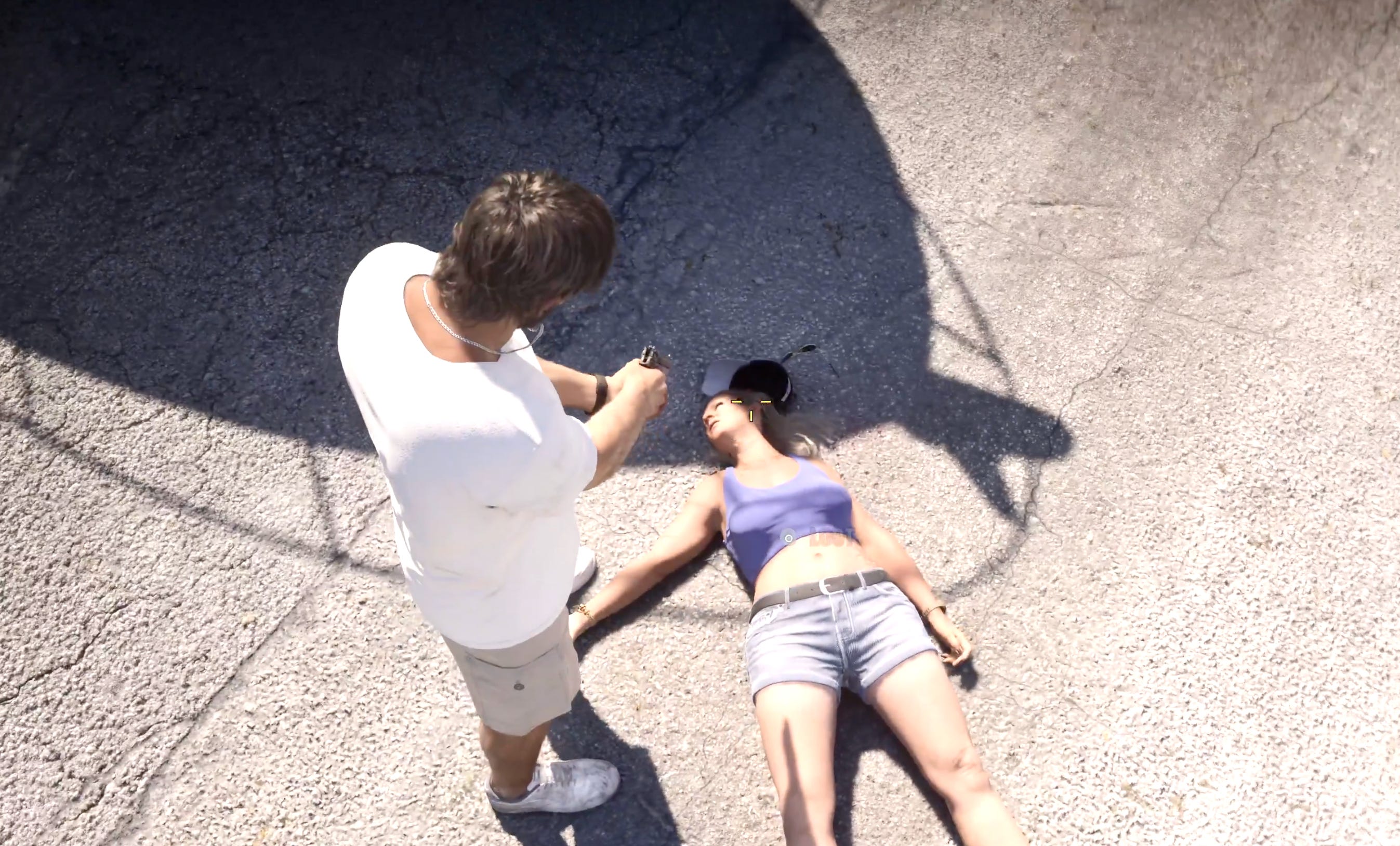
Unless you’ve been hiding under a rock, the biggest popular culture news this week has been the release of the video game “Grand Theft Auto VI,” which has been widely praised as a masterpiece. After putting away the Atari at age 15 (this was 1982), I never again played a video game, so the whole culture of gaming is completely foreign to me. I can’t make informed judgments about something of which I know nothing, and I’m not going to start now.
I read this long piece in The New York Times, by Joseph Bernstein, about the game, and I recommend it. The writer is convinced that this is a Very Big Deal, and based on the public’s response since it was released this week, I think he’s right. Excerpt to set the stage:
If you care about this game, you are probably already playing. If you don’t care about it, just so we’re on the same page, it’s the one that involves zipping around a meticulously rendered three-dimensional simulation of an American metro area, committing crimes. Sometimes it’s New York, sometimes Los Angeles; in the new game, it’s Miami.
There’s a story to follow, but many gamers opt for the extracurriculars, things like dirt-bike racing, weight lifting and eating hot dogs. Others, in a time-honored G.T.A. tradition, simply cause as much chaos as possible before being killed by the police. It’s this invitation to murderous rampage that has made the game controversial since the first one came out in 1997.
Conspicuously missing from the hype this time around has been much tut-tutting, if any. For years, the games were a symbol of what was wrong with the state of young people and their morals. But over the intervening decades, the nation reconciled itself to G.T.A., or at least developed more pressing concerns. In September, Miami Beach commissioners approved a marketing proposal that would see Vice City (G.T.A.’s version of Miami) logos festooned around town, and last night, the Miami Heat wore special Vice City uniforms in their game against the Milwaukee Bucks. The best outrage Fox News has mustered in the run-up to the release was to
[lecture men]that they should not be gaming past the age of 40. (Disagree.) In other words, G.T.A. now falls into that category of hyperpopular things that many Americans deep down sense might have poorly understood side effects, but that we have resolved to shrug our shoulders at, like dating apps or legal weed.
I do remember reading about vile things in previous versions of GTA, and wondering why anybody would want to participate in that. The GTA world is one in which participants play lowlifes who have the run of a city, and can do very bad things (violence, drugs, sex stuff). It is also, they say, very creative and immersive. I’ve read reviews of the new version, and have seen comments from reviewers saying it’s more emotionally complex and humane.
Maybe so. But I saw 𝕏this clip from the game last night online, and then 𝕏this one … and I’m like, *what fresh hell is this?! *Fair warning: in the first clip, a male player confronts a woman on the street, beats her, then takes out a gun and blows her head to smithereens; it explodes like a watermelon. In the second one, a burly guy approaches three women on the beach, one of them elderly, and beats the crap out of them.
What is a teenage boy supposed to think, immersed in this? I’m not one of these people who believes there is a direct line between video game violence and real life violence, but I think you’d have to be a fool to think that there is no connection between what we choose to attend to, and how it affects our souls. I don’t consider myself a prude about movies, and will watch movies that have sex and/or violence in them … to a point. I avoid the horror genre, especially movies that feature gory violence, and I won’t see any movie that comes anywhere close to pornographic. I’m just too sensitive to that stuff, too disturbed by it … and I don’t want to get comfortable with it.
Two lessons come to mind. The first is the well-known passage from St. Augustine’s “Confessions,” in which his young Christian friend Alypius allows himself to be peer-pressured into going to the gladiatorial games at the Colosseum. Alypius knows a Christian has no business watching men be murdered for the sake of entertainment, but he can’t say no to his friends. He tells himself that he’s just going to avert his eyes at the moment when the death blow is struck. But when that moment comes, he’s so moved by the roar of the crowd that he looks anyway. From that moment on, Alypius was seized by a passion to watch that kind of gore, and, says Augustine, it took him years to overcome it.
In my case, when I was a professional film critic, I had to see almost everything that came out. Despite what you might think, it wasn’t fun. Before I would walk in to see a movie that I had reason to suspect would be super-violent or near-pornographic, I would silently pray for protection, then go about my job. I thought I was fine.
Then I got married, moved to New York, and took up a job as the chief film critic for the New York Post. I had to see even more movies than I had before. I would take my wife to evening screenings sometimes, if she wanted to go. I can’t remember what movie it was, but I recall us leaving after the screening of some movie — it was on the Upper East Side, in a theater near Bloomingdale’s, I remember that much — and I noticed she was pretty shaken. I was thinking, “Well, that wasn’t pleasant,” but that’s it.
Not her. It had really gotten to her. She said, “How can you watch that stuff and not be really bothered by it?” We talked about it all the way home, and I realized that despite my best efforts, I had really become desensitized to this kind of thing on screen. But that was my job, and I had no answer for her.
In late 1999, just before our first child was born, I switched jobs from movie critic to columnist. I went from seeing ten movies a week to only seeing what I wanted to watch. I recall sitting at home one night, our baby boy just a few weeks old, holding him in my arms as he slept, and settling in to watch “Goodfellas,” the classic mobster movie, which I had loved when I saw it on the big screen years earlier. Now it was on TV, and I was excited to revisit it.
I had to turn the thing off before the first hour, because of the violence. I had an intense reaction to it. I realized after a minute’s thought that it had everything to do with the baby I was holding in my arms. The child was so defenseless, so weak, and I had come to understand from the first time I held him how infinitely precious life is. The deep revulsion I had at the grotesque violence in the Scorsese film came directly from that. I suppose I would still call “Goodfellas” a masterpiece, but that’s based only on my memory of it from the first screening. I could not watch it again today.
As those months passed by, and I “detoxed” from watching so many movies, I regained my moral sensitivity. When I would choose to see a movie, I found that I had far less tolerance for explicit sex and visceral violence. It wasn’t a matter of thinking, well, I like this, but I know I shouldn’t; it was more like, *this defiles me, and I can’t keep watching. *
On a more everyday note, I’ve told the story in this space before about how, when I first married, my wife couldn’t understand why I would hate-watch “The Jerry Springer Show”. I did it because I took pleasure in these idiots making fools of themselves. She gently but insistently challenged me on that, asking me if I really wanted to be the kind of man who took pleasure in vulgar, brutish people humiliating themselves in public with vile confessions and trashy behavior. What could I say to that? She was right. Y’all know me: that stuff is catnip to my inner Ignatius Reilly. But I know it’s bad for me, so when it presents itself on social media, I try to avoid it (but fail more often than not).
The point is, getting accustomed to depictions of brutal behavior brutalizes us, in the same way encountering beauty and goodness in art raises us up. There’s no way around it. Again, I’m not saying that everybody who plays GTA VI is going to go out and beat women or blow their brains out. That’s not how it works. But ask yourself: do you want to become the kind of person who finds even the simulation of that behavior pleasurable and entertaining? Do you want your teenage son to do so?
Last anecdote: In 1993, I was working at The Washington Times in DC, and went to see the acclaimed ghetto movie Menace II Society, for a story I was working on (I wasn’t a film critic then). It’s set among violent gangs in Los Angeles. At the time, DC was the murder capital of America. A colleague at the paper lived not far from me on Capitol Hill. One night, he and his girlfriend were coming back from dinner, when they were jumped by a young black thug, who put them on the ground with a pistol to their heads, and robbed them. Soon after that, he quit his job and moved back to the Midwest. This was in my own neighborhood.
Anyway, the film was very violent, but it was not a movie that glorified violence. It was a movie that depicted the brutality of L.A. gang life, and dramatized the plight of a young black man, the main character, who was trying to escape it. I saw a matinee screening at the Union Station theater. Not too many people were there, but I noticed that I was the only white guy in the theater. The movie started, and yeah, it was a very good film, on the whole — but again, quite graphic. Arguably, it needed to be to illustrate the brutality of that life, and the grip it had on the protagonist, despite his efforts to escape it.
At one point, there was a severed head that went rolling down the street. It was a moment meant to shock by its horror. You are meant to recognize that the protagonist really does live in hell. But the whole row of teenage black boys sitting behind me went nuts with laughter and delight. It was unnerving. Obviously I don’t know where in DC they lived, but probably in a neighborhood a lot like the one we were seeing on screen. And remember, DC at that time had the highest murder rate in the country — higher, even, the Los Angeles, where Menace II Society was set. I suppose the filmmaker, John Singleton, wanted young guys like the ones behind me in the theater to see that movie, and to resolve to live differently. Not that lot. They thought it was cool to see gory things like a head rolling down the street.
I left that screening wondering what the hell I was doing living in Washington, a city awash in guns, and with feral young men who thought it was a matter of high comedy to see someone’s head cut off and rolling down the street like a bowling ball.
It’s not a cut-and-dried thing with art. As I’ve said here before, back in 2003, I visited the Neue Galerie on Manhattan’s Upper East Side with a friend, and saw all the Expressionist canvases from the Weimar era hanging on the wall. They were disturbing. My friend said at one point, “It’s like you can hear the sound of the train to Auschwitz coming around the bend.” True.
But as I learned in my study this year of that period, the artists of the era endeavored to tell the truth about the decadence of post-Imperial German society. To what extent was an individual artist simply bearing witness, and to what extent was he reveling in decadence? It’s hard to know. The Nazis considered all of it to be “decadent art,” but the sanitized garbage they valorized was simply a different kind of decadence — a way of hiding the moral brutality of Nazi life and thought beneath the clean, well-ordered canvases. I believe that artists have a duty to tell the truth about life and the human condition, as best they can — even if that truth is ugly. Sometimes, a great artist can find hope even in the moral ruin. That’s what the Tarkovsky film Andrei Rublev is about.
From what I’ve read about “Grand Theft Auto VI,” it does sound like a work of artistic accomplishment, in terms of graphic realism, at least. And it’s not only about shooting and killing and beating people up. But what does it do to a person’s soul to immerse oneself in an audiovisual experience where the horrors I mentioned above are open to one, as a participant, if one chooses them? Do we even think about that? Or do we just follow our instincts, and consider anything that is entertaining to be self-justifying by that fact?
𝕏Mario Nawfal tweets about how GTA VI really is a cultural phenomenon:
Grand Theft Auto 6 is a mirror the size of a country... so what do you see in it?
Thirteen years ago this series was what politicians blamed for ruining kids.
This week the Miami Heat played in Vice City jerseys and delivery orders jumped 30% because nobody would stop playing to cook.
So look at what everybody is staring into.
The heroes are a broke couple with credit too bad for a bank account, living out of a motel and scrolling their phones in bed while cameras track their every move.
No film or novel has held a whole country still like this, which makes it one of the most influential pieces of media ever made... and possibly the most honest.
Crime games used to be the escape, and now millions are escaping into a story about being tracked, broke and glued to a phone.
So here’s the question worth sitting with: when the fantasy millions of people choose to escape into looks remarkably like the life they already have, what are they really escaping from?
That’s a powerful observation. I don’t have the answer for it. Do you? It tracks with Joseph Bernstein’s lines in that NYT article I quoted at the start:
Those G.T.A. games made the ugly subtext of American life text through puerile exaggeration, a useful register for a product aimed at young men. But the issue today is that there is no longer much subtext to extract from America’s derangements, no distance between the way the country presents itself and any number of acid jokes you could make about it. … How do you represent a world that’s already so detached from reality?
Here again is a link to that NYT piece — please read it, all the way to the end. It’s important.
To conclude, again, I can’t make a firm judgment about GTA VI, because I haven’t played it, and have no interest in it. Besides, I don’t own a game machine, so I couldn’t play it if I wanted to. But this thing is such a huge phenomenon that it simply can’t be brushed aside as mere entertainment, or ignored, or condemned out of hand. No doubt some of you readers have played it, or at least played earlier version of the GTA series. Tell us about it in the comments.
The next item, for subscribers only, is about a new Buddhist sect that views AI as a new religion (they’re right, in my view), and who are trying to find a way to stay human in the face of it. Fascinating, important stuff. Read on.