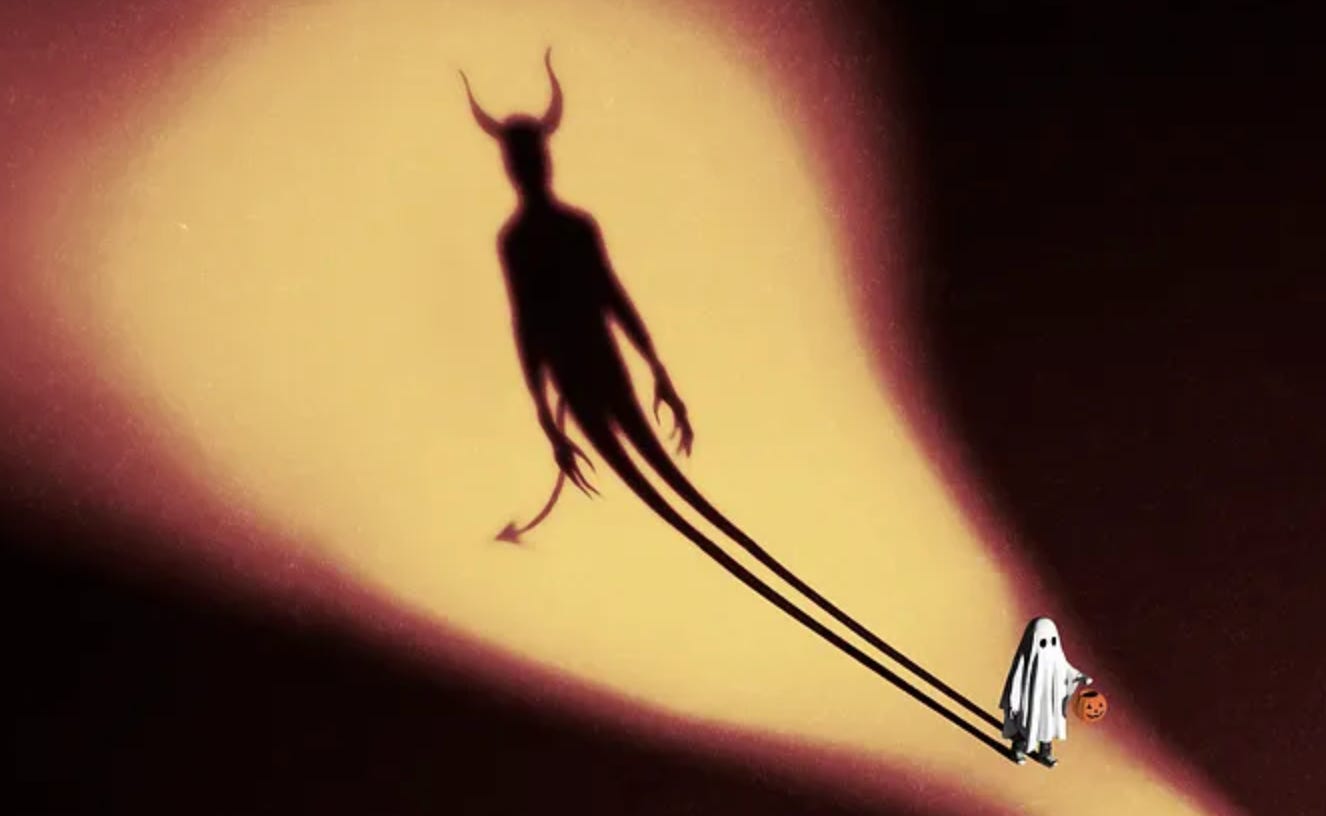
Yesterday I published an essay in The Free Press explaining why I don’t observe Halloween. Many of the stories I tell will be familiar to longtime readers of this newsletter. But I wonder if you know this part:
The first exorcist I ever met was also the first one to tell me to stay in on Halloween. In 1989, working the police beat at the
[Baton Rouge], my first job out of journalism school, I saw one of my colleagues come into the newsroom as stiff and white as a starched dress shirt.[Advocate]“What happened?” I asked. He waved me away and sat at his desk. I followed him and pressed.
The reporter, a dapper dude from Chicago, had just come from interviewing Father Mario Salvador Termini, an elderly south Louisiana priest who lived way down Bayou Pigeon. Whatever my colleague had heard, it frightened him so much that he had dropped the story, and now he was refusing to repeat anything the old priest said.
“Can I have his number?” I asked.
I called the priest, then drove into the swamp to meet him. I was not Catholic at the time, and barely Christian. But I was curious. Short, balding, with an air of both gentleness and gravity, Father Termini (which is Italian for “terminate”) met me at the door of his modest brick house in the Atchafalaya Swamp, invited me in, and opened up about his line of work. The aged cleric told me many things that day, all of them fully justifying the fright I had seen on the face of my Yankee colleague. The thing Father Termini said that I remembered most was this: that Halloween was not a joke, because deep in the swamp, on that night, Satanists conduct rituals that sometimes involve human sacrifice.
Human sacrifice? Really? When I expressed polite journalistic skepticism, the exorcist gave me the phone number of Sgt. C.P. Wilson, then the Baton Rouge police department’s go-to guy for investigating occult crimes. He also gave me contact information for Carolyn Carroll, a local psychotherapist who sometimes called him for help.
Before I tell you what happened next, I acknowledge: It’s easy to sit in the well-ordered environment of a big city, all straight lines and grids, where the lights never go out, and think these are just tales. But things are different in Louisiana. Out in the swamp, there are few straight lines, only the meandering of alligator-filled bayous, the drape of choking vines, and the sinister squiggle of deadly cottonmouths gliding across the muddy water. The swamp is where the really wild things are. If one got to you at night, nobody could hear you scream.
Roll your eyes if you like. “Nobody wants to believe there’s witchcraft being practiced and animals and children sacrificed in their own neighborhoods,” Father Termini, who died in 2002, told me. “But it’s happening.”
Soon thereafter, I found myself sitting in Dr. Carroll’s office, and she was telling me about the time she had to call Father Termini to help with one of her patients, a young woman with multiple personality disorder—who was manifesting terrifying paranormal symptoms. This was in 1986. Then 25, the patient had escaped a Satanic cult in which she had been sexually abused in a ritual fashion by various people, including her own parents.
Dr. Carroll recalled that, as part of the therapy process, she had given the traumatized young patient a tape recorder, and told her to press “record” and start talking when she discerned that her personality was about to shift. The patient did as she was asked, and at their next meeting, she handed over the tape recorder—but she begged Dr. Carroll not to listen to the cassette.
Of course, the therapist pressed “play.”
Years later, I asked Dr. Carroll to repeat the story she first told me on that hot summer day in 1989, because I didn’t publish back then. I used some of the details for
[a][New York Post]and they ran with the headline: “Shrink’s Chilling, Real-Life Exorcist Ordeal.”[column—this was the year 2000—]“All of a sudden, there was this break in the tape where there was nothing. Then there was this growling, snarling voice that came on the tape, and it began to make threats to my safety,” Dr. Carroll told me. “The girl got into a fetal position and hid in the corner. The room filled up with a presence. The lights literally began to dim.” In our initial late 1980s meeting, Dr. Carroll told me that a disembodied voice ordered her to leave the young woman alone. “She’s ours,” it snarled.
Dr. Carroll had no idea what to do. She was a Protestant for whom the existence of the devil was an abstraction. All she could think to do was pray. The room, and the patient, returned to normal. After that, Dr. Carroll called Father Termini.
There’s more, but you get the idea. After the FP published the column, a friend whose wife had been sexually abused as a child in occult rituals texted me. Family members had taken her to them; her Christian parents trusted these family members, and had no idea at all what they were doing to their child. The wife has been under treatment for years for the trauma she endured in all that. The abusive family members confessed; I can’t remember if either went to jail, but in any case, they’re dead now. The friend’s text said his wife testifies that the Satanic abuse rituals to which she was subject were always the worst on Halloween.
You might think that Halloween is a night of innocent fun — and for you, it may well be. But there are ritualist occultists for whom this night is not that at all.
My friend Bethel McGrew, a conservative, highly intellectual Evangelical, is skeptical:
I certainly don’t begrudge Bethel her skepticism. This stuff is really, really weird. But my guess is that she is operating from purely theoretical knowledge, and has never met exorcists, deliverance ministers, or people who have been delivered from demonic bondage.
Take somebody like Tammy Comer, the wife of the Evangelical pastor John Mark Comer. I met John Mark backstage at a conference years ago. He was still visibly shaken by what he had just seen happen to his wife. She tells her full story below, but the gist of it is that a few years earlier, Tammy had been overcome by an extremely rare, terrible nervous system disease that caused her face to go into uncontrollable spasms. It was progressive and incurable. It had gotten to the point where she could not go out in public.
Around this time, Tammy, who comes from Mexico, learned from her brother back home that their grandmother (or perhaps great-grandmother — I can’t recall) had been the common-law wife of the Cuban ambassador. He had an entire family with this woman, with whom he was having a bigamous affair. Back in Cuba, the lawful wife of the ambassador had been confined to an insane asylum. Yet somehow, the wife contracted with a sorcerer to put a curse onto the family line descended from her husband’s common-law wife. The curse was specific: the firstborn daughter of every subsequent generation would either die, and suffer from a terrible disease.
It had all come true. And Tammy was the firstborn daughter of her generation. There was little to nothing in the Comers’ theology to account for this, but they found a Protestant deliverance minister who came to pray over Tammy against the curse. On that day backstage at the conference, John Mark told me he was standing at his wife’s side, and watched her face turn from hysterical spasms to total smoothness as the minister broke the curse in the name of Jesus.
Later, Tammy, who had long been a faithful Christian, went public with her story. Watch it:
You say you can’t believe in generational curses, or that serious Christians can be harmed by demons? What do you do with the real-life story of Tammy Comer?
It doesn’t sound like Tammy was in any way “possessed” — a strict category among exorcists, and a rare condition — but she was certainly “obsessed” or “oppressed” (a lesser, distinct categories). And it came on her through no fault of her own. The same thing happened to a devout Catholic friend of mine in New York City (the “Emma” story that’s familiar to many of you). It wasn’t her fault — it was a generational curse, and after years of prayer and ministry by an exorcist, she was freed.
Why does God permit such things? We don’t know. But they happen. The evidence is overwhelming, if one cares to raise one’s head from the books and talk to people who have dealt with them.
A good place to start is, well, with a book: The Exorcist Files, by Father Carlos Martins, a practicing exorcist. He explains the ins and outs of the phenomenon. Father Carlos writes from a theoretical perspective, but also from a practical one, based on years of experience in this field. It’s important for people to understand that full-on possession is rare, but oppression — which runs a spectrum — is far more common. Being a faithful Christian gives one more protection against it, but ancestral curses really are a thing, and can affect one no matter how faithful. Plus, a Christian who fools around with the occult — tarot readings, Ouija boards, things like that — or who falls into serious sin (marital infidelity, drug abuse, etc.) can open the door to direct demonic influence in their lives.
The world of exorcism and spiritual deliverance is not a science. The field — especially in the Internet age — is full of people who don’t know nearly as much as they think they do, and who can mislead others unintentionally. One should go forward with discernment and caution. Many should not look into this stuff at all, for their own spiritual protection.
My objection, though, is Christians and non-Christians who insist that it cannot be real because These Things Can’t Happen. That’s an easy position to hold if you are determined to dismiss all evidence that doesn’t fit the theory you’ve settled on. Theory melts in contact with the real world, though. I once had a long, contentious (but in a friendly way) discussion with an atheist friend who maintained with barnicle-like resistance that miracles, the demonic, all of it, had naturalistic, materialistic explanations. When I would give her cases of which I had personal knowledge, she twisted herself into implausible knots concocting explanations that would allow her to hold fast to reductionism (that is, the idea that there is nothing beyond the material world).
I finally told her that her rationalism was a form of faith, because that’s exactly what it was: there was nothing I could say, no evidence I could present, that would move her from her conviction that the world was constructed as she wished to believe. There are Christians like this too, of course, and bring that fideism to the question of the occult, supernatural, and paranormal. They are highly discomfited by mystery, and prefer to live in an iron cage of rationalism (albeit a theologically informed rationalism) than concede that reality itself might not be entirely comprehensible, and therefore, in principle, controllable. It’s a very modern way to be.
Like I said, I understand why people — even Christians — think like this. But again, it is simply unsustainable once you have met enough exorcists or deliverance ministers who have dealt with these things, and/or people who have been delivered. Can I explain all of it? Of course not — but then, I don’t feel the need to do so.
Regarding Halloween, I don’t have a fully worked out theory of why Christians should not participate in Halloween, and for that matter, I let my own kids trick-or-treat for most of the years of their childhood (though I had a bad conscience about it). In my Free Press article, I quote Father Martins giving guidelines for how Christian families can participate while protecting themselves spiritually. You do you — for me, though, I’ve seen and heard enough over my decades learning and writing about this to realize that I’m better off staying out of it.
I write this in response to Bethel’s objections, though. I’ve known people over the years — even a couple of priests who believed in demons, though in a more abstract sense, like Carolyn Carroll — who built epistemic walls between themselves and the phenomenon, out of fear. They’re not wrong to be afraid of it in the sense that this is not a dimension of life that people should seek out. But they are wrong to be afraid of it to the point where they deny its reality, and therefore, whether they intend it or not, leave themselves and other Christians without the spiritual defenses against the work of the demons, and without recourse to deliverance through the power of the Holy Spirit.
I have a friend, a devout Evangelical who reads this newsletter, who sought deliverance prayer from an exorcist a couple of years ago. This man had very serious demonic oppression resulting from childhood traumas and ancestral sins, and suffered suicidal depression. His own Evangelical tradition had no resources to help him, by his own testimony. I found an exorcist willing to help him — and he was delivered, with an extraordinary miracle accompanying his deliverance. He remains in his old church, for various good reasons, but he has told me subsequently how grateful he is that I helped him find a priest from one of the older churches (Catholic or Orthodox — I’m deliberately concealing this to protect his privacy), which takes spiritual warfare seriously, and that has developed over the centuries proven ways of combating the Enemy contending for our souls.
We live in a highly materialistic, scientific-technological culture. I understand why it is so hard for non-religious people to accept all this (though it’s getting harder and harder). I find it much more difficult to understand why believing Christians radically doubt it (meaning, doubt it beyond reasonable skepticism, which should always be part of one’s approach to this; that’s why the Catholic Church, for example, requires all those who apply for a ritual exorcism to be thoroughly examined by a psychiatrist to rule out any natural explanations for what the person says she is enduring).
I’m not sure if my friend Bethel is a “cessationist” — that is, a Christian who believes that miracles stopped after the last Apostle died — but she’s certainly skeptical of faith healing and suchlike (e.g., read this Substack essay). I think this is good and healthy — to a point. I’ve encountered a number of Catholics, Orthodox, and Protestants over the years who are eager to believe just about any claims of miracles, healings, and demonic manifestations. There is danger in that too. Skepticism is an important part of the discernment process, and again, I think the…