Harry and Meghan want to be public figures. That, according to the Sunday Times, is the point of their upcoming first joint engagements since they returned to Britain.
On Thursday the Duke and Duchess of Sussex will visit Nottingham, the city where they made their first joint public appearance after announcing their engagement in 2017, to see projects at three charities supporting young people and local communities through music, film, sport and tackling food poverty. “Nottingham is a really special place for them,” a “friend” told the paper, “and they are looking forward to getting back out there into the community, together.”
The royals tend not to preannounce their jobs these days to minimise security issues. It seems slightly odd, therefore, that the Sussexes are doing so, especially after Harry got booed at the rugby on Friday.
“Public figures” is a carefully chosen phrase. When the King had the Lord Chamberlain remind everyone that the Sussexes are not working royals (indeed that they are “akin” to private citizens), their office professed itself “surprised” and let it be known that it would rather they were described as … public figures. Thursday is the phrase made flesh: a program of engagements for the faux king and queen, cameras flashing.
There is just one problem. The public, the people they seem to wish to be a figure to, have spent the past fortnight telling the Sussexes exactly what they think of them.
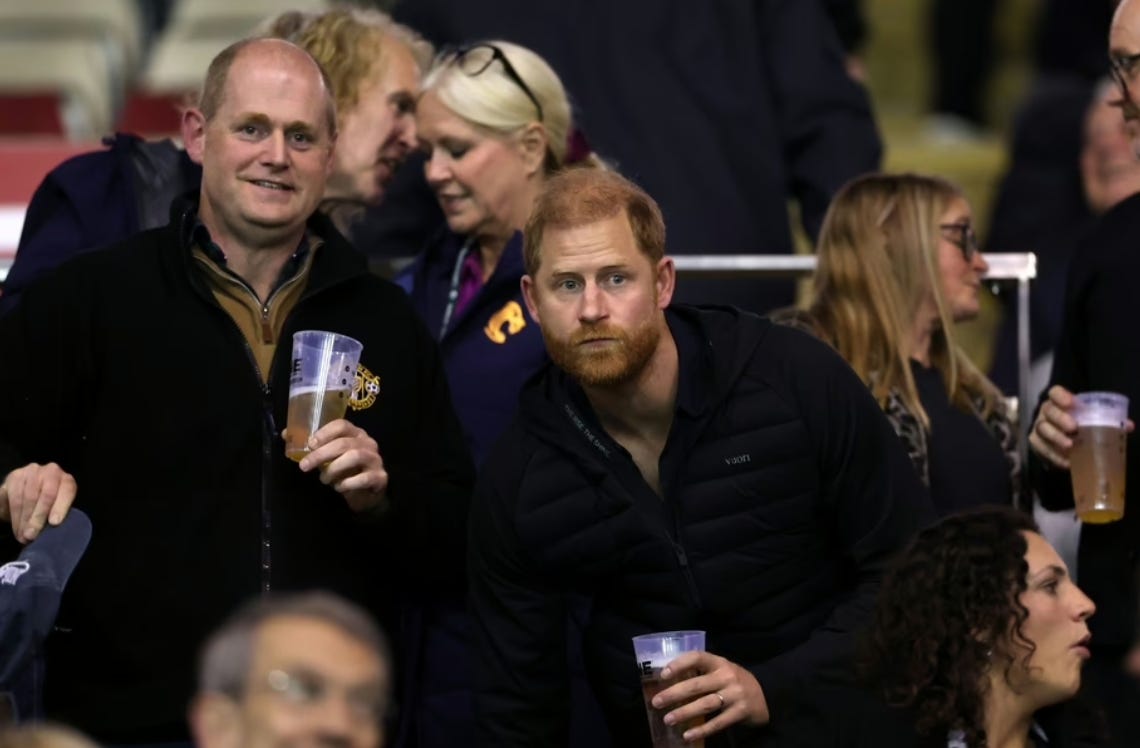
On Friday night, Harry went to Welford Road to watch Leicester Tigers play Gloucester. It was a private night out: a pint carefully positioned in his hand. Twenty-eight minutes in, his face went up on the big screen and the crowd booed. The boos were clearly audible on TNT Sports’ live broadcast. “Some boos there,” said the commentator Nick Mullins, who got back to the rugby as fast as he decently could. TNT’s live blog filed the moment under, “Indifferent reception for Prince Harry,” which is certainly one way of putting it, and noted that the pundits had tried to laugh it off by pretending the boos were for player turned commentator Ugo Monye.
That this happened at the rugby, Harry’s game, the sport he watched at Twickenham as a boy with his mother and whose governing body he was patron of until the role went back to the late Queen when he left royal life (it now belongs to Catherine, the Princess of Wales), will have been painful. The match was being played for the Slater Cup, named for Ed Slater, the former Leicester and Gloucester lock who has motor neuron disease. If any crowd in England was going to give Harry the benefit of the doubt, it was this one.
Boos are the stuff of royal nightmares. When the tabloids attack him, Harry can take them to court. When the Palace sends a chilly letter, he can blame the men in grey suits. The entire Sussex story depends on the idea that the press and the courtiers are the problem, and that the British people, deep down, are still on his side. The boos at Welford Road were the verdict of the people. This isn’t a media conspiracy. This isn’t the press. It mirrored a moment just under a year ago, when Harry and Meghan were booed at Dodger Stadium when their faces flashed up on the big screen. He has now been booed in the stands of his adopted home and in the stands of his real one.
Then there was the school trip. Last week one of the “public engagements” on the Duke’s media schedule, a visit to a school in Birmingham, ended with Harry being mocked by the pupils and told, on camera, to F off. These were annoyed kids who felt their space had been invaded, who had “six cameras” shoved in their faces so that the Duke could be seen doing good.
Their office then complained that photographers near the Sussex children’s school were dangerous and unacceptable, while raising no apparent objection to photographers at the pub in Great Tew or to Meghan posing with Malala outside Claridge’s. A lot of people simply do not feel any of this is authentic. Everything is staged for the cameras; everything is an obsession with how it will land. That is how the American tabloids do things, and it works there. It does not work here.
It is all of a piece with the six weeks since they arrived: the private jet; the push for taxpayer-funded security (which a Mail on Sunday poll found just 2 percent of the public supports); the children changing schools after two days; the professed surprise at the Lord Chamberlain’s letter.
And through it all, not a word of contrition.
That is the heart of it. Harry and Meghan went on Oprah and told the world that the royal family, one of the last institutions in Britain that people still revere, was racist, cruel and happy to lie; that the King and William were trapped; that silence was betrayal; that the family had got into bed with the devil. Nobody who saw it will forget Meghan’s curtsy on Netflix three months after the Queen died. The British people have formed a human chain around the institution, for all its faults, and their message is simple: by attacking the royal family, you are attacking us, and we do not forgive that.
Instead of an apology, the Sussexes are doubling down. Only this week a source close to the couple dismissed as “nonsense” a report that they were preparing to say sorry for the Oprah interview. Harry said as much himself to the Guardian last year. On Tuesday, Meghan put the King’s five-year-old granddaughter, seventh in line to the throne, in a commercial for jam.
Compare Friday in Belfast, where William and Catherine turned up unannounced and were cheered to the rafters.
Six years ago Harry held one of the best hands anybody has ever been dealt: a prince, a soldier, Diana’s son, a man who could fill a stadium with cheers. Today he is a man so widely disliked that he gets booed.
He still has a choice. He can apologize properly, publicly, ideally without a Netflix crew in the room and not for money, and a small but significant percentage of the country would, I believe, give him a second chance. If he will not, then the reception he got on Friday night is his future, as he and Meghan may find out on Thursday.