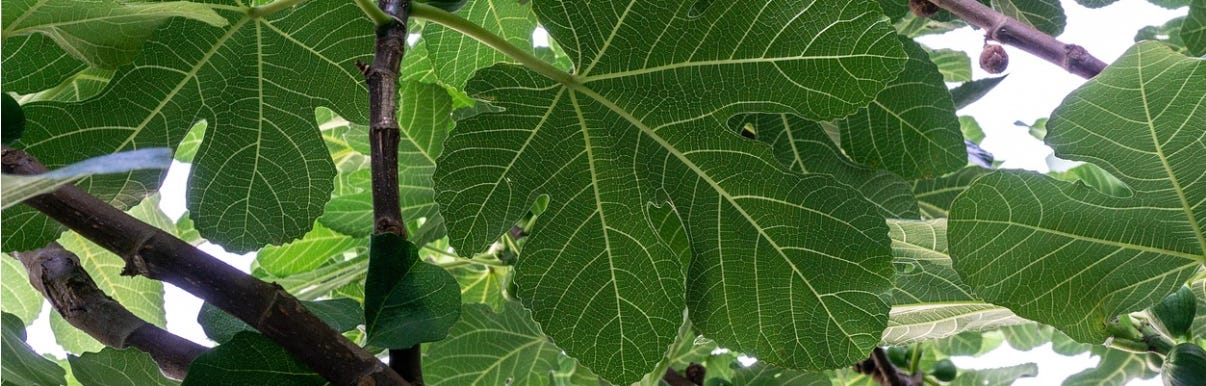
And seeing in the distance a fig tree in leaf, he went to see if he could find anything on it. When he came to it, he found nothing but leaves, for it was not the season for figs.— Mark 11:13
It is the week He will die. Jesus leaves Bethany in the morning, and somewhere on the two-mile walk to Jerusalem (John 11:18) He is hungry (Mark 11:12). Far off, a fig tree stands in full leaf. He goes to it. He reaches in. Nothing.
Then He says something we do not expect from Him. May no one ever eat fruit from you again (Mark 11:14). By the next morning the tree is dry to its roots (Mark 11:20). It is the one miracle in the Gospels where His word withers instead of heals.
Those who know the fig trees of that land tell us something helpful. In spring, small early figs appear around the time the leaves come. Poor eating, but a hungry traveler would take them. So a tree in full leaf is making an announcement. Come closer. There is something here.
This tree was advertising what it did not have.
Mark will not let us keep this as a story about a tree. Between the curse and the withering, he places Jesus in the temple, overturning tables (Mark 11:15-17), and most interpreters read the two scenes as one. The temple that week was magnificent. The disciples themselves gaped at its stones (Mark 13:1). Crowds, sacrifices, songs. All leaf. It was meant to be a house of prayer for all the nations (Mark 11:17), and when He came close, He found a market.
It would be easy to read this as their problem. But leaves grow wherever worship goes on. Ours included.
Still, Mark refuses to leave out the awkward detail: for it was not the season for figs (Mark 11:13).
I used to hear that as the tree’s defense. Now I hear it as mine.
His hunger that morning was real, but it was never only for food. At the well in Samaria the disciples brought Him lunch, and He told them, I have food to eat that you do not know about (John 4:32). His food, He said, was to do the will of the One who sent Him (John 4:34). That day the Father’s will had a face. A woman had just opened her life to Him, and He was no longer hungry. The Father is seeking people (John 4:23), and the Son walks the road looking for them. What He wants to find in us is love. And He comes when He comes. Hunger does not check our calendar.
We keep a calendar for Him too. After this project. When the children are older. When things settle down. We have told Him “not yet” more times than we can count, always very politely.
Someone else in the Gospels talks that way. When Jesus came ashore in the country of the Gadarenes, the demons cried out, Have you come here to torment us before the time? (Matthew 8:29). They knew exactly who He was. Their complaint was about His timing.
So how does anyone have fruit ready out of season?
Later that week, on the night before He died, Jesus answered that. I am the vine; you are the branches (John 15:5).
Put the two plants side by side. The fig tree is broad and handsome. Nathanael sat in its shade (John 1:48). Its leaves are large enough that the first man and woman reached for them to hide behind (Genesis 3:7). The vine is a thin, crooked thing that cannot even stand without support. Ezekiel asked whether anyone could make so much as a peg from its wood (Ezekiel 15:3). No one can. A vine has nothing to offer except what hangs on it.
One had everything to look at and nothing to eat. The other has nothing to look at and feeds a village.
By this my Father is glorified, that you bear much fruit and so prove to be my disciples. — John 15:8
In the very next breath He turns to love. Abide in my love (John 15:9). Love one another as I have loved you (John 15:12). That is what He was reaching for under those leaves. And a branch does not produce it by straining. It stays (John 15:4). Ezekiel saw trees that bore fresh fruit every month, and gave the reason: their water flowed from the sanctuary (Ezekiel 47:12). Fruit out of season is never about effort. It is about the source.
Leaves can be seen from the road. Fruit is found only by someone who comes close and reaches in. We can build a faith that looks right from a distance. Knowledge, service, the right vocabulary. He does not stay at a distance.
So the question is not whether we look alive. It is what He would find today, not on the day we have scheduled to be ready.
This is not a threat. The withered tree is not the last word about trees that week. By Friday He hung on one Himself, taking the curse that was ours (Galatians 3:13), so that barren branches could be joined to a living vine.
He is still coming up the road, hungry. It does not have to be the season.
© 2026 Bible Portal. Free to share with attribution. Please keep the source and a link to Bible Portal intact. For other uses, contact us.