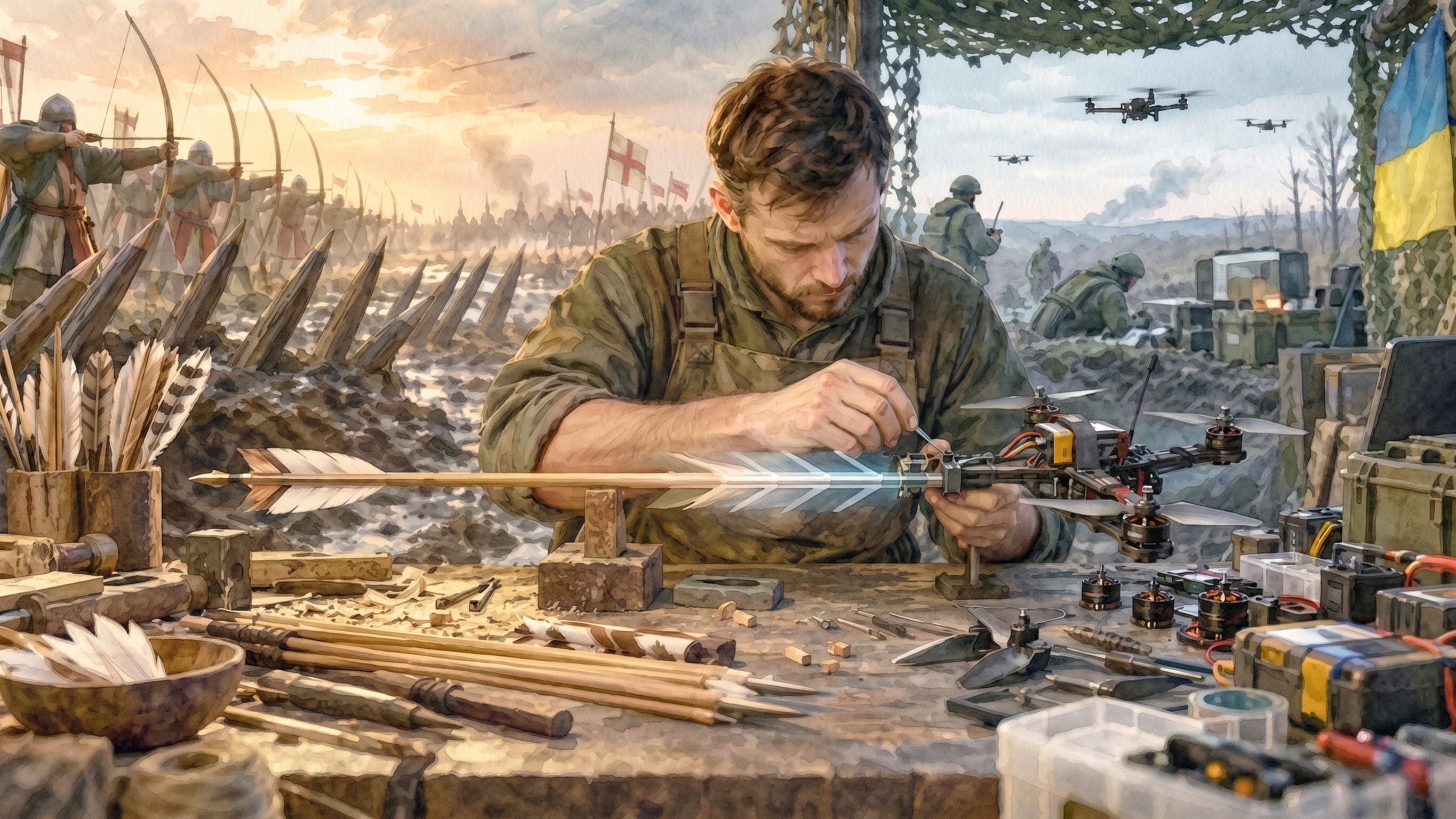
POGRADEC, ALBANIA—On the morning of 25 October 1415, near the castle of Azincourt in northern France, French men-at-arms walked toward the English line across a ploughed field that a night of rain had turned to mud. Their plate armour was among the most expensive military technology in Europe. The mud held them, and the English arrows found them. By afternoon, a tired, sick, and outnumbered English army had destroyed the glory of French chivalry.
The English weapon was the longbow. A trained archer could fire perhaps ten arrows a minute and strike at more than 200 yards, and a yew bow cost a tiny fraction of a knight’s armour.
The English victory at Agincourt did not come from the longbow alone, just as the answer to Russia and China today is not simply “drones.”
The longbow was not new. English archers had already won at Crécy and Poitiers with it two generations earlier, and the French still had no answer to it.
What was new was the system Henry built around the longbow. Archers made up most of his army, about five in six. And, as US Secretary of War Pete Hegseth noted at Quantico on 30 September, King Henry V kept his fletchers, the craftsmen who made and repaired the arrows, close to the archers.
**Henry also adapted to circumstances as they changed. **On the march, when he learned the French planned to ride down his archers with cavalry, he ordered every archer to cut a stake, sharpened at both ends, and plant it in front of him, angled toward the enemy so that charging horses would impale themselves. He also chose a narrow field between two woods, where the French could not use their numbers. Behind that hedge of stakes, the archers, with their cheap arrows produced close at hand, shot down the most expensive army in Christendom.
On Wednesday at Marine Corps Base Quantico, Pete Hegseth announced a new four-star Autonomous Warfare Command, due by October 2027, and an interim effort to build it called Project Agincourt.
“In 1415, many moons ago,” Hegseth said, “the outnumbered English army defeated a numerically superior French force in their legacy armour with a new technology—the longbow.”
But the victory did not come from the longbow alone, just as the answer to Russia and China today is not simply “drones.”
Hegseth treats Ukraine as an example to study, when Ukraine is the fletchers themselves.
The English, Hegseth said, “had to look outside their traditional recruitment pools to find skilled archers,” and “they integrated fletchers—the craftsmen who made and repaired the arrows for the longbows,” moving them “close to the front lines to sustain the rate of fire.”
A fletcher is an arrow-maker; the word comes from the French flèche, arrow. The royal records show how seriously Henry took them. In 1414 he appointed Nicholas Mynot, fletcher, as Keeper of the King’s Arrows in the Tower of London. In June 1415, as his army gathered, Henry ordered Mynot to find twelve more craftsmen and to take whatever timber, feathers, silk, and wax they needed.
That is the right lesson, and Ukraine has been living it for three years: build the weapons beside the people who use them.
Ukraine’s fletchers work in garages, basements, and field workshops, in regular contact with frontline-zone warriors and drone operators. They repair drones overnight, adjust their software within hours, and send what they learn back to the makers, who change the design within weeks. The invading Russians are trapped into the “mud” of Ukraine’s mil-tech iteration that is rapid and reliable because it is designed for and by the warfighters.
Hegseth knows there are lessons to learn from Ukraine. “Ukraine’s lesson is not that one type of drone wins wars,” he said at Quantico, “but rather the need for a purpose-built system that maximizes the ability to adapt.”
But Hegseth falls short, thinking that a “Ukraine vibe” is enough, and so he focused more on a battle from 1415 than today. He does not need to reach back six centuries. The lesson of Agincourt is being demonstrated right now, in Ukraine, and he knows it. He treats Ukraine as an example to study, when Ukraine is the fletchers themselves. The engineers, the workshop crews, and the drone operators who build, rebuild, adjust a weapon between missions are exactly the people America needs at its own front.
A purpose-built system only comes about when it is built with the people in the fight, and today those people are Ukrainians. You cannot copy and paste “Ukraine’s lesson” into the American procurement system without Ukrainians. At Agincourt, French confidence in their armour lost the day. Today, American confidence in its own famous contractors, including the more innovative ones, plays the same part.
Henry V made his arrow-makers part of the war. The question for Project Agincourt is whether America will do the same with Ukraine’s makers, or only borrow their vibes.
So far the record is mixed. In February, the Pentagon bought 2,000 Ukrainian drones, based on results in Hegseth’s Drone Dominance Program. In September, as Cédric Karlikowski of CELLULE 51 wrote for UFN yesterday, the same drone lost out on a far larger order, even though it is proven in combat every day. Ukraine grades a weapon by what it did. The West still grades it by who built it, and it prefers builders with American names and Silicon Valley fame.
On the same day he launched Project Agincourt, Hegseth named Elon Musk, Palmer Luckey of Anduril, and former US House Speaker Newt Gingrich to co-direct Project Meridian, a 120-day study of the technologies America will need for future wars.
Gingrich saw the Agincourt–Ukraine parallel early. In late May 2025, on Governor Gavin Newsom’s ▶podcast and days before Ukraine’s Operation Spiderweb, he compared Ukraine’s drone innovation to the English longbow at Agincourt, a moment that overturned how wars are fought. The comparison has travelled from a podcast to a Pentagon programme in about sixteen months.
This week I finished listening to *Shakespeare’s *** Henry V on the shore of Lake Ohrid, here in NATO-member Albania. Before the battle, in his St Crispin’s Day, or “Band of Brothers” speech, King Henry tells his men:
And gentlemen in England now abed
Shall think themselves accursed they were not here,
And hold their manhoods cheap whiles any speaks
That fought with us upon Saint Crispin’s day.
If Project Agincourt means what its name says, it will bring Ukraine’s fletchers to the front and center of American mil-tech innovation and production. Otherwise, the speech will need a new ending for Hegseth:
And gentlemen in Washington now abed
Who read the old lesson but forgot the modern men,
Shall hold their manhoods cheap whiles any speaks
That fought beside the fletchers of Kyiv.
*JP Lindsley, an American journalist based in Ukraine, is co-founder and editor-in-chief of UnderFire.News. *
Your subscription fuels our work.
**Ukraine’s FP-7 Ballistic Missile Makes Its Combat Debut—**Ukraine hasused Fire Point’s FP-7 tactical ballistic missile in combat for the first time, President Volodymyr Zelensky announced on October 1, releasing footage of a launch and identifying production as the next step. He praised the result without disclosing the target or location. Fire Point first presented its FP-7 and larger FP-9 programs in September 2025, followed by FP-7 flight tests in February 2026.
The weapon is designed to engage targets rapidly and launches from a rail mounted on a trailer, avoiding the specialized heavy truck launchers commonly associated with tactical ballistic missiles. Its development also feeds into Freyja, a project to build an interceptor capable of shooting down incoming ballistic missiles. That gives the underlying technology two intended roles, striking enemy targets and defending against similar weapons. Fire Point expects the interceptor’s comparatively low cost to offer an advantage over expensive American missiles used for ballistic missile defense.