“The ideal subject of totalitarian rule is not the convinced Nazi or the convinced Communist, but people for whom the distinction between fact and fiction... no longer exist.” Hannah Arendt
Close, they say, only counts in horseshoes and hand grenades. Washington has spent the summer proving it can lose at both.
Start with the grenades. They keep coming and the pins are all pulled. Saturday morning a 50% tariff went live on $20 billion of Canadian goods, invoked under Section 338 of the 1930 Tariff Act, a provision no president had touched in ninety-six years. The deal that died at midnight Friday would have CUT auto tariffs on Canada to 15% and steel to 25%. Instead: dead, over a refusal to ease duties on heavy trucks, including the ones Ford builds in Ontario. We are now tariffing our own largest auto producer’s supply chain ( !!) to punish a country that buys more American goods than any other. Ottawa retaliates dollar for dollar on September 8. Even the most reliably pro-tariff-skeptic editorial page in America called the original round the dumbest trade war in history and just published the sequel (
WSJ). Carney, for his part: ‘You’re at war when you get attacked. We got attacked.’ Three quarters of Canadians back him (Bloomberg). Ninety thousand Canadian jobs on the line, and a loonie at 1.3845 this morning. Grenade, thrown, at an ally of a century.South Korea got its grenade the same week, in the quieter form of a canceled amphibious landing exercise because the hardware is busy in the Persian Gulf, while Pyongyang lobbed ten actual missiles and dismissed the White House’s outreach unanswered. An alliance is a promise that the exercises will happen. Skip them, and the promise gets a question mark; Seoul noticed, and Samsung’s worst day in three weeks did not help the mood.
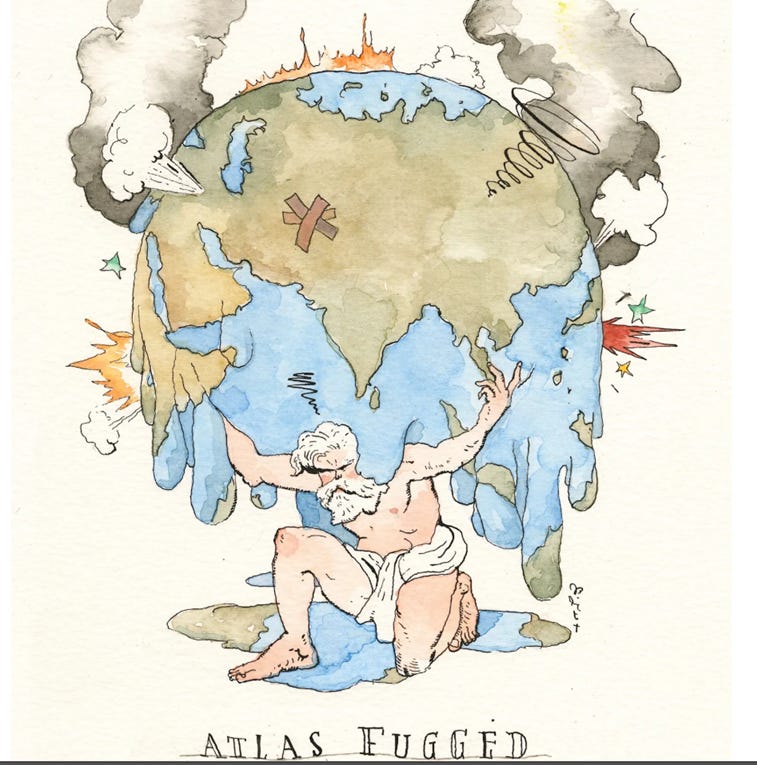
And notice WHEN the grenades fly. Each one lands just as the previous story turns uncomfortable. The Iran campaign ramped precisely as the Epstein files burned hottest. The ballroom got its rebrand the week the questions got specific: first it was built because ‘it would be nice,’ now it is a security necessity, except the Washington Post found the actual security necessity, a nuclear-hardened bunker sixty feet under the complex, finished under Obama, sleeps dozens for weeks (Washington Post). The $600 million ballroom is a tribute with a hard hat on. A leaked memo even has us lobbying against global plastic limits on national security grounds, fifty-seven million tons of it a year. Distraction is not a side
*effect of this administration’s foreign policy.*Distraction is the operating system, visible from space: 69% of Americans now tell Reuters/Ipsos the president’s personal business interests steer his decisions, a number Peggy Noonan spent her Saturday column mourning (WSJ).Now the horseshoes. Bend the political spectrum far enough and the ends touch. The DSA left and the MAGA right agree on more than either will admit: both want out of foreign entanglements, both have made anti-Israel politics a growth business (the socialists in the streets, the America Firsters in the group chats, London now drafting Israeli settlement sanctions while Republican senators shrug), both despise the institutions, and both have discovered a taste for state direction of capital. One end demands price controls and public ownership. The other end just had its Treasury Secretary buy back the government’s own bonds, instruct corporate CFOs which maturities to issue, and float a ‘Fed-Treasury accord.’ Call it socialism with American characteristics. Yes, Brookings counted the actual DSA footprint at well under 1% of Democratic nominations, so the horseshoe is louder than it is numerous. Volume moves policy anyway. The center holds the bag, and the bag has a number on it.
$40,067,864,994,925 as of the weekend print. Just under $20 trillion the day Obama walked out of the office in January 2017. Doubled, in nine and a half years, under both parties, which is the fiscal horseshoe: nobody ran on doing it and everybody did it. Publicly held debt is back at 100% of GDP, a level last seen when we were paying for a world war and demobilizing twelve million men.
Which is why the rest of this note is about the one institution that cannot be distracted, does not care whose grenade it was, and grades everyone on the same curve. The bond market watched the horseshoes land near the stake all week. It counts them as misses.
**The term premium regime got its confirmation: the two-year finally moved.**Up five basis points Friday to 4.24%, a ten-session high, joining the long end. Book stays short duration. Add at 10Y 4.80%.**New short: utilities, half unit.**XLU broke a three-year trendline and closed on its low at a decade-low ratio to the index. Bond proxy meets AI power capex, meets a 5.27% thirty-year.**Long index volatility is the week’s position.**Three binaries in five sessions: sanctions today, Nvidia and PCE Wednesday, Warsh Friday. VIX 15.99 pre-open against my 15.47 entry. Target 22.**Financials dispersion compressed for the first time, 511 basis points after 686.**Mean reversion in the beaten deal-flow cohorts, no regime change. Sleeve holds: brokers over regionals, exchanges over life.
Futures are soft into the heaviest catalyst week of the summer, Nasdaq contracts down twice the S&P’s decline, volume thin, and the volatility index up five and a half percent before the open.
Friday mattered more than it looked: the Dow rose 518 points while the entire Treasury curve sold off five basis points in parallel, and the two-year, frozen at 4.19% through four sessions of long-end drama, finally moved up to 4.24%. The front end has joined the term premium argument, meaning the market is now pricing in both hike risk and supply risk.
Today Bessent unveils the Iran isolation plan he calls an economic D-Day, with the rial at a record 2.02 million per dollar, Iranian crude exports near zero, 46 named ships threatened with confiscation in Hormuz, and Tehran promising that not a single drop leaves the Gulf if the economic war proceeds. Oil is lower this morning anyway, WTI near 85, because the tape wants to see the fine print before paying the premium again. Canada’s 50% tariffs went live Saturday and the counter-round lands September 8.
Wednesday brings core PCE, the payroll benchmark revision, and Nvidia after the close. Friday brings Warsh’s first Jackson Hole keynote as chair, into a bond market that has stopped believing tight-lipped is a strategy.
All last week I wrote about a front end that refused to have an opinion. Four sessions at 4.19%, through a nine basis point long-end rally, a nine basis point reversal, an off-cycle buyback doubling and a Treasury Secretary on television. Friday it spoke. 4.24%, a ten-session high, on a day the ten-year rose to 4.74% and the thirty-year to 5.27%.
Read what Friday’s shape says. Not a steepener. Not a flattener. A parallel shift higher, front end included, with 2s10s pinned at 50 and 2s30s at 103. A long-end-only selloff is a supply-and-term-premium story. A parallel one is that story PLUS a front end starting to price that the next move in the funds rate is up. The July minutes had several participants wanting a hike and many saying one would be needed if inflation stalls. Inflation is 3.4% and the war just repriced diesel. The market did the arithmetic Friday and charged both ends of the curve for it.
Why can nobody put the long end back down? The best explanation I read all week is structural and it comes with numbers (
FT Alphaville). Two decades ago, the official sector, foreign reserve managers plus the central bank held half the Treasury market and did not care what yields were. Today the split is 27/73 the other way. Marketable debt went from $4 trillion to $29 trillion and private investors absorbed $19 trillion of the increase. Demand, in the phrase that should be stapled to every terminal in the building, has become ‘*materially more valuation-sensitive.’*Price-insensitive buyers do not need a term premium. Price-sensitive ones bill for it, and the pre-crisis bill averaged 1.3 percentage points, roughly double the current level. Room to run, in the wrong direction.
And the single largest price-insensitive customer is not merely stepping back. The largest one has switched sides.
China’s Treasury holdings just hit an 18-year low, while its official gold reserves sit at a record high (
Tavi Costa). Costa’s caption for the month: two interventions to save the Treasury market, both failed, ‘America’s emerging-market moment.’ Strong words.The uncomfortable part is how ordinary the mechanics looked. A commentator in the FT put it dryly: concentrating issuance at the short end to relieve pressure at the long end resembles an emerging-market playbook, a band-aid that leaves the underlying fiscal problem untouched. When the Treasury of the United States starts managing its curve the way Ankara manages the lira, the comparison writes itself, and the ‘Treasury twist’ bought exactly one afternoon before the ten-year closed the week at 4.74%, its highest of the Bessent era.
The twist does have one quiet friend worth knowing about: stablecoins. Under last year’s crypto law, a dollar stablecoin must be backed by assets including bills inside 93 days, and each stablecoin dollar carries roughly 80 cents of bills against 8 cents per bank dollar (
WSJ). A $4 trillion stablecoin market, the bull case Bessent himself cites, could hold a quarter of all bills by 2030. Convenient. A Treasury shortening its issuance profile while sponsoring legislation that manufactures structural bill demand is running an integrated strategy, whatever it calls it. The catch sits in the same article: the stablecoin float has gone sideways since October. The demand is theoretical. The forty trillion is not.So Friday is Warsh’s stage, and the bar could not be lower or the stakes higher. Nearly 60% of surveyed economists think getting back to 2% takes longer than they thought in May, over 60% blame Fed credibility for part of the long-end move, and three-quarters call his communication blackout the biggest change he has made (
FT). One camp thinks he uses the speech to capitulate gracefully, acknowledge that 5.27% thirty-year yields are doing his tightening for him, and hint at balance-sheet mercy, the path that ends, eventually, in yield curve control wearing a technical-sounding acronym (Quoth the Raven). The other camp notes the hike chatter in his own minutes.My position does not require picking: a dovish Warsh into 3.4% inflation feeds the term premium through the credibility channel, a hawkish Warsh feeds it through the front end, and only the sequencing differs. The trade that loses is owning the long bond and hoping. Which, per the positioning data below, is exactly what almost nobody is doing, and crowded shorts are the one thing that keeps me at a half-size add rather than a full one.
Utilities. Look at Friday before reading a word of theory: the utility cohort fell 2.56% on one composite and 1.96% on the other while the Dow rose 518 points. Diversified utilities fell 4.28%. Regulated gas fell 3.04%. XLU closed at 42.77, DOWN 2.28%, on its low of the day, through the trendline that had held since the 2025 lows.
Three charts, one mechanism. A regulated utility is a bond with a rate case attached, and the thirty-year Treasury now pays 5.27% for the same duration with none of the wildfire liability.
On top of the bond-proxy problem sits the AI problem: the sector spent eighteen months being re-rated as the picks-and-shovels of the data center boom, and that trade is now being financed at sovereign-competitive rates while the politics turn. Data centers are suddenly a midterm attack ad in Texas, Ohio, Michigan, Wisconsin and Pennsylvania, with ‘why is my electric bill going up’ as the opening line (NYT).
The newest NIMBY, and the utility holds the bag in both directions: it pays term premium on the capex and eats the ratepayer backlash on the revenue.
HAVEN TEST this morning. Gold bid near 4,644. Bonds mildly bid, ten-year indicated near 4.71% from Friday’s 4.74%. Yen offered at 159.19. Dollar bid, 99 flat. Split verdict. Rotation, not panic, with the risk leg (Nasdaq futures off 0.6%) doing the de-risking work. And the shock test on oil answers itself: WTI down 2.3% to 85 and fading BEFORE a sanctions announcement is a market refusing to prepay the premium. It wants the fine print first.
The prime brokerage data from Friday deserves a longer look than it will get anywhere else, because the shape of it is odd.
Goldman’s prime desk clients net sold at 2.3 standard deviations, the fastest in two months, the fastest since Liberation Day week by one measure. Robinhood’s five-session net buying of single stocks ran at four-fifths of its all-time June pace. Fast money out, slow money in, at the same prices, in the same week. A horseshoe of its own: the two ends of the sophistication spectrum are absolutely certain, in opposite directions, while the middle (the vol-control and CTA complex) sits still and does nothing.
And the institutional short is not small.
Record net short NDX futures. Component short interest at a nine-year high. On positioning alone, the setup into Nvidia on Wednesday is symmetrical and violent: a beat squeezes a record futures short into a thin late-August tape; a miss lands on a retail cohort running at 80% throttle with no institutional bid underneath. Add the seasonal shape, which says we are in the post-earnings lull that has averaged a 0.5% drag with a 2.3% worst case, and the case for owning convexity rather than direction writes itself. My Idea 5 entry at VIX 15.47 is 52 cents onside before the first catalyst has even printed.
Four charts that belong together.
Spending below last year. Confidence on the floor. Half a million more home sellers than buyers, a record gap, which is what a 4.7% ten-year does to a 7-handle mortgage market. And diesel, the invisible tax, up 60% in six months, which loads cost into every truckload of food while corn futures sit at a three-year high on a smaller harvest. The Walmart print told us that ticket growth has already halved. Nothing in these four charts says recession tomorrow. All four say the pass-through window for corporate margins is closing, which is precisely the thesis of the ag-inputs-over-packaged-foods pair, and the reason it stays on at a full unit.
At 2 PM Bessent stands up with what he has marketed as the greatest financial offensive ever assembled against an adversary.
The market question is narrow: does it name China. Secondary sanctions with real teeth against Iranian oil’s remaining buyers would reprice crude, tanker rates and half the EM complex inside an hour. A list of shell company designations would reprice nothing. WTI at 85, down 2.3% this morning, says the tape leans toward nothing.The stranger truth is that the economic war is mostly already won, on the evidence. Iranian crude exports have ‘virtually stopped’ by Tehran’s own central banker’s admission. Only about 40 million barrels of Iranian oil still float east of Malaysia and just 4 million are unsold (Bloomberg). Sinopec’s chairman spent the weekend adding the other half of the ledger: China’s oil demand probably peaked last year, earlier than anyone modeled (Bloomberg). The rial printed 2.02 million per dollar this morning. Inflation runs above 80%. Hormuz transits are down to roughly 16 a day from 130 before the war, and Iran…