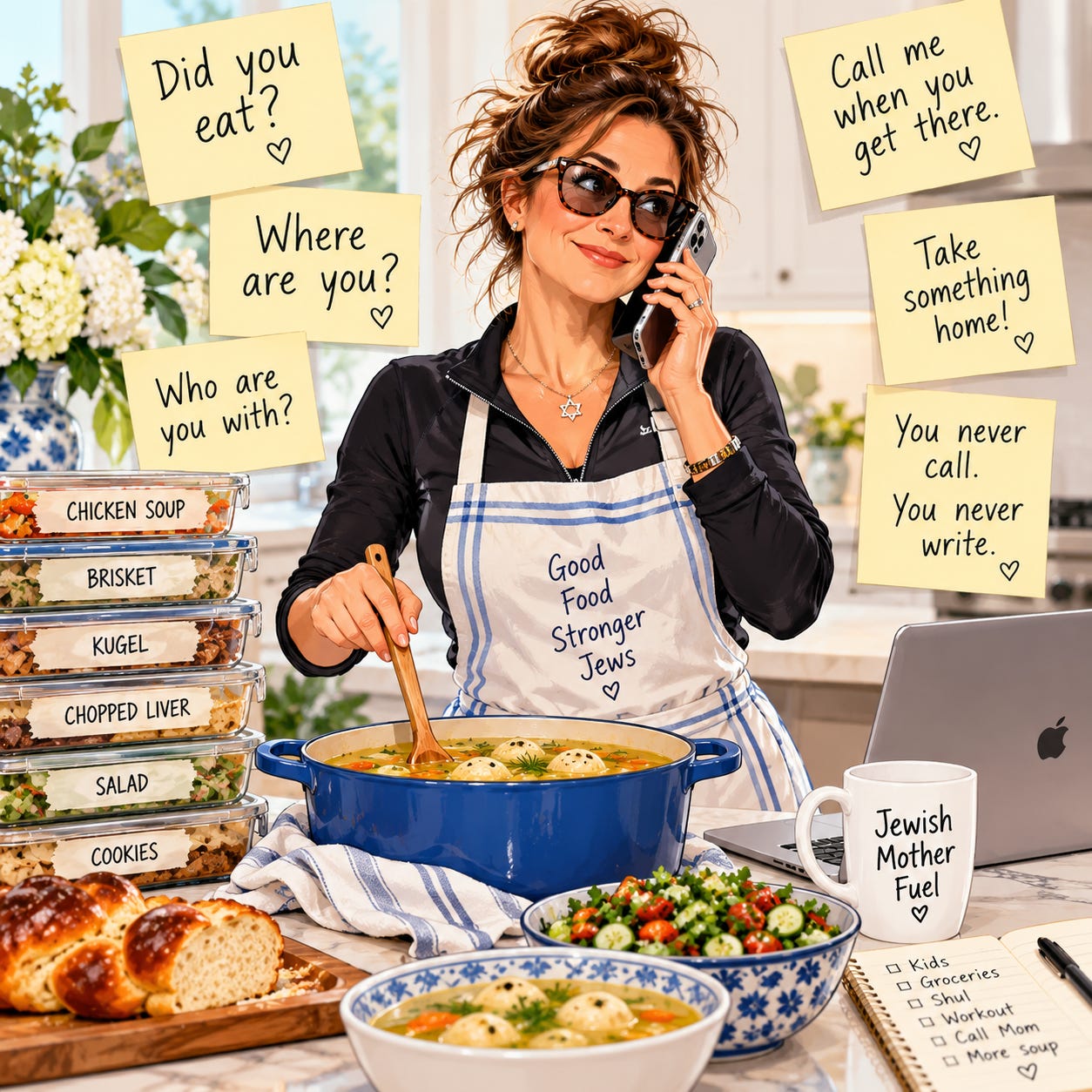
I’m a Jewish mother of five adult children, and I can tell you that “OMG, Mom, NO!” is practically a family catchphrase. I’ve heard it for offering unsolicited advice, asking questions nobody wanted me to ask, saying something embarrassingly blunt, and occasionally just being myself in public. Sometimes I haven’t even finished my sentence before somebody gives me that eye roll. You’d think after raising five children I’d have earned the right to speak without a committee reviewing my remarks, but the committee is still meeting.
My mother had a telephone attached to her ear. Sometimes, if I needed to find her, I’d follow the coiled cord from the kitchen to wherever she was in the house. It was a long cord. And it was in the old days, when phones were attached to the wall. She knew everything. Who was getting married, who was getting divorced, whose daughter was pregnant, whose son had become a doctor, and who had gained weight. And…when I skipped school. Especially when I skipped school. I’m convinced there’s something to those eyes in the back of the head.
And then there was Jewish geography. You could mention a Jewish person from anywhere in America, and my mother would begin an investigation. Where did they grow up? What’s their mother’s maiden name? Did they go to Mumford? Was their grandmother from Detroit? Within three minutes, she’d establish that their cousin’s former roommate had once dated someone whose parents knew my uncle. Which, in Jewish geography, meant we were practically related.
My mother didn’t need Google. She had cousins, best girlfriends, a telephone, and an excellent memory for other people’s business.
Somewhere along the way, Jewish mothers became one of America’s favorite comedy routines. We were portrayed as overprotective, opinionated, guilt-inducing women who believed food could solve almost anything and that our adult children still needed supervision. Jewish comedians made careers out of us, and television introduced the rest of America to the woman who could make her son feel guilty simply by saying, “No, no, I’m fine.”
How did we get from mothers who held immigrant families together to mothers who could ruin a grown man’s afternoon by asking whether he’d eaten lunch? The answer takes us from the tenements of New York to the Catskills, Broadway, bestselling novels, and a television mother who never met a meal or a prospective son-in-law she couldn’t inspect.
When Eastern European Jews arrived in American cities in the late nineteenth and early twentieth centuries, they brought their families, traditions, recipes, and an impressive ability to find somebody they knew in a city of several million people. They settled near relatives and people from their old hometowns, often in crowded neighborhoods where privacy was limited and everybody knew what everybody else was cooking.
Immigrants organized hometown associations called landsmanshaftn. These groups helped people find jobs, supported families during financial emergencies, and arranged burials. New York had thousands of them over the immigrant era. Imagine trying to keep track of all those hometown connections without a computer. My mother would have loved it.
Knowing people could mean finding work, borrowing money, or finding somewhere to live. If your cousin knew somebody whose brother-in-law was hiring, you wanted that information. Jewish geography was useful long before it became a game played at weddings while the bride and groom were trying to enjoy their dinner.
In 1902, the price of kosher meat on New York’s Lower East Side jumped from 12 to 18 cents a pound. Jewish housewives, including Fanny Levy and Sarah Edelson, helped organize a boycott. Thousands of women confronted butchers, blocked shops, and refused to buy meat. Some protesters smashed windows and destroyed meat, and police made arrests. By June, the price had fallen to 14 cents a pound.
These were immigrant women, many without voting rights, organizing an economic revolt because feeding their families had become too expensive. Imagine being the butcher who thought he could raise the price of brisket by 50 percent and nobody would notice. He’d clearly never met a Jewish mother.
The same women who knew everybody’s business also knew whose husband was out of work, which family had a sick child, and who might be able to help. Conversations took place in stairwells, markets, kitchens, and over fences. The neighborhood grapevine was part gossip, part employment agency, part emergency assistance program.
The immigrant Jewish mother worked, stretched a dollar, kept her family fed, and pushed her children toward opportunities she hadn’t had. Her children might have been embarrassed by her accent, but many also understood what she’d sacrificed for them.
Long before the Catskills comedians became famous, Jewish families were watching versions of themselves onstage. By the late nineteenth century, New York had a thriving Yiddish theater scene, with performers such as Boris Thomashefsky and Jacob Adler drawing immigrant audiences. The plays dealt with family conflicts, marriage, tradition, money, and the difficulties of raising children who were becoming American faster than their parents.
Imagine a mother who had crossed an ocean, worked to support her family, and spent years dreaming of a better life for her children. Now her daughter wanted to marry somebody her parents disapproved of, or her son wanted to abandon the family business. Audiences understood those arguments because they were having them at home. Sometimes the stories were tragic, sometimes sentimental, and sometimes funny enough to make an entire theater laugh.
Vaudeville offered another kind of entertainment. Performers delivered songs, sketches, jokes, and comic characters in short acts that could travel from one theater to another. Jewish entertainers worked in both Yiddish-language and English-language entertainment, bringing recognizable immigrant accents, family disputes, and generational tensions to increasingly diverse audiences.
The Jewish mother was already a familiar figure in these stories, although she hadn’t yet become the standardized comedy character Americans would recognize later. She could be stubborn, sentimental, interfering, or fiercely protective. Her children wanted independence, but she wanted to know why they were making such foolish decisions when she’d already explained everything to them.
In 1925, Sophie Tucker introduced audiences to My Yiddishe Momme, a sentimental song about a Jewish mother’s devotion. Tucker performed it in English and Yiddish, and audiences wept. People bought tickets to sit in a theater and cry about how wonderful their mothers were. Try getting five adult children to do that today. I’d settle for a group text with five responses.
Tucker was an interesting choice to deliver all this maternal sentiment. She was a bold, successful entertainer known as the Last of the Red Hot Mamas, and her stage persona was a long way from the modest, self-sacrificing mother in the song. Yet audiences adored both versions. They could laugh at Tucker’s bawdy jokes and cry when she sang about the mother waiting at home.
By 1929, another Jewish woman was turning motherhood into entertainment, although Gertrude Berg’s Molly Goldberg was much closer to the mothers audiences remembered.
Berg created The Goldbergs for radio, writing and starring in a program about a Jewish immigrant family in New York. Molly Goldberg was warm, nosy, opinionated, and constantly involved in her neighbors’ affairs. She leaned out her apartment window, exchanged news, offered advice, and generally kept track of everybody.
When the show moved to television in 1949, Americans could finally see the woman they’d been listening to for years. Molly was a busybody, but she was also clever, generous, and capable. People came to her because she knew things and could solve problems. Berg even won an Emmy for her performance.
Molly was funny because she was recognizable, and audiences loved her. She could meddle in somebody’s affairs and still be the smartest person in the room. My mother would have understood Molly perfectly, although she probably would have told her to stop leaning out the window and pick up the telephone.
By the middle of the twentieth century, Jewish families were moving from immigrant neighborhoods into the suburbs. Their children were going to college, entering professions, buying houses, and building lives their grandparents could hardly have imagined. Their mothers were delighted. They were also full of suggestions.
Meanwhile, the Catskills resorts were becoming one of the great training grounds for American comedians. Jewish families vacationed at hotels and bungalow colonies where entertainment was part of the experience. Comedians performed for audiences who shared many of the same family traditions, accents, expectations, and arguments.
A performer didn’t have to explain what a Jewish mother was. He could walk onto the stage, imitate a worried mother asking why her son hadn’t called, and the audience already knew the next six questions.
The resorts produced and hosted generations of entertainers, including comedians such as Jackie Mason, Joan Rivers, and Totie Fields. Jewish family life, marriage, money, social climbing, and the constant negotiations between parents and grown children supplied material that audiences recognized immediately.
Alan King was another comedian who came out of that world. Born in Brooklyn to Russian Jewish immigrant parents, King worked in the Catskills as a teenager and eventually became a familiar face on television, including The Ed Sullivan Show and The Tonight Show. His routines drew on everyday irritations, family life, and the peculiar difficulties of being Jewish in America.
One of King’s Jewish mother jokes was particularly savage: “What’s the difference between a Rottweiler and a Jewish mother? Eventually the Rottweiler lets go.”
That was the entire joke. No lengthy explanation, no elaborate setup. By the time King delivered the punchline, audiences knew exactly which mother he meant. The image of the woman who refused to loosen her grip on her children had become so familiar that a comparison with a guard dog could bring down the house.
Jackie Mason grew up in a rabbinical family and knew the world he was joking about. He later described his mother as a typical Jewish mother who fussed over her children and thought they could do no wrong. That combination of fierce devotion and constant interference was exactly what made the character so useful to comedians.
The mother-in-law became another favorite target. American comedians had been making mother-in-law jokes for generations, but Jewish family comedy added its own familiar arguments over marriage, money, food, and the proper way to raise children. A son could get married, move into his own home, and have children of his own, but his mother might still have an opinion about what was happening in his kitchen.
The mother-in-law jokes worked because marriage brought another adult into a family that already had somebody accustomed to being in charge. A mother who had spent years feeding and advising her son was now expected to watch somebody else do it. Naturally, she had suggestions. Possibly a few hundred of them.
And one of the richest subjects was matchmaking.
A Jewish mother’s favorite qualification in a prospective husband was that he was a doctor. It didn’t matter if he was a little nebbishy. He could have the personality of a damp dishrag. He could spend an entire dinner discussing his gallbladder patients while you silently prayed for dessert.
“But he’s a doccctooor!”
That settled everything. Your mother could overlook the questionable haircut, the complete absence of chemistry, and the fact that you’d rather spend the evening reorganizing your sock drawer. He had an M.D. after his name. What more could a girl want?
There was history behind the obsession. For Jewish immigrant families, education and professional success represented security and advancement. Becoming a doctor was a tremendous accomplishment, particularly for families whose earlier generations had faced restrictions on education and employment in Europe.
And marrying a doctor? Well, that meant your mother could tell everybody she knew. Which was a substantial number of people.
If his mother knew your mother’s cousin, the wedding practically planned itself. You might not even have met the man yet, but somebody was already discussing the guest list.
The Catskills comedians took these familiar family conversations and exaggerated them. A mother who worried became a mother who worried about everything. A mother who encouraged education became a woman who couldn’t imagine her daughter marrying anyone without a medical degree. A mother who wanted her children to visit became a master of guilt.
Picture the telephone call. “Ma, I’m going away for the weekend.” “With whom?” “Some friends.” “What friends?” “People you don’t know.” “Why don’t I know them?” By the time you hung up, you’d explained the entire weekend, named every person involved, and promised to call when you arrived. You were thirty-seven years old.
The Jewish mother was an especially useful comedy character because she could win an argument without making one. Her son could announce that he wasn’t coming for dinner, and she didn’t have to shout or threaten him. “No, no, go. Have a wonderful time. I’ll just put the food away.”
The audience knew exactly what that meant. So did the son. Somewhere, a brisket was being wrapped in aluminum foil with enough disappointment to last until Thursday.
These jokes were funny to Jewish audiences because they recognized their own families. But they also reflected something happening beyond the resort dining rooms. The children of immigrants were becoming more independent, more prosperous, and more comfortable in American society. Their parents’ accents, anxieties, and old-country expectations could become sources of embarrassment.
Some of those children became writers and comedians. They had grown up being told to study, work hard, and make something of themselves. They succeeded, found microphones, and began telling audiences how their mothers had driven them crazy.
The transformation became especially clear in 1964, when Dan Greenburg published How to Be a Jewish Mother. The bestselling book presented maternal guilt and manipulation as skills that could be learned. The joke had become so familiar that Greenburg could write an entire manual about it. Readers didn’t need to be introduced to the character. They already knew her.
By 1969, Philip Roth had taken the image into much darker territory with Portnoy’s Complaint. His fictional mother, Sophie Portnoy, was intrusive, controlling, and a major source of her son’s psychological torment. The Jewish mother had traveled quite a distance from Sophie Tucker’s beloved Yiddishe Momme.
In the space of a few decades, audiences had gone from crying over their mothers to laughing at them, and sometimes blaming them for everything.
Historian Joyce Antler examined this evolution in You Never Call! You Never Write!: A History of the Jewish Mother. As the children of immigrants became more Americanized and sought independence, popular culture increasingly portrayed maternal involvement as interference. The qualities that had helped families survive and succeed were recast as smothering, manipulative, and embarrassing.
And there was a particularly sharp irony in the jokes. These mothers had spent years insisting their children get an education, become successful, and build better lives. Once the children did, they started complaining that their mothers were too involved.
Then again, I have five adult children. I know how quickly a perfectly innocent question can turn into an accusation of conducting a federal…