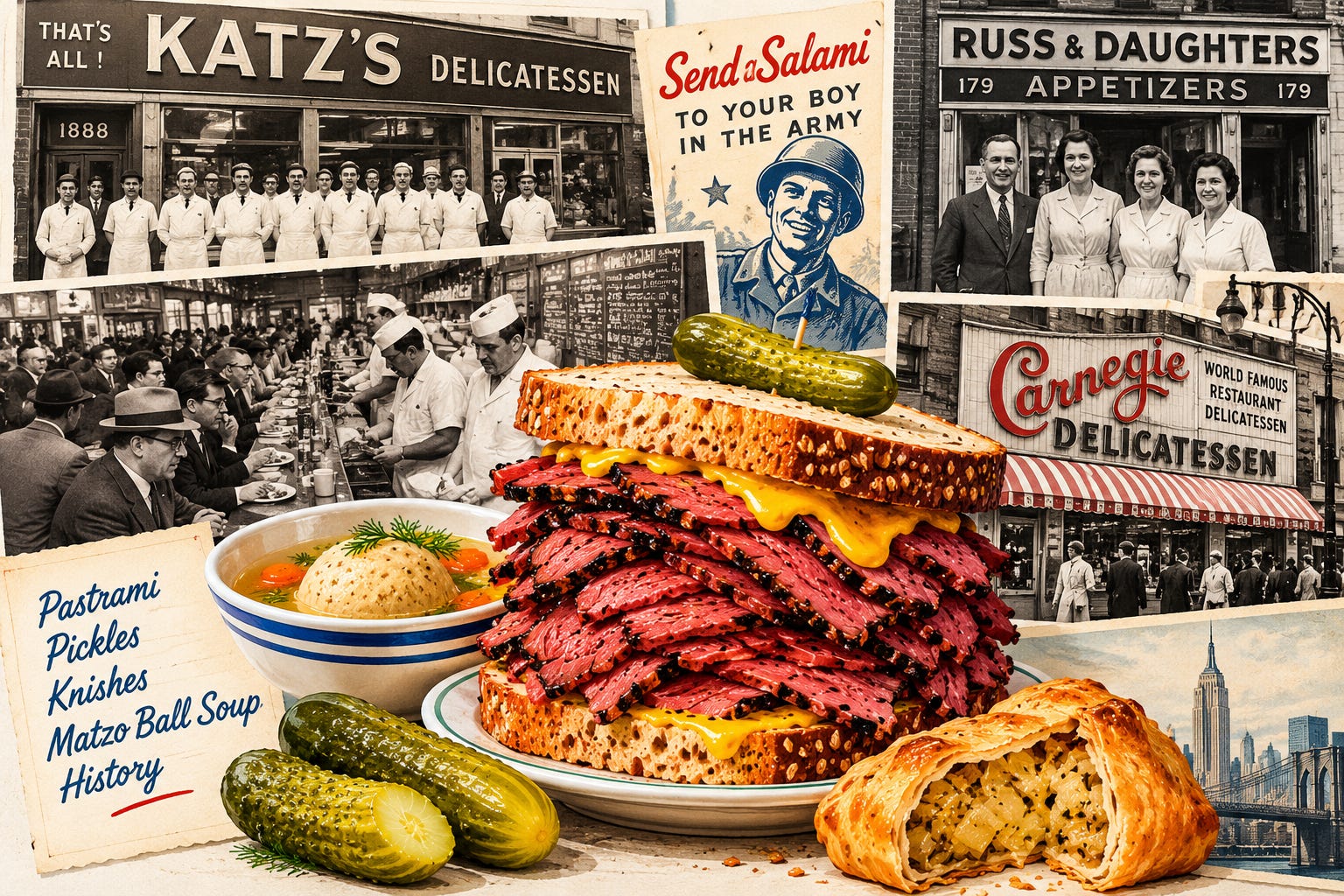
There’s something wonderful about a Jewish deli. You walk in hungry, somebody hands you a menu the size of a newspaper, and before you’ve decided what to order, the person at the next table is explaining why you’re making a mistake.
You want pastrami? Fine. But is it lean enough? Too lean? Are you getting mustard? Don’t even think about asking for mayonnaise. And whatever you order, somebody will “swear to gd” another deli makes it better. The sandwiches dropped in front of you are piled so high that eating one becomes an engineering problem.
I love everything about it. The rye bread, the mustard, the chopped liver, the knishes, and the matzo ball soup with a matzo ball the size of a toddler’s head. Even the arguments are part of the experience. Ask ten Jewish people where to find the best pastrami, and you’ll get eleven answers, along with a few opinions about places that closed forty years ago.
But the Jewish deli has a history that goes well beyond well-endowed sandwiches and waiters with attitudes. Its story begins with European immigrants who brought their food traditions to America, opened small businesses, and discovered that a place selling cured meat and pickles could become the center of an entire neighborhood.
The precariously towering pastrami sandwich we associate with Jewish immigrants wasn’t something their grandparents ate back in Eastern Europe. The American Jewish deli was largely created here, where families who had known poverty found themselves living in a country with more meat than they’d ever imagined.
The word delicatessen came from German, where it referred to specialty foods. German immigrants brought delicatessen businesses to America during the nineteenth century, selling prepared meats, sausages, cheeses, pickles, and other foods customers could take home.
Some German Jewish merchants operated kosher delicatessens before the great wave of Eastern European Jewish immigration began in the 1880s. When Yiddish-speaking immigrants arrived, they found businesses that offered a model for selling familiar foods in their new country.
The Lower East Side of Manhattan was crowded with immigrant families, tenements, pushcarts, butcher shops, bakeries, and small food stores. People from Poland, Russia, Romania, Hungary, and other parts of Europe lived within blocks of one another. They shared religious traditions, but their recipes weren’t always the same.
A Romanian Jewish family might have different ideas about preparing meat than a family from Lithuania. Hungarian immigrants brought their own sausages and seasonings. Polish Jews had their pickles, herring, and breads. New York brought these traditions together in a way that hadn’t existed in the old country.
Historian Ted Merwin, author of Pastrami on Rye: An Overstuffed History of the Jewish Deli, makes an important point about those early immigrants. Most hadn’t been eating ginormous meat sandwiches in Europe. Meat was expensive, eating out was uncommon, and many Jewish families lived on modest diets centered on bread, potatoes, vegetables, and whatever they could afford.
America had a much larger supply of beef, but that didn’t mean every immigrant family could afford it. In May 1902, Jewish women on New York’s Lower East Side decided they’d had enough of rising prices for kosher meat. Beef had gone from about 12 cents to 18 cents per pound, and families already struggling to pay rent couldn’t absorb another increase. The women blamed the meat wholesalers and organized a boycott.
On May 15, thousands of women took to the streets. They confronted butchers, overturned pushcarts, and threw meat into the streets. Police arrested protesters, but the women kept organizing. They went door to door, held meetings, and pressured neighbors not to buy meat until prices came down.
The boycott spread beyond the Lower East Side, and some rabbis and community leaders eventually supported the effort. The women formed committees, raised money, and kept the pressure on wholesalers and retailers. By June, prices had fallen enough for organizers to declare a victory, although the reductions didn’t settle every complaint about the meat trade.
These were immigrant women who were often responsible for stretching a family’s food budget. They knew exactly how much a pound of beef cost and what it meant when the price rose. Their protest became one of the best-known examples of Jewish immigrant women’s organizing in New York.
As more Jewish families found economic stability, meat became a more regular part of their diets. Jewish butchers and food merchants could also work with cuts of beef that had been luxuries for their parents and grandparents. Over time, the generous meat sandwich became one of the foods associated with the success of immigrant families in America.
Pastrami is an excellent example. Its roots go back to meat-preserving traditions in southeastern Europe, especially Romania, where Jewish cooks used salt and spices to preserve meats such as goose breast. In New York, beef became the preferred meat. Curing, seasoning, smoking, and steaming produced the pastrami that eventually became one of the city’s most recognizable foods.
Corned beef followed a somewhat different path. The method of preserving meat in salt brine had existed in Europe for centuries, and American Jewish delis made their own versions using beef. Pastrami developed its peppery, smoky flavor through additional seasoning and smoking, while corned beef was generally brined and cooked without that smoky finish.
Both became fixtures in rye-bread-inspired arguments about which was better, how thick the meat should be sliced, and whether anybody in their right mind would order it lean. Except for me, I ordered mine lean.
The bread…well, it mattered. Jewish rye, often flavored with caraway seeds, had a firm crust and enough substance to hold a sandwich piled with piping hot meat. Mustard added the sharpness, and pickles offered something sour and crunchy alongside all that mouth-watering richness.
The pickle had its own immigrant history. Eastern European Jews were accustomed to preserving vegetables in salt brine, and cucumbers fermented with garlic and dill became a staple of Jewish food shops. Full-sour and half-sour pickles developed loyal followings. A half-sour retains more of the cucumber’s fresh crunch, while a full-sour spends longer fermenting and develops a stronger flavor.
People can get very emotional about pickles. I’ve seen discussions about full sours that were more heated than family arguments over inheritance. And if you’ve ever watched two people argue over whether a pickle should crunch or practically collapse when you bite into it, you know what I mean. The main question…new or old dill? I’m not picky; I just love pickles.
Other familiar foods made their way into the deli as well. Knishes, stuffed with potatoes, kasha, or meat, provided inexpensive and filling meals. Chopped liver, prepared with onions and schmaltz, became a favorite appetizer. Chicken soup with matzo balls moved from the family table onto restaurant menus. And don’t even get me started on Mish Mosh soup… matzo balls, kreplach, rice, noodles… all of it thrown into the perfectly salted chicken soup. The best cure-all for whatever ails ya.
These foods had different histories, and some had traveled across several countries before reaching America. The Jewish deli brought them together under one roof, where customers could order a little of everything and take the leftovers home.
There was also an important difference between a kosher deli and a kosher-style deli. Traditional Jewish dietary law prohibits pork and the mixing of meat and dairy, and kosher meat has to meet specific preparation requirements. A certified kosher meat deli follows those rules. A kosher-style restaurant may serve familiar Jewish dishes without observing all the dietary laws.
That’s why the famous Reuben sandwich, with corned beef and Swiss cheese, presents a problem for anyone calling it traditional kosher food. It may be associated with deli culture, but meat and cheese together don’t belong on a kosher menu.
The Reuben’s origins are disputed, with competing stories from New York and Omaha. One credits Reuben Kulakofsky, a grocer who supposedly helped create the sandwich during poker games at Omaha’s Blackstone Hotel in the 1920s. Another credits Arnold Reuben, the German-Jewish restaurateur behind Reuben’s Restaurant in New York. Neither story has settled the argument, and the sandwich became an American favorite regardless of which account people believe.
There’s something totally fitting about a sandwich associated with Jewish delis having two competing origin stories, each defended by people who are certain they know what happened. Even the sandwich’s history comes with an argument.
Katz’s Delicatessen goes back to 1888 on New York’s Lower East Side. Its early history includes the Iceland brothers, Willy and Benny Katz, and Harry Tarowsky, who became a partner in 1917. Some details of the earliest ownership timeline have been disputed, but the restaurant’s place in Lower East Side history is unmistakable.
The business eventually became Katz’s Delicatessen, and its history followed the changes taking place around it. The shop moved across the street to its present location during subway construction, and the familiar Houston Street storefront developed over the following decades.
Katz’s served a neighborhood filled with immigrant families, workers, shopkeepers, and people who wanted a good meal without cooking it themselves. Its countermen sliced meat, customers found tables, and the restaurant became a place to meet people and exchange news.
The Lower East Side was also home to a thriving Yiddish theater district. Actors, musicians, and comedians performed for audiences who understood their language and recognized the immigrant family stories being told onstage. Restaurants in the neighborhood became places where performers and customers could meet after a show.
Another Lower East Side institution began with a barrel of herring. Joel Russ arrived from Eastern Europe and began selling herring from a pushcart in 1907. He opened a shop on Orchard Street in 1914 and moved to East Houston Street in 1920. His business specialized in smoked fish, herring, and the foods Jewish families served at breakfast, brunch, and holiday gatherings.
Russ had three daughters, Hattie, Ida, and Anne, who became partners in the business. In 1933 he renamed the store Russ & Daughters.
That name was a little piece of history all by itself. At a time when family businesses routinely put “& Sons” on their signs, Joel Russ put his daughters’ names into the identity of the store. They helped build a business that has continued through generations of the same family.
Russ & Daughters is an appetizing store, a particular kind of Jewish food shop that specializes in smoked fish, herring, and foods such as cream cheese. In neighborhoods where customers kept kosher, appetizing stores operated separately from meat delicatessens.
For customers keeping kosher, that separation made perfect sense. You went to one shop for pastrami and corned beef and another for smoked salmon, herring, and cream cheese. Bagels and lox belonged to this appetizing-store tradition, though both types of shop became part of the same neighborhood food culture.
Women were essential to these family food businesses, even when their names weren’t on the signs. They worked behind counters, prepared food, handled customers and accounts, and kept shops operating while raising families. The records often spotlight male founders, but a family store could depend on the work of a wife, daughters, sisters, and other relatives just as much as on the person whose name appeared over the door.
The Russ daughters were unusually visible because their father put them on the sign. They weren’t simply decorative names: they worked in the store and helped carry it into the next generation. The same immigrant neighborhoods that produced the women who organized the 1902 meat boycott also produced women who understood exactly what it took to buy, prepare, and sell food for a living.
By the 1920s, Jewish delis were becoming more than places to buy food. The children of immigrants were entering professions, earning better wages, and enjoying opportunities their parents hadn’t had. They could afford to eat in restaurants, meet friends after work, and take someone out for a good meal.
Merwin argues that the Jewish deli reached its cultural peak during the years between the world wars. The immigrants had built the businesses, but their American-born children helped turn them into social institutions.
Theater-district restaurants became especially important. Lindy’s, which opened in 1921, attracted entertainers, Broadway audiences, and people who wanted to be near the excitement of New York show business.
Al Jolson was one of the famous performers associated with the city’s deli culture. After a performance, the opportunity to eat in the same restaurant as a Broadway star gave ordinary customers a little taste of celebrity life. These places became gathering spots where Jewish Americans could enjoy their success and feel comfortable in their surroundings.
The deli also offered something valuable during a period when antisemitism was widespread. The 1920s brought immigration restrictions, discrimination, and public attacks on Jews. Inside a Jewish deli, customers could speak freely, enjoy familiar food, and spend time with people who understood their background. Jews encountered barriers in housing, jobs, hotels, and private clubs, so a neighborhood business where they were welcome had a value that went well beyond lunch.
The delis welcomed non-Jewish customers too, but their menus, languages, and regulars reflected the communities around them. Someone might hear Yiddish at the next table, run into a relative from synagogue, or learn who had gotten married before the family had even announced it. Friends met, business contacts were made, and arguments about politics could outlast the meal. For American-born children of immigrants, the deli offered a familiar place even as their lives became very different from those of their parents.
By 1931, New York City had more than 1,500 kosher delicatessens, according to historical figures discussed in Merwin’s work. That number tells us how important these businesses had become to Jewish life. They weren’t all famous restaurants with celebrity customers. Many were small neighborhood establishments serving families who lived nearby.
And the deli was spreading beyond Manhattan. Jewish communities in Brooklyn, the Bronx, Queens, and cities across the country developed their own delicatessens. Chicago, Detroit, Cleveland, Philadelphia, Los Angeles, and other cities had Jewish families who wanted the same foods and gathering places they’d known in New York or remembered from their parents’ kitchens.
In 1937, two more famous New York delis opened near Broadway. Carnegie Deli was founded by Izzie and Ida Orgel, while Max Asnas opened the Stage Deli. The two restaurants eventually became fierce competitors, famous for their enormous sandwiches and their connections to theater and entertainment.
Carnegie Deli developed a reputation for portions that seemed designed to defeat the customer. Pastrami and corned beef were piled high, cheesecake came in generous slices, and photographs of famous customers covered the walls.
The Stage Deli had its own celebrity following. Performers, theatergoers, and tourists crowded into both establishments, and the rivalry became part of New York restaurant folklore.
There were people who would argue about Carnegie versus Stage with the seriousness saved for Yankees versus Mets. The fact that both restaurants served sandwiches larger than most people could comfortably eat without unbu…