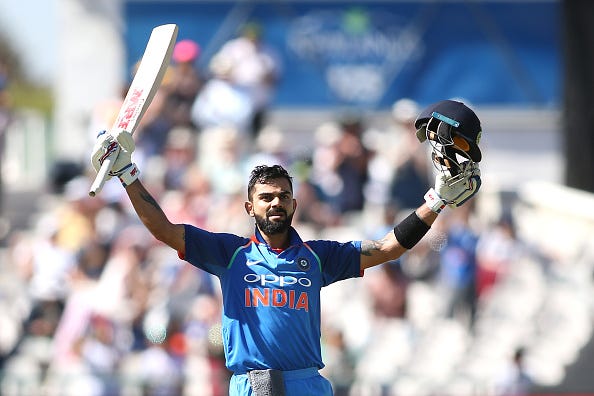
Sometimes, athletes deliver a season or a year that makes you look at the sport’s historical thresholds and wonder whether anyone else has ever done better. Shubman Gill in ODIs this year has reached a level that makes you glimpse across eras, reach for the record books, and search for an individual performance of this calibre in a single year. He has scored 895 runs in 11 ODI innings in 2026 at an average of 99.44 and a strike rate of 118.70. Gill has notched up three hundreds and five fifties in the process.
When we talk about ODI cricket and the top performances, the discussion is incomplete without mentioning Virat Kohli. Gill’s 2026 has certainly forced us to at least think if he has reached the peak Kohli attained in 2018. That year, Kohli scored 1,202 runs in 14 innings at an average of 133.56 with six hundreds and three fifties, while scoring at a strike rate of 102.56. If we consider averages alone, the gap looks enormous, but a deeper dive into the numbers tells a whole different story.
The average offers a false idea of a player’s consistency, as it excludes innings in which the batter has remained unbeaten. A better metric could be runs per innings. Gill has scored 81.36 runs per innings in 2026, while Kohli in 2018 scored 85.86 runs per innings. It looks a lot closer now than what that 34-run difference in average suggested.
The reason Kohli’s average orbits is also the reason 2018 was so special for him. In five of his 14 innings that year, Kohli remained not out. Three of these five innings were in a century-scoring cause. In 2018, whenever Kohli got an innings, he more or less ensured he played an impactful role and finished the job for his team. In 2026, Gill has remained unbeaten only twice in 11 innings.
Gill’s way is very different
Gill has maintained a strike rate of 118.70 in 2026. In 2018, Kohli’s read 102.56. The obvious difference is the speed at which Gill is scoring runs. Debates around a different era and how the game has changed will arise, but this is just a statistical comparison showing how the two have gone about their business in their respective years. Shubman Gill has scored 568 of his 895 runs in boundaries, which amounts to 63.5 percent. Kohli has always been the percentage cricketer at his peak; it was never only about boundaries for him. His best ODI knocks are all about how he rotated the strike before switching gears, and it’s evident from the fact that he scored 47.4 per cent of his runs in boundaries in 2018. Also, Gill is hitting sixes nearly twice at Kohli’s rate.
This further suggests that these are not actually identical batting peaks. Kohli’s 2018 was about manoeuvring, manipulation and playing with the opposition. Gill’s peak has been more aggressive, and he has come down harder at the bowlers.
A number suggests that Gill has been more consistent than Kohli. He has scored fifty in eight of his 11 innings. That means if he bats in 100 innings in 2026, there is a chance that he will score a fifty in 72 of them. Meanwhile, in 2018, Kohli had nine fifty-plus scores in 14 innings, which is around 64 in every hundred innings. Hence, Gill has actually been more regular in getting himself into a substantial knock. However, when it comes to conversion, Kohli’s 2018 season proves why many consider it one of the greatest individual seasons in ODI history. Three of Gill’s eight fifty-plus scores have been converted to a century in 2026; that is a conversion rate of 37.5. Kohli converted six of his nine fifty-plus scores into centuries, a conversion rate of 66.7 per cent.
Another big difference between these two performances is the geography. Gill’s major performances this year have come at home. He has scored 238 runs against Afghanistan and 334 against the West Indies, with both series played in India. Notably, Gill is yet to score an away ODI hundred in 2026. Kohli’s 2018 had no such gaps. While touring South Africa in that year, he scored 558 runs in six innings at an average of 186 with three centuries. He led the team from the front as India won the series 5-1. Kohli scored 749 runs at an average of 124.83 in away ODIs in 2018.
There is one inning that even Kohli’s 2018 could not match in sheer force. Gill’s 223 not out against the West Indies. It came in a record chase of 406 runs, and he scored them in just 133 balls. In fact, Gill’s 2026 feels like a modernised peak in ODIs. It has aggression, an abundance of boundaries, and the proper use of the conditions available in an evolving format. However, when we consider the whole year, Kohli’s 2018 is still unmatched. Be it the geography, the quality of attacks or the batsmanship that Kohli showed in that year, Gill’s 2026 is yet to reach that level.