As I do with so many of my posts I write from inspiration provided by a fellow Substack writer, this one is no different. Thanks to for commenting on my response:
It is rare indeed that I receive such a challenging response to my work — thank you for reading so carefully and for taking the time.
I see the question of whether light travels or not as being answered by geometry. In classical intuition, light is a tiny projectile launched across an empty stage. But c is not simply the speed of a traveler rushing through a container. It is a structural constant of the geometry of spacetime itself, and light moves according to the shape of it. The difficulty then is in understanding the geometry of spacetime. No small feat!
If you are unfamiliar with my books, the theories have been carefully carved out of many observations in physics, biophysics and mathematics. I consider that we have already emerged from the binds of pure Newtonian physics and work now as theorists in the Quantum Paradigm.
In the chapter The Architecture and Capacity of Light, I note that the constancy of c is the backbone of relativity, and that since 1983 the meter has been defined by the distance light travels in a fixed fraction of a second. We no longer measure light with the world, we measure the world with light. Along the path light takes, no proper time passes, and light has no rest frame of its own. Light traces the edges of spacetime’s causal structure: the light cone itself.
In my theories, force and motion are governed by geometry. Seen as geometry, propagation needs no mechanical “pushing.”
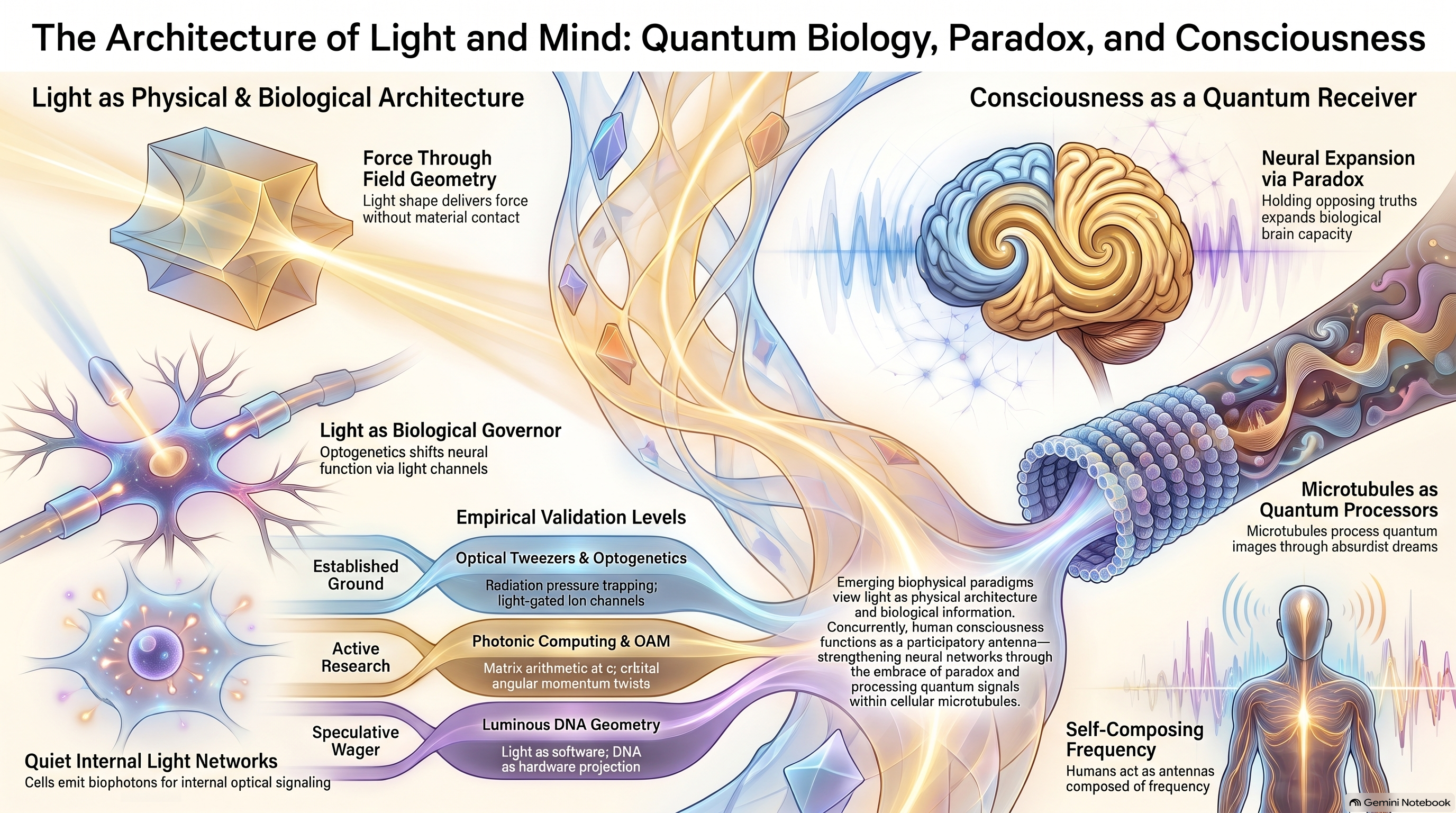
I ground this principle in Arthur Ashkin’s optical tweezers. In the laboratory, a focused laser beam holds and moves a particle with no contact and no tether. The trapping force comes from the shape and gradient of the field. What directs the particle is a pure relation between the particle and the field’s geometry.
Scale that principle up to general relativity, and matter and energy do not “push” on light across empty space. Energy and momentum shape the Riemannian geometry of spacetime, and light simply follows the paths that curvature carves, the null geodesics.
The chapter’s line “light is the software” was a wager, not my view. I don’t see light as any sort of software. I have written elsewhere, in The Topology of Light, of light as a braided multidimensional geometry which unfolds.
Our senses train us to think in flat, static Euclidean boxes.
In From Gaia to Geometry, I trace how human measurement grew from surveying the Earth into Riemann’s geometry — a mathematics that carries human reach past its limits, across gravity, fluids, topology and primes.
In this geometry, space and time are not a passive background but an active, folded manifold.
Geometry is relational. It lets us see light as it appears in the spacetime relationship. Information and paths live in the relations among points and fields, not inside isolated substances.
We humans cannot function in spacetime as disinterested observers, because we are embedded in it. We cannot step outside the manifold to look at its shape; our instruments and our biology are made within the very geometry we are trying to map.
So, understanding spacetime geometry means holding a foundational paradox: the geometry of spacetime sets the paths of light, and light is also the yardstick that reveals and defines that geometry.
I have written many books which touch on these subjects. A lifetime’s work crafted into a few of the past years.
My main website, with list of books: https://theparallaxidentity.com/books