I’m not a psychologist. There’s never been any kind of “ologist” at the end of my job title. But the internet lets us learn about whatever interests us, whenever we want. When the reading gets dense, AI can help translate it into plain English and give us the CliffsNotes. We still have to check the sources, but access to that much knowledge is a beautiful thing.
So…I started with this intensely burning question. Don’t ask… this is the kind of stuff I think about when I’m trying to fall asleep at night. So obviously, I never sleep.
Anyhoo…
How come some of us seem immune to propaganda while others fall madly in love with it? I’m talking about the professors, student activists, and political allies who responded to October 7 by celebrating the attack, blaming Israel for it, or defending the people doing both, and attacking Jews…erm, Zionists along the way.
You know how zombie movies always have someone with a mysterious immunity to the virus? Everyone around them is infected, and they’re still walking around wondering what the hell happened and why they’re still there. That’s how it feels to watch an educated adult explain why Hamas terrorists killing civilians belongs in a story about liberation. Except nobody’s chasing us down for blood samples to develop a cure. They all seem perfectly happy living in harmony with their mind virus.
I know seeing through one lie doesn’t protect me from every other lie. But I want to understand why the same propaganda meets resistance in one person and finds a willing audience in another, especially when that audience has built its identity around tolerance and opposition to hatred of any kind.
On October 8, 2023 Columbia professor Joseph Massad published an essay in The Electronic Intifada about the Hamas-led attack. He described the scenes of fighters breaking through the Gaza barrier and crossing by air as “awesome.” He also counted Israelis losing confidence in their military’s ability to protect them as an achievement.
Massad knew people had been killed. He acknowledged the deaths in Israel and described the human toll on all sides as horrifying, then placed those deaths inside a story celebrating Palestinian liberation. Israelis fleeing their homes became colonists discovering they’d never be safe there. The attack’s success remained something to admire.
At Harvard, the Undergraduate Palestine Solidarity Committee wrote a statement initially endorsed by 33 other student organizations. It held Israel entirely responsible for the unfolding violence. The committee later said it opposed attacks on civilians, but it had already told readers who deserved all the blame: the country Hamas had attacked.
A Columbia professor and 34 Harvard student organizations gave readers plenty of reasons to assume these arguments deserved respect. There were credentials, institutional names, and a coalition of students presenting itself as committed to justice. Attached to all of that was an explanation that relieved the attackers of responsibility for their own decisions.
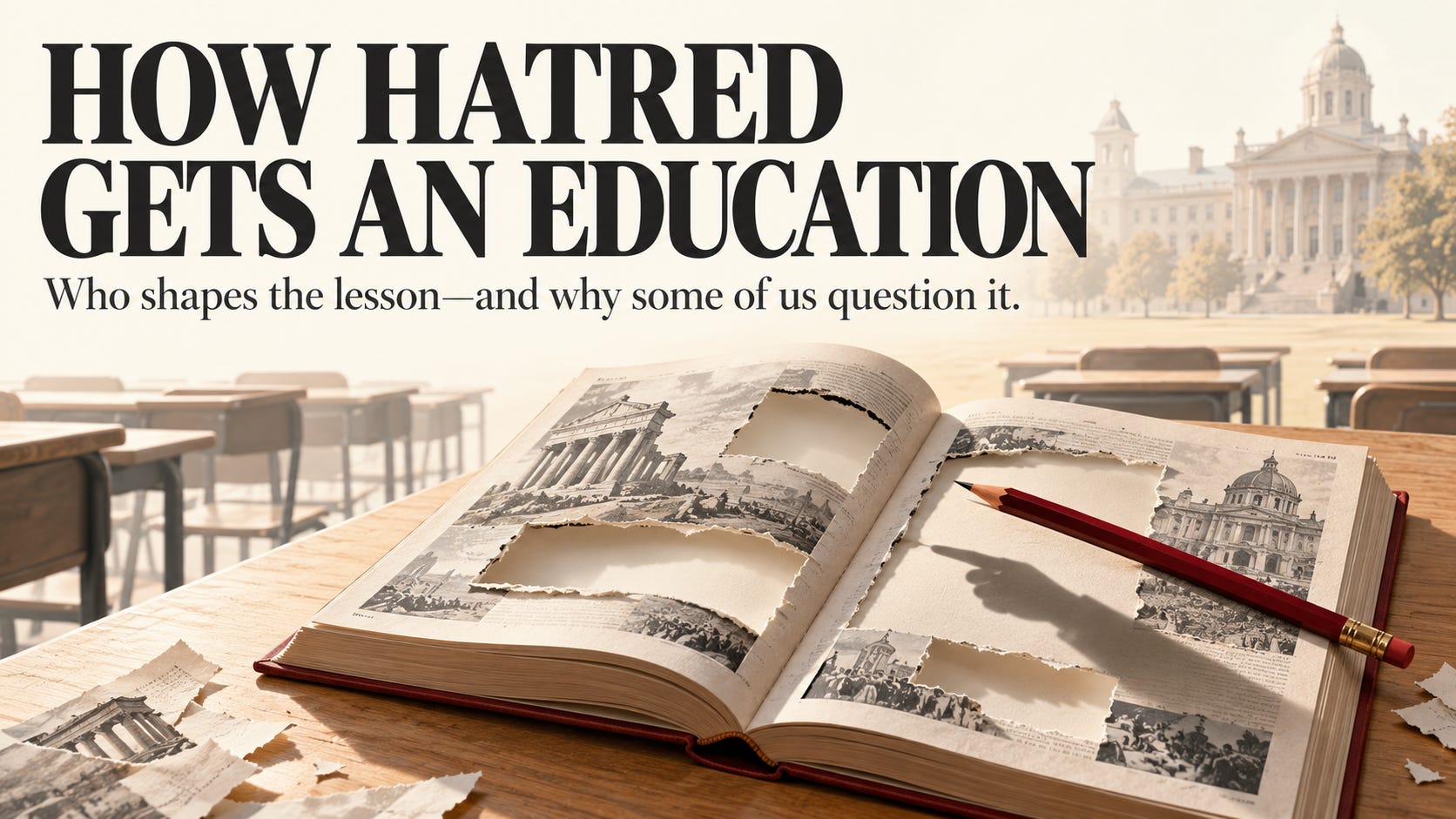
We recognize propaganda when it comes from an account we already distrust. We’re less prepared for it in a teacher’s resource guide or a university classroom, where someone we’ve been taught to respect is explaining what happened. By the time we hear the argument, the school has already helped make it credible.
Qatar has poured money into American higher education. The Education Department’s disclosures for 2025 alone identified more than $1.1 billion in reportable gifts and contracts from Qatari sources. What did those agreements require? What restrictions came with them, and what did the universities promise in return? Students and the public deserve to see those terms. The dollar amounts tell us who accepted the money; the contracts and the universities’ decisions tell us what the donors got.
CAIR’s efforts to influence schools are described in its own announcements. In September 2026 CAIR-New Jersey said it had emailed an educator’s guide to 2,400 teachers and school administrators. Along with religious practices and accommodations, the guide addressed curriculum issues and included a unit on teaching September 11.
Here in Florida, CAIR circulated an October 7 resource that directed teachers toward an account of history built around settler colonialism and apartheid. It also reproduced guidance from Teaching While Muslim presenting “occupation, apartheid, genocide” as examples of accurate classroom language. Before students had examined the evidence, teachers were being handed the conclusions they were supposed to use.
The George Washington University Program on Extremism examined CAIR’s education campaign in an October 2026 report. Its researchers documented educator guides, parent templates, district outreach, legal advocacy, and efforts to influence state policy. They found uneven results, along with access to education officials and the processes used to develop curriculum. Sending out a guide isn’t the same as getting it adopted, and the report doesn’t establish that every school contacted used the material.
But some of us hear a lesson and immediately feel that something’s missing. Why does this history start here? Where are the sources for that claim? Why are we getting so much about accusations against Israel and so little about Jewish history? Those questions don’t disappear because the person at the front of the room has a teaching credential.
A lesson about 1948 has to include Jewish history, Palestinian displacement, partition, and the Arab armies that invaded the new state. A lesson about October 7 has to account for what Hamas terrorists chose to do. “Inclusive” on the cover doesn’t make up for what’s missing inside.
Two students can sit through the same lesson and leave with different reactions. One trusts that the teacher has given them a fair account. The other notices that every source leads to the same verdict and wants to know what was left out.