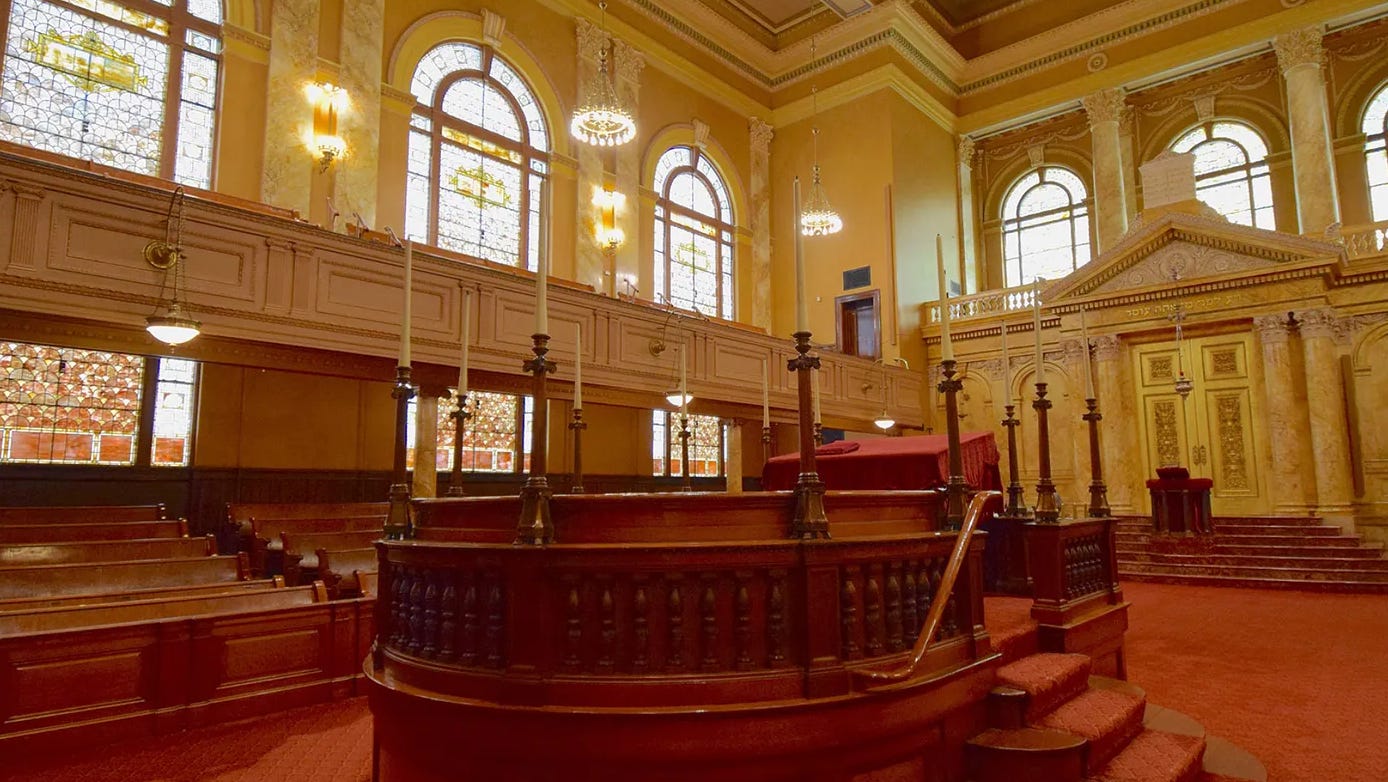
I spent the weekend in New York City, at a conference on Jewish-Christian relations, sponsored by Tikvah, a Jewish philanthropic organization. The conference itself was on Sunday, but I was invited to come up early to experience Shabbat (Sabbath) with a couple of Orthodox Jewish congregations on the Upper West Side. These are what are called “modern Orthodox” congregations — that is, they observe Jewish ritual law, but are more “in the world” than the “ultra-Orthodox,” many of whom live in Brooklyn. I came with no expectations, other than curiosity to know how Jews pray at their liturgies. I’m nearly sixty years old, and have had Jewish friends for most of my life, but have never been to Shabbat services.
By the time you read this, I’ll be home in Birmingham, but I’m writing this late Saturday night from my hotel. Shabbat ended a few hours ago, and I wanted to get this all down while my heart is full. This has been a great blessing. Honestly, I left New York determined to be a better Orthodox Christian. Let me explain.
There are three liturgical services in Shabbat: one that begins the holy day at sundown Friday, one on Saturday morning, and one to end the observance just before sundown on Saturday night. I entered the Lincoln Square Synagogue, took a place in a pew, and had to restrain myself from doing the reflexive Orthodox Christian thing of crossing myself. The prayers were in Hebrew, but I stood next to a new friend, who helped me follow in the prayer book, which featured an English translation.
Honestly, I was shocked by how very much like Orthodox Christian vespers that liturgy is. Much praying of Psalms, just like we do. In fact, in all three services, I was startled to find only a handful of lines that I would not have been able to pray as a Christian. I have heard it said by other Orthodox Christians that we Orthodox, of all the Christian churches, have best preserved the Jewish Temple liturgical practice. Now I know it’s true, because I have experienced it.
In truth, the Shabbat liturgies are both a continuation of the Temple rites, and an innovation on them. Temple rites ceased in 70 A.D., after the Romans destroyed the Temple and expelled the Jews. In the diaspora, Jewish congregations had to do their best to continue their worship in the absence of sacrifice. I researched this just now, and learned that “the framework, timing, sacrificial substitutes, key Psalms, incense and service descriptions, and restorative prayers are deeply rooted in or explicitly modeled on the Temple liturgy.”
When I became an Orthodox Christian twenty years ago, one of the big changes I had to get used to was the frequent use of Psalms in liturgical worship. This quickly became one of my favorite things about Orthodox vespers and the Divine Liturgy. I guess it should not have come as a surprise to me that Jewish Shabbat liturgies are full of the Psalms, but it did.
Not only that, but the spirit of the prayers — frequent praises exalting the Most High — was very familiar to me from the Orthodox Christian way of liturgical prayer. An Eastern Rite Catholic friend who works for Tikvah, and who was present, told me afterward that she had advised her boss that I, as an Eastern Christian, would feel right at home at the Shabbat liturgies. She was right. I’m not sure why we Eastern Christians pray in such a Jewish way, but we do.
For me, though, the biggest surprise came in the Saturday morning service. This one was held at Congregation Shearith Israel, also known as the “Spanish Portuguese Synagogue,” because it was founded by Sephardic Jews, which is to say, diaspora Jews who trace their lineage to the Iberian peninsula. The rabbi, the charismatic Dr. Meir Soloveichik, descends from a prominent Ashkenazic rabbinical dynasty (the Ashkenazim are diaspora Jews descended from Central and Eastern Europe); the congregation itself is both Ashkenazic and Sephardic, though its roots are in the Sephardic tradition. This particular congregation is the oldest one in America, founded in 1654.
The prayers were much like the night before: Psalms, Scripture readings, and hymns, all chanted in Hebrew; I followed along in the English translation. Look at the wooden structure in the photo above. That platform is called the bimah; it’s where the cantor and the other clergy stand to chant and read Torah (the first five books of the Hebrew Bible). They face the wall in the distance, which serves as the equivalent of the iconostasis in Orthodox Christian churches. Behind it are the Torah scrolls, resting in the “Holy of Holies” — where, in the Temple, the Ark of the Covenant was kept. In post-temple Jewish worship, the Torah scrolls substitute for the Ark. In this particular synagogue, they keep an oil lamp burning in front of the doors. Inscribed in the lintel above the door are words in Hebrew reading: “Remember Where You Are Standing”.
When the doors slid open, there sat a number of Torah scrolls that the synagogue has collected over its long history. Here’s what that looks like; here, the scrolls are shrouded in white cloth:
As the designated clergyman (I don’t know what he is called) took one of the scrolls from the Holy of Holies and brought it reverently to the bimah, I realized that for us Orthodox Christians, this is equivalent to the moment when the priest emerges from behind the iconostasis bearing the chalice with the consecrated wine and bread inside: the Body and Blood of Jesus Christ.
I thought in that moment, on Saturday morning: **This is what the Gospel of John means means when it says, “The Word became flesh and made his dwelling among us.” (John 1:14) **
And that Torah passage chanted from the bimah? That’s the same Torah that Jesus of Nazareth heard read in the Temple. The very same one. Jesus said, in Matthew 5:17, that he did not come to destroy the Law and the Prophets, but to fulfill them. Over and over, on both Friday and Saturday at the Shabbat liturgy, I kept thinking, “It is impossible to understand Christianity apart from Judaism.” I knew this intellectually, but when they brought the Torah scrolls down among the people, and lifted them up onto the bimah to be chanted to the congregation, that reality hit me viscerally.
Saturday’s fixed Torah reading was the story of the birth of Jacob and Esau (Genesis 25:19-34):
This is the account of the family line of Abraham’s son Isaac.19Abraham became the father of Isaac,
and Isaac was forty years old when he married Rebekah daughter of Bethuel the Aramean from Paddan Aram and sister of Laban the Aramean.20
Isaac prayed to the Lord on behalf of his wife, because she was childless. The Lord answered his prayer, and his wife Rebekah became pregnant.21The babies jostled each other within her, and she said, “Why is this happening to me?” So she went to inquire of the Lord.22
The Lord said to her,23
“Two nations are in your womb,
and two peoples from within you will be separated;
one people will be stronger than the other,
and the older will serve the younger.”
When the time came for her to give birth, there were twin boys in her womb.24The first to come out was red, and his whole body was like a hairy garment; so they named him Esau.25After this, his brother came out, with his hand grasping Esau’s heel; so he was named Jacob.26Isaac was sixty years old when Rebekah gave birth to them.
The boys grew up, and Esau became a skillful hunter, a man of the open country, while Jacob was content to stay at home among the tents.27Isaac, who had a taste for wild game, loved Esau, but Rebekah loved Jacob.28
Once when Jacob was cooking some stew, Esau came in from the open country, famished.29He said to Jacob, “Quick, let me have some of that red stew! I’m famished!” (That is why he was also called Edom.)
Jacob replied, “First sell me your birthright.”31
“Look, I am about to die,” Esau said. “What good is the birthright to me?”32
But Jacob said, “Swear to me first.” So he swore an oath to him, selling his birthright to Jacob.33
Then Jacob gave Esau some bread and some lentil stew. He ate and drank, and then got up and left.34So Esau despised his birthright.
In his sermon, Rabbi Soloveichik explained that in that part of the world, raw lentils are red, but not after they are cooked. What this story is telling us is that Esau was so hungry that he demanded to eat the lentil stew before it was fully cooked. This revealed how impulsive he was — something we see in how casually he cast aside his birthright. The rabbi discoursed on the symbolic meaning of this in the spiritual life, with regard to how we can make foolish mistakes through our impatience to fulfill material desire.
After the Torah scroll was returned to the Holy of Holies, the liturgy continued with more prayers, and a reading from the Prophet Malachi, in which God, speaking through the prophet, recalls the struggle between Jacob and Esau, to emphasize the importance of doing things in the right order.
The service was long this morning, and I’m not sure exactly where the story of Isaac and Abimelech was told (it wasn’t in the formal reading from the Torah scrolls). It’s in Genesis 26. Isaac, the son of Abraham, was told by God to remain in the land of Gerar, whose chief was Abimelech, king of the Philistines (which is to say, Palestinians). Abimelech gave Isaac and his people permission to stay there, but when Isaac prospered, the Philistines grew angry:
He had so many flocks and herds and servants that the Philistines envied him.14So all the wells that his father’s servants had dug in the time of his father Abraham, the Philistines stopped up, filling them with earth.15
Do you remember in 2005, when the Israelis departed Gaza, forcibly removing Israeli settlers and handing the land back to the Palestinians? American Jewish donors raised $14 million to buy 3,000 greenhouses from the settlers and give them to the Palestinians, so they could take them over and benefit from the Jewish settlers’ advanced agriculture. What did the Palestinians do? The mob looted and destroyed the greenhouses in anger, just as their ancestors had filled up Isaac’s wells out of spitefulness at Jewish success.
Some things never change.
After the morning service, I told my Tikvah host, “You Jews are making me a better Christian.” I texted my spiritual father (confessor) to tell him how astonished I was by how much the Jewish Shabbat prayers mirrored our own, and to tell him that in my next confession, I will confess that I have neglected the study of the precious Word of God. Watching and listening to how precious the Jews regard Scripture made me reflect on how I don’t take the Word with enough seriousness. I resolved to repent.
Moreover, I resolved to take up the pious Orthodox Christian practice of praying one *kathisma *of the Psalter daily. In Orthodox Christian practice, the Psalter (150 psalms) is divided into seven sections, called kathismoi. It isn’t required, but prayerful Orthodox Christians pray one kathisma each day, meaning that you can pray the entire Psalter in a week. I’ve done this from time to time, but never stuck with it. We Orthodox pray the Psalms in our liturgies as much as the Jews do, but there was something about seeing how precious these Orthodox Jews treat the Word of God that made me realize that I have been neglecting the precious treasure of the Psalms in my daily prayer life. I should repent. I will repent.
I also knew that Orthodox Jews treat the Sabbath with massively more reverence than we Christians today treat Sunday. For Orthodox Jews, it really is sacred time. But to call it “sacred time” greatly understates the holiness of Shabbat, as I saw up close this past weekend. The late Rabbi Abraham Joshua Heschel once wrote:
The meaning of the Sabbath is to celebrate time rather than space. Six days a week we live under the tyranny of things of space; on the Sabbath we try to become attuned to holiness in time. It is a day on which we are called upon to share in what is eternal in time, to turn from the results of creation to the mystery of creation; from the world of creation to the creation of the world.
Sabbath-observant Jews treat this time with the kind of reverence we Christians reserve for the holy sacraments. I vaguely understood this before spending Shabbat among Orthodox Jews, but boy, does it really land when you’re with them. We Christians don’t have anything like the rules Sabbath-observant Jews have to govern their holy day, but it occurred to me over the weekend that after church on Sunday, I treat the day like any other. Couldn’t I at least practice a Sabbath discipline of staying offline, and instead use that time for spending time with friends, or reading, or doing anything other than checking e-mail, social media, and scrolling the web? Yes, I can.
I spent Saturday afternoon with some college students, both Christian and Jewish, talking about my books, and answering questions. All the students were part of a Tikvah-sponsored study program. As we mingled in the gym of the Emet Classical Academy, a classical Jewish school launched by Tikvah, before the final prayer service of Shabbat, I spoke with some of the Christian college students present. They talked of how much it meant to them as believing Christians to get to know more about Jews and Judaism, out of which our Christian faith grew. Couldn’t agree more.
The short closing prayers of Shabbat in the gym were less formal, obviously, than those in the synagogues, but boy, were the Jewish students passionate about them. When the prayers ended, and the final ritual (involving the lighting of a candle, and the communal smelling of spices) was complete, some of the young men danced in a circle, singing a cheerful song in both Hebrew and English, looking forward to the next Shabbat. I thought: boy, these kids really are living out their faith joyfully. That’s the way to do it: prayer, worship, Scripture reading, and the joy of community united in shared faith.
I finally said goodbye, and made the long walk back across Central Park to my hotel on the Upper West Side. I was worn out — I walked eight miles on Saturday, according to the pedometer on my smartphone — but happy. I thought about how this weekend had made me think more deeply about both my own Christian faith and practice, but also how inextricable it is from Hebrew religion. Jesus himself taught us, in his conversation with the Samaritan woman at the well, that “salvation is through the Jews” (John 4:22), by which he meant that God chose to reveal Himself to humanity through the Jewish people.
The Messiah, as we believe, was a Jew, and had to be a Jew. Jews do not recognize Jesus of Nazareth as the Messiah, of course, but that does not negate the fact that **Christianity makes no sense apart from the Jews. **We Christians believe, as St. Paul taught us, that we have been “grafted in” to the olive tree that is Israel (Romans 11:17-24). Our roots as Christians are in Judaism; they are our elder brothers in the faith.
And they are under siege today. As we Christians met in New York this weekend with these Orthodox Jews, in Dallas, another group of Christians — the “New Christian Right” — brought together by the white nationalist pastor Joel Webbon, to engage in a religio-political rally that spent a lot of time on Jew-hatred. From UnHerd’s report from the scene:
[“MAGA blessed Israel, and God cursed MAGA. That’s what happened last week.”]Any mystery over whom the far Right would ultimately blame for last week’s mid…