OpenAI ran agent teams against the Linux kernel in mid-October 2026. The agents produced 2,308 candidate findings. Triage agents reproduced 1,724 of them. ExploitDev agents turned 1,238 LPE candidates into 948 distinct exploits to root. OpenAI reports the work Nov 4th, 2026 in the this article.
LPE means local privilege escalation. An unprivileged local user runs code on a machine. The code gives that user root access. Root access means full control of the machine. The Linux kernel runs Android devices, cloud servers, and supercomputers. It has more than 40 million lines of code. System calls, networking, filesystems, and device drivers expose the kernel to attack.
OpenAI ran the work in five stages. Scout agents picked audit targets. Analyst agents scanned those targets for candidate findings. Triage agents reproduced candidates in isolated virtual machines. A screening agent ranked the reproduced bugs by impact. ExploitDev agents built exploits for the highest impact bugs. Human researchers reviewed each exploit, each patch, and each severity rating before OpenAI reported the bug to maintainers.
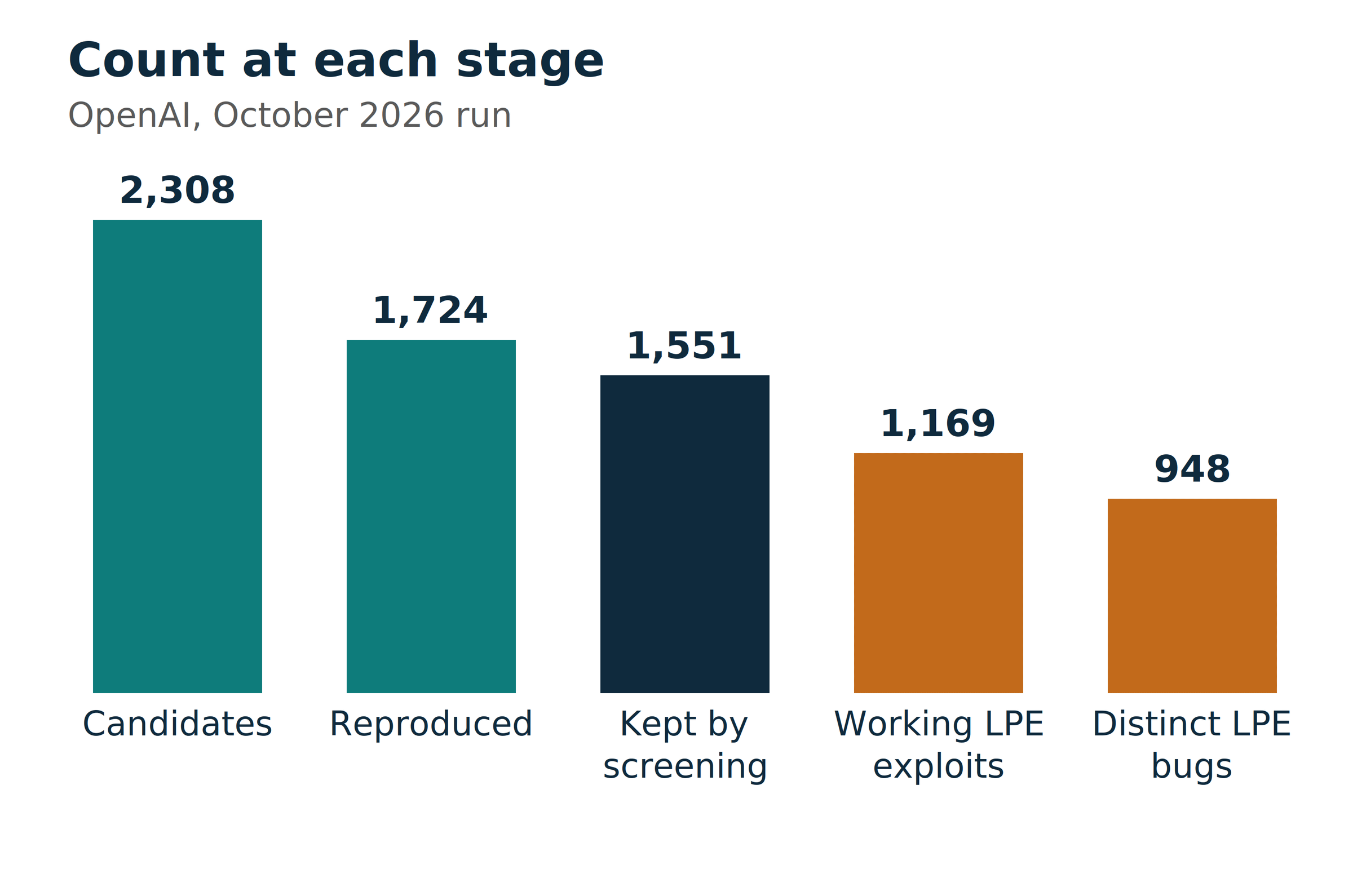
Figure 1 is a bar chart: the count fell at each stage, from 2,308 candidates to 948 distinct exploits.
Figure 1: The count at each stage of the OpenAI work.
OpenAI tested the kernel at its full size. The kernel holds more than 40 million lines of code. It runs on Android phones, cloud servers, and supercomputers. Billions of people use devices that run it. A single bug in that code can give an unprivileged user root access on the machine. OpenAI found 948 bugs that do exactly that.
The count fell for a plain reason. Each stage tested the output of the stage before it. Scout agents cut the kernel to 5,034 audit targets. Analyst agents produced 2,308 candidates from those targets. Triage agents reproduced 1,724 candidates. The screening agent kept 313 information-leak candidates and 1,238 LPE candidates. ExploitDev agents built 1,169 working LPE exploits. Variant analysis collapsed those exploits to 948 distinct bugs. OpenAI also built 948 distinct patches, one per bug.
Each stage removed candidates in a different way. Scout agents removed 93 percent of the kernel from the audit. Analyst agents produced candidates, and OpenAI deduplicated them to 2,308. Triage agents removed 584 candidates that did not reproduce. The screening agent removed 173 validated bugs with no plausible path to exploitation. ExploitDev agents built 1,169 working LPE exploits from 1,238 candidates. Variant analysis then collapsed those exploits to 948 distinct bugs. The 221 remaining exploits shared a bug with another exploit. OpenAI built one patch per distinct bug.
Human researchers reviewed each exploit, each patch, and each severity rating. They reviewed the output before OpenAI reported the bug to maintainers. OpenAI follows the Linux kernel community guidance on reporting order. Critical bugs go first. OpenAI sent hundreds of reports and patches for critical bugs already. OpenAI works with Patch the Planet partners to send the rest in stages. OpenAI reports one reason for the work. OpenAI wants defenders to fix bugs before attackers use them. OpenAI wants exploitation to cost more than the payoff.
The June run gives the scale of the change. In June, GPT-5.5 Cyber found 24 LPE exploits. OpenAI shared those 24 exploits as part of its Patch the Planet work. The October run used a newer cyber model and a full sequence of stages. It produced 948 distinct LPE exploits. OpenAI spent $1,213,430 in API credits on the October run. The July run with GPT-5.6 Sol produced 166 unique LPE exploits for $513,690.
Patch the Planet is an OpenAI initiative. It pairs OpenAI with partners to report bugs and patches for open-source projects. The June run proved that the approach worked on a small scale. The October run scaled the approach. OpenAI built a sequence of five stages around a newer cyber model. The stages were discovery, validation, screening, exploit work, and patch generation. Human researchers reviewed the output of each stage.
The scan ran on the latest Linux kernel in mid-October 2026. The scan and the manual analysis finished after 10 days. By then, maintainers had patched 61 LPEs upstream already. Maintainers had staging patches for 43 more. Maintainers were reporting and discussing 299 more in public.
Scout agents and Analyst agents: 5,034 targets, about 7 percent of the kernel, and 2,308 candidates in 12 hours.
KASAN validation: 1,724 candidates reproduced in 30 hours, and only 3.1 percent showed wrong analysis.
Screening and static triage: 313 information-leak candidates and 1,238 LPE candidates kept from 1,724 validated bugs.
ExploitDev agents: 291 information-leak proofs of concept and 1,169 working LPE exploits, at $775,929 for the stage.
Patch generation: 948 distinct patches, with variant analysis for each bug.
Cost and bounty math: $1,213,430 for the October run, against $18.9 million to $66.3 million in historical bounty rates.
Model generations and orchestration: 166 LPE exploits in July, 948 in October, on the same harness.
The wrong 0-day: 20 of 200 early exploits used a different bug than the one assigned.
Ten new techniques: 5 data-only techniques, 2 elastic objects, 2 page grooming techniques, and 1 type confusion technique.
Other tools: KMSAN, UBSan, KCSAN, KFence, Syzkaller, and static analyzers test what KASAN misses.
The test lab had a bug too: the agents found a QEMU TCG bug in the test machines.
Maintainers and the 10 days: 61 LPEs patched upstream, 43 with staging patches.
The full animated tutorial sits in the paid part below. It has 20 slides. It shows the technical details, the KASAN loop, and the exploit paths. It also discusses 10 potential new techniques that OpenAI did not report. To better understand OpenAI report, I created animated slides; paid subscribers can get the link below