👋 Hey there, I’m Lenny. Each week, I share deeply researched product, growth, and career advice. For more: Lenny’s Podcast | Lennybot | How I AI | Become an AI-Native Builder and other favorite AI/PM courses
P.S. Get a full free year of Cursor, Notion, Replit, Lovable, Factory, Wispr Flow, Linear, ElevenLabs, PostHog, Brain.fm, Waking Up, and more, by becoming an Insider subscriber (while supplies last). Learn more.
Kristen does such an incredible job of introducing this piece that I’ll just skip my regular intro and jump right into it.
Kristen Lowe is an executive ghostwriter and narrative strategist, and the incoming Director of Founder & Editorial Communications at Scribe. Previously the Director of Operations at Hinge, she has built founder communication platforms across LinkedIn, Substack, X, and keynote stages, and written for leaders in every format from essays to TED Talks. You can find more of her work on AI, careers, and storytelling on Substack and TikTok.
It’s never been easier to start a company. It’s also never been harder to get someone to care that you did. Anyone can now go from idea to business in less time than it takes to hire a single engineer. But the same tools that make building simple make standing out a challenge.
As channels like X and LinkedIn flood with soulless AI slop, startups are having to work harder to grab people’s already fractured attention amid all the noise. But this moment presents an opportunity for founders who can say something honest and connective by “going direct”—or what I call founder-led communication. Today, a solid founder-led communications strategy is one of the lowest-cost, highest-leverage tools at your disposal to get people’s attention.
Most founders seem to know this. When I started writing for founders as an executive ghostwriter and comms strategist, the biggest surprise was the constant stream of inbound clients at all stages who thought they “should” be building a public platform but didn’t know how to start. I’d assumed people would want ghostwriting help because they just hated writing, but the number one reason founders reached out for help was “I have no idea what to say.”
There’s a discouraging misconception that for comms to be impactful, you have to be vulnerable, contrarian, or profoundly entertaining in every message you put out there. I hear from founders all the time who are daunted by that expectation. But in my experience, the only thing most people need to build a credible comms strategy is an answer to the question “Why did I start this company?”
This answer is usually the most narratively powerful idea to share about your business. Starting a company is a life-altering pursuit with a famously high failure rate. Whatever reason sent you down that path, it was once compelling enough to rearrange your whole life around and recruit others to do the same. Founder communications work because people care about and root for other humans, not entities or widgets.
More importantly, if you’re not excited about the story of why you started this company, you should probably look for a different line of work. As more people stray from traditional career ladders and as entrepreneurship becomes more popular, there will be a wave of founders who start companies simply because they can, or because it looks like a fast track to a lot of money. People can tell when you’re in it for the wrong reasons—which includes no reason at all. There’s no comms strategy for that. But for everyone else: if your reason was convincing enough for you, it’s convincing enough to make other people care too.
Once you know your “why,” this guide will help you figure out the right strategic communications choices for your business, so all you have to do is start writing and hit post.
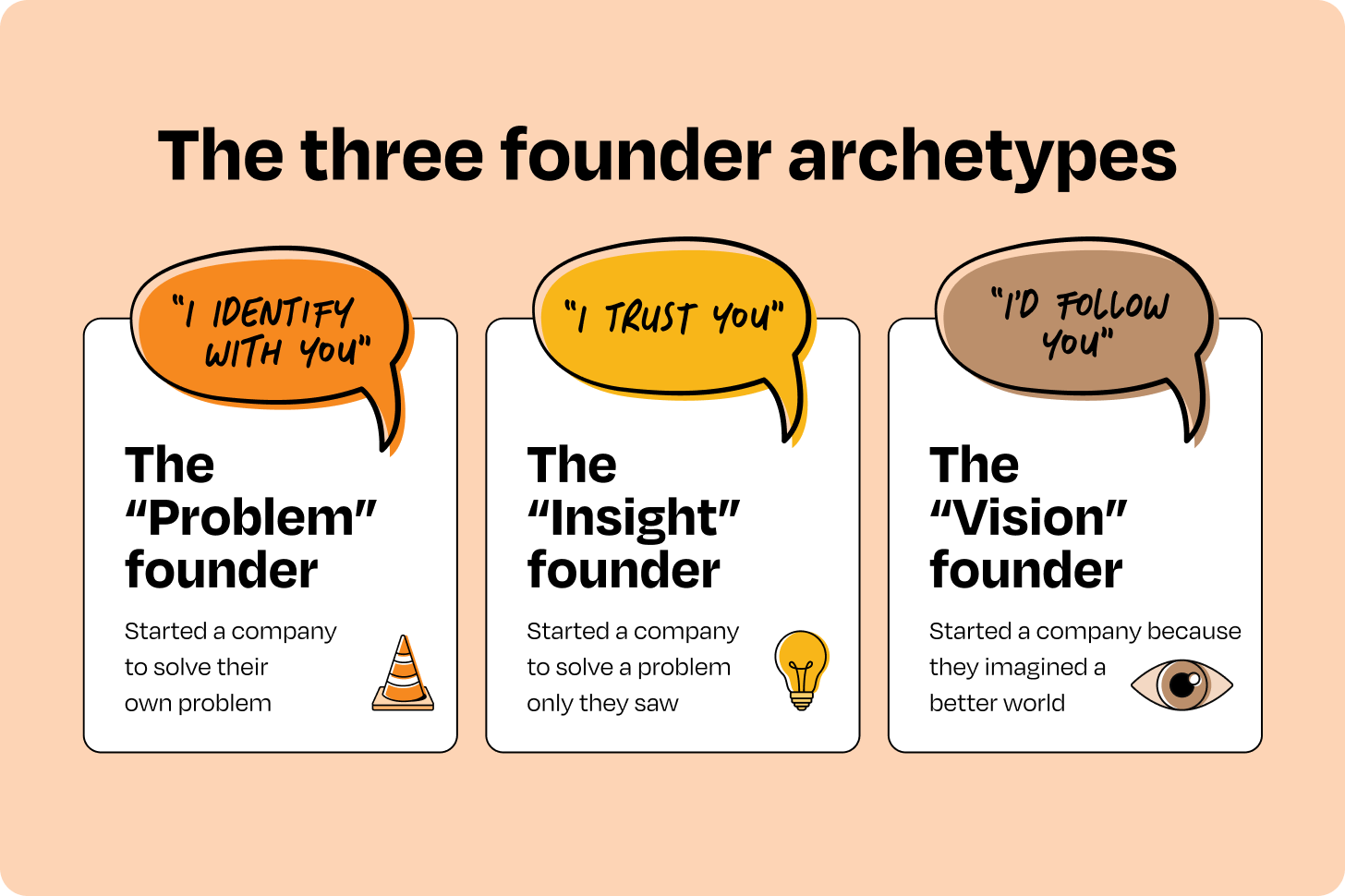
While every founder’s “why” is unique, they almost always fall into one of three categories, each mapping to a founder archetype that can help you define your comms strategy:
**The “Problem” founder:The person who started a company to solve their own problemThe “Insight” founder:The person who started a company to solve a problem only they sawThe “Vision” founder:**The person who started a company because they imagined a better world
Lumping yourself into an archetype might seem like a counterintuitive way to build distinctive founder content, but the ways people connect with founders map to these three relationships: I identify with you, I trust you, I’d follow you. A unique story makes your content interesting, but your archetype determines which feeling it evokes in your audience, and cultivating the right one for your business requires different strategic choices.
Your founder archetype will guide you to the decisions that matter for a comms strategy:
**Goal:What specifically your content strategy is meant to achieveVoice:How you should soundMessaging pillars:What you should talk aboutSuccess conditions:**How you’ll know if it’s working
What your founder archetype will not tell you are answers to questions like “How often should I post?” Founder comms are like workout routines: the best one is the one you can commit to. Regardless of your archetype, committing to any channel and cadence that works for you beats agonizing over the perfect one. And everything else you might be worried about—audience segmentation, attribution, earned vs. organic media balance—is secondary. You can tackle that once you have a substantial body of content to optimize around.
The Problem founder is someone who started their business to solve a problem that was personally tormenting them. Think Sara Blakely, who hated how pantyhose looked under her pants, so she cut the feet off them and founded Spanx, or Tobi Lütke, who tried to sell snowboards and got so frustrated with the existing e-commerce programs that he decided it would be easier to build Shopify instead.
What makes these founders compelling is that they understand the customer better than anyone else could, because they are the customer. When you’re solving a problem because it caused you so much pain that you restructured your life around fixing it, you have a unique power to make your customer feel seen and understood. You get to say that you’re working for “us,” not for “them,” and your success becomes “our success.” That narrative is a powerful tool for building affiliation and brand loyalty. The Problem founder has a singular ability to identify as a customer first and business owner second, which should anchor their entire comms strategy.
You’re a Problem founder if: you started your business to fix a problem you were personally experiencing, when you realized the only way to get it solved was to do it yourself.
**Goal:**Build a loyal following of customers who feel deeply understood and recognized by your product.**Ideal voice:**Personal, honest, detailed, (appropriately) urgent/frustrated
**Primary messaging pillar:**The centerpiece of a Problem founder’s comms strategy is high-repetition, vignette-style storytelling about their experience with the problem. I think of this as the Taylor Swift method: communicate specific, scene-based details about an experience to evoke universal and strong emotional responses. You should have a well-rehearsed “origin story” that describes your experience with the problem and can be repeated across channels. For that story to connect, it can’t sound like “existing options weren’t working for me.” It needs to be more like “I was crying in my car during lunch.”**Additional pillars:****Product design.**The Problem founder has one of the best excuses to talk about the product in granular detail because every feature likely has a personal origin story. Beyond telling the founding story, you should share the experience of building the product, the choices you made, what personal experiences led you to make them, and which features you love the most and why.**Community experience.**The Problem founder can also engage and highlight early and devoted supporters of the company by recapping interactions with customers or directly sharing their stories. Share what it meant to you to hear from other people who needed your product. Use their words to explain why your product exists.
**Founders who have done this well:**Sara Blakely (Spanx):**HerLinkedInpostsarethetemplate for talking about the problem, even after decades of doing so. If you want to hear what a detailed origin story sounds like in full, listen to herMasters of Scaleepisode.**Dave Gilboa (Warby Parker):**HisGood Life Projectpodcast episode andinterview are excellent examples of how to tell the same story across mediums.Daily Californian**Will Ahmed (Whoop):**HisHow I Built Thisepisode sounds well-rehearsed but not canned. Check out his original Whoop “Locker Blog”postsand this𝕏tweetfor short, effective examples of the written version of this storytelling mode.**Tope Awotona (Calendly):**HisHow I Built Thisepisode stands out because he also talks about companies he started just to make money. Listen to the contrast to understand why the personal narrative plays so well.
**Common mistakes:****Overgeneralizing.**A Problem founder who wants to decenter their story or who worries their experience is too niche often ends up talking about vague descriptions of the problem that anybody could share. Stay in the details. Remember, you are Taylor Swift, not a corporate sales team.**Slipping into CEO persona.**A Problem founder who is busy thinking about the mechanics of their business can end up accidentally talking in the language of market gaps and competitor shortcomings instead of their actual experience. That slip pulls you away from the part of your identity that matters to your customer: your shared challenge or frustration.**Oversharing beyond your story.**It’s easy to think that because people care about your founding story, they want to hear about your whole life, but a Problem founder who gets sucked into acting like an influencer can quickly dilute their message. You don’t need to reveal tons of information about your personal life. It sacrifices your privacy without bringing anyone closer to the business.
**Best channels:**Problem founders play well with organic storytelling opportunities and community-forward environments: social media, podcasts (think: How I Built This or The Diary of a CEO), and profile pieces. Go where your community already is, pick a short-form video platform you can commit to (if you’re willing), and try to get a conversation-style speaking engagement where you can tell your story in full. Then clip and spread it across your other channels. X is not usually your best storytelling channel, and panels won’t always give you space to tell your story. That doesn’t mean you should say no to them on principle, but your time is limited, so try to spend it where you can tell the full story and then syndicate.**How you’ll know it’s working:**Customers will start telling you about their experiences in your comments, replies, and inbox instead of just writing “great post!” Followers will share and amplify your content.**Prompts to get you started:**What was the very worst day I ever had with this problem? (Be vivid!)
What was the tipping point when I decided I had to fix this myself?
When did I realize that it wasn’t just me dealing with this?
Once I figured out how I wanted to fix this for myself, why did I feel like I had to fix it for other people too?
The Insight founder is someone who started their business because they saw or understood something before others did and decided to change it. Insight founders are intriguing because the inciting incidents in their stories usually take the same shape, but the motivations vary widely. Some Insight founders see a better way to do something and recognize the gap as a financial opportunity; others see a suboptimal system and are just so annoyed by the inefficiency that they have to fix it themselves.
Classic examples of Insight founders include Stewart Butterfield, who built Slack because he noticed that the workplace was running on informal communication without a specific product to support it, and Reed Hastings, who recognized that the most profitable part of the video rental business, late fees, was also the part customers hated most.
What makes Insight founders compelling is that they were right—early. Where Problem founders build customer loyalty by making people feel understood, Insight founders do almost the reverse. They make people feel smarter by helping them consider new perspectives, understand complex subjects, and form opinions that they otherwise wouldn’t have come up with. That relationship with customers is a slow build, but it’s a durable one. An audience that believes you understand things others don’t and trusts your read on an industry will borrow your language, repeat your conclusions, and eventually accept your opinions as a reason to believe in your company. Most founders you think of as “thought leaders” are Insight founders, and they’re uniquely positioned to share and debate their points of view.
You’re an Insight founder if: you spotted an incorrect assumption, a broken process, or a mispriced problem—and once you saw it, you dove in to correct it.
**Goal:**Build a following of people who trust your opinions and analysis enough to adopt your ideas and believe in your company.**Ideal voice:Clear, analytical but accessible, curious, opinionated, generousPrimary messaging pillar:**The core communication pillar for an Insight founder is regular, incisive thought leadership about their industry. It’s easy to believe an Insight founder builds credibility by being right all the time, but the more important thing is beinghelpful. You can lend credence to your original insight by generously helping people understand other subjects with clear, explicit reasoning. The insight you’ll explain the most should still be the one that sparked your business. Speak about it frequently but not exclusively, so you don’t get branded as someone who was only right about one thing one time.**Additional pillars:****Predictions.**The natural extension of sharing opinions about industry changes and events is predicting what happens next. Especially in high-ambiguity moments (like the current AI boom), the Insight founder is uniquely positioned to make a prediction early. If you’re right, it’s a major boost to your credibility, but too many wrong calls will catch up with you, even if you can explain what you misread. Only make predictions that you feel confident about your reasoning for.**Engaging with other thinkers.**An Insight founder who only puts out their own takes can come across as interested only in their own thoughts. Interacting with other thought leaders will strengthen your thinking. Debate, share what inspires you, and comment on other people’s posts. This content is easy to produce and shows people you’re learning as much as you’re speaking.
**Fo…