November 2018.
The museum smelled like wet wool and the inside of other people’s mouths.
Uncle Richard walked behind me. Three steps back. Always three steps. His shoes made a sound like he was angry at the floor. Click. Pause. Click. Each step a small argument he was losing.
He checked his phone every thirty seconds. I counted because counting is what you do when nobody’s talking to you. I counted his steps too. And how many paintings had circles in them. Seventeen so far.
The storm closed the airport for six days. Uncle Richard’s hotel cost more per night than our car payment. He called it “an inconvenience.” My mother called it “fate giving you a sign.” The kind of sign you can’t ignore because your younger sister said so.
Nobody talked in museums. Or if they did, they whispered. Even though no signs said to whisper. Everyone just knew. The same way everyone knew to stand exactly the same distance from the paintings. The invisible correct distance that everyone agreed on without meeting about it first.
The Guggenheim was shaped like a spiral. You could look up and see people walking on the curve above you. You could look down and see people getting smaller toward the center. Everyone going the same direction because you couldn’t turn around. The building wouldn’t let you.
Most people looked at each painting for three seconds. I timed them. Three seconds of looking. Two seconds of nodding. One second of checking if other people were nodding too.
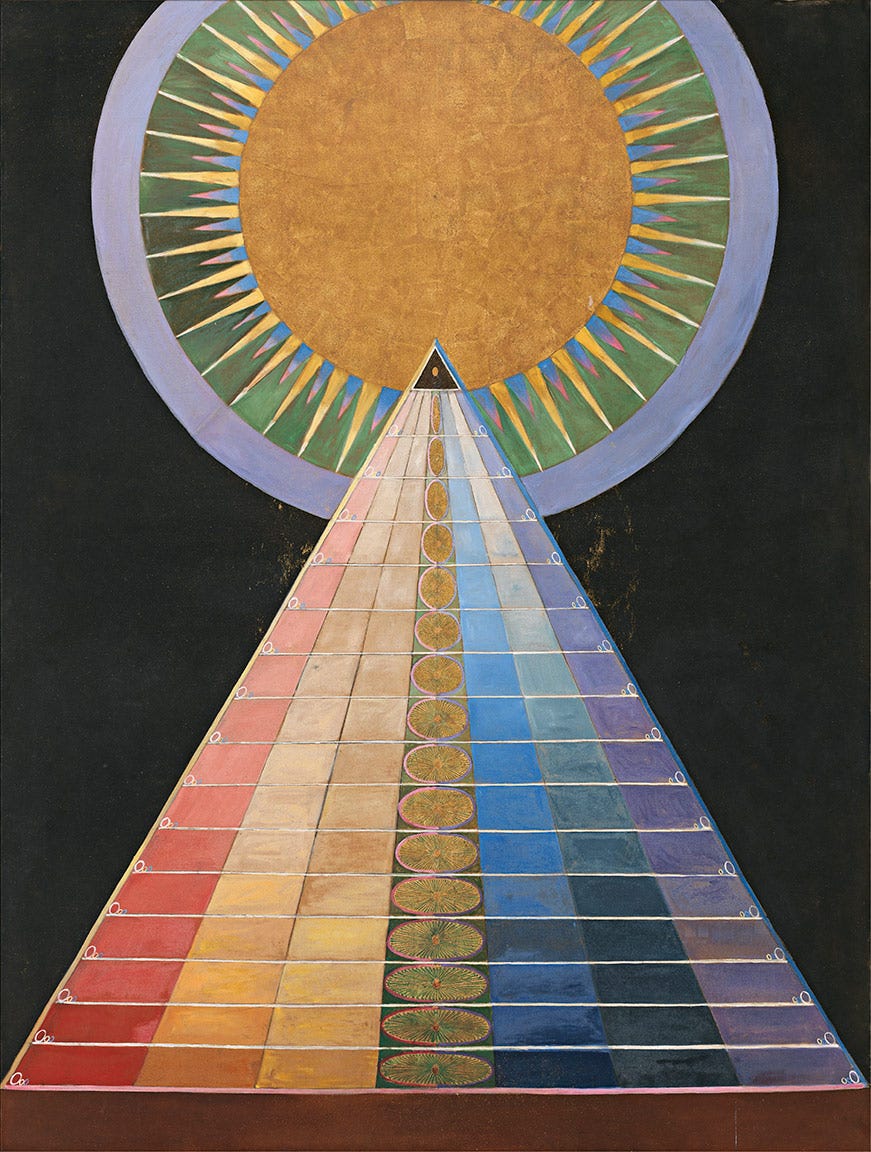
I stopped in front of one the little white card called Altarpiece. Group X, No. 1. An orange sun at the top with green and yellow rays shooting out like it was exploding. A purple ring around it like a halo. Then a pyramid descending in rainbow. Red melting into orange into yellow into green into blue into purple. Ovals running down the center like a spine. Black background like outer space.
Uncle Richard stopped behind me. Made a sound like air leaking from a tire.
I looked at the painting straight on. Saw the sun. Saw the pyramid. Saw the colors in their perfect order.
Then I did the thing I learned in first grade.
The woman came to our school in March. Gray suit. Clipboard. Very clean shoes. She took me out of reading time to a small room that smelled like printer paper and anxiety.
She showed me cards. Black ink on white paper. Pictures that changed depending on how you looked at them.
“Do you see the guitar or the apple first, Stella?”
I saw both. The guitar was also the apple. They were the same lines doing two different jobs simultaneously.
But her eyebrows told me that wasn’t what she wanted to hear. Her pen hovering told me there was a correct answer and an incorrect answer.
“Guitar,” I said.
Her eyebrows relaxed. She smiled with just her mouth.
She wrote something down in very small handwriting.
“And this one? The bird or the hand?”
Both. Always both. But I was learning the rules fast. Adults asked questions that sounded like they had multiple answers but really only had one.
I gave her the answers that made her stop writing.
Now I let my eyes go unfocused. Let them soft the way you do with those Magic Eye posters. The ones where if you stare wrong enough a dolphin appears.
I stopped trying to see the painting the correct way.
And something else appeared.
A face.
Lines that only existed when you weren’t looking at them. Lines that lived in the corner of your vision where you weren’t paying attention.
A face constructed from the space between attention and neglect.
Watching me from inside the colors.
The child hasn’t moved in three minutes and forty-seven seconds.
Alexis warned me Stella was unusual. Words like “precocious” and “sensitive” and “advanced.” The way parents do when their child doesn’t fit the standard template.
“She’s reading at a grad student level,” Alexis said last week. As if it explained why I was now standing in the Guggenheim watching my nine-year-old goddaughter stare at a painting like it contains answers to questions nobody asked.
I have no children. No daughters. No experience with how to speak to girls who notice too much and say things that make adults shift their weight and remember urgent appointments.
The painting is aggressive. An orange sun radiating green and yellow like an explosion. Purple halo. Rainbow pyramid descending into black. Geometric patterns repeating down its center. Hilma af Klint. Swedish mystic. Dead for decades. Claimed spirits guided her hand.
The Guggenheim is packed. Bodies pressed against white walls. We funnel up the spiral because the architecture permits no alternative.
Stella stands perfectly still. Her breathing changed. Slower. Deeper. Eyes unfocused.
I should say something. I’m her godfather. I send birthday checks. I attend holiday dinners.
But I don’t know how to talk to her. To this person who sees things I can’t see and says things that make my chest constrict.
“Do you like this one?” I ask. My voice sounds wrong. Too formal. As if I’m asking a stranger for directions.
She doesn’t answer.
Just continues staring at the rainbow pyramid.
“Stella?”
She blinks. Returns. Eyes focusing again.
“Uncle Richard,” she says. Not “Uncle Rich.” Never the diminutive. Always the full formal address. “Do you see it?”
“See what?”
“In the painting. When you look at it wrong.”
I look at the painting. Orange sun. Purple ring. Rainbow pyramid. Geometric ovals. Black background. Nothing unusual. “I see shapes.”
“No. Look peripherally. Let your eyes go soft. Like those 3D posters from the nineties.”
I try. Let my vision blur. Nothing changes. The pyramid remains a pyramid. The sun remains a sun.
“I don’t see anything different.”
She looks back at the canvas. “They tested us in first grade. Pulled me out of class. A woman with a clipboard. She showed me cards with pictures that changed depending on how you looked at them.” Pause. “I could see both images. At the same time. The guitar and the apple. The bird and the hand. Both simultaneously.” Another pause. “But that wasn’t the right answer.”
What does that mean? What kind of test? Why didn’t Alexis mention this?
“What was the right answer?” I ask.
“Whichever one made her stop writing things down.”
Uncle Richard was looking at the painting now. Really looking. Trying to do the thing I told him. His eyes going soft.
But he couldn’t see it.
I could tell by the way his jaw got tight. By the way his eyes snapped back into focus like a rubber band.
“What do you see?” he asked. His voice sounded different. Higher. Thinner.
I looked back at Altarpiece. Let my peripheral vision take over the way I’d been practicing since first grade. Since I learned there were two ways to see things. The correct way everyone expected. And the other way that made adults write things down in tiny handwriting.
The face appeared immediately. Constructed from lines that only existed when you weren’t looking directly at them.
“Instructions,” I said.
“Instructions for what?”
“For how to see everything else wrong,” I said. “Or maybe right. I’m not sure yet.”
The child has just informed me that a painting contains instructions for perceiving reality incorrectly. Or correctly. She isn’t sure which.
I need to leave this museum.
“Stella,” I say. Too loud. Someone two paintings away glances at me. I lower my voice. “We should move on.”
“But don’t you want to see it?” She’s still looking at the painting. Not at me. “Don’t you want to know what it says?”
“I don’t think I can see what you see.”
She looks at me. Studies my face the same way she studied the painting. “Maybe you already learned not to,” she says.
My chest constricts. I take her hand. Gently. But with purpose. “Come on.”
We walk up the ramp. Past more af Klint paintings. Past tourists nodding comprehension they don’t possess.
Stella keeps looking back. At Altarpiece. At the rainbow pyramid. At whatever frequency she’s tuned to that I can’t access.
I’ll call Alexis tonight. Tell her the museum visit went well. That Stella was engaged and thoughtful.
I won’t mention this. The four minutes of stillness. The breathing change. The peripheral vision. The hidden face in the colors. The way she looked at me like I was missing something fundamental. Something we were all trained not to see.
We exit through the gift shop. I buy her a postcard of Altarpiece. Three dollars and twenty-five cents.
Stella takes it out immediately. The entire subway ride home she stares at it. Never directly. Always peripherally. Always seeing something I can’t see.
The nor’easter will clear by tomorrow morning. My 6 AM departure back to Boston back to my apartment back to my life where nine-year-olds don’t tell me about hidden faces in paintings.
I’ll be gone before she wakes up.
The relief I feel about this makes me ashamed. But not enough to change my flight.
Not enough to stay and ask what else she sees that I can’t.