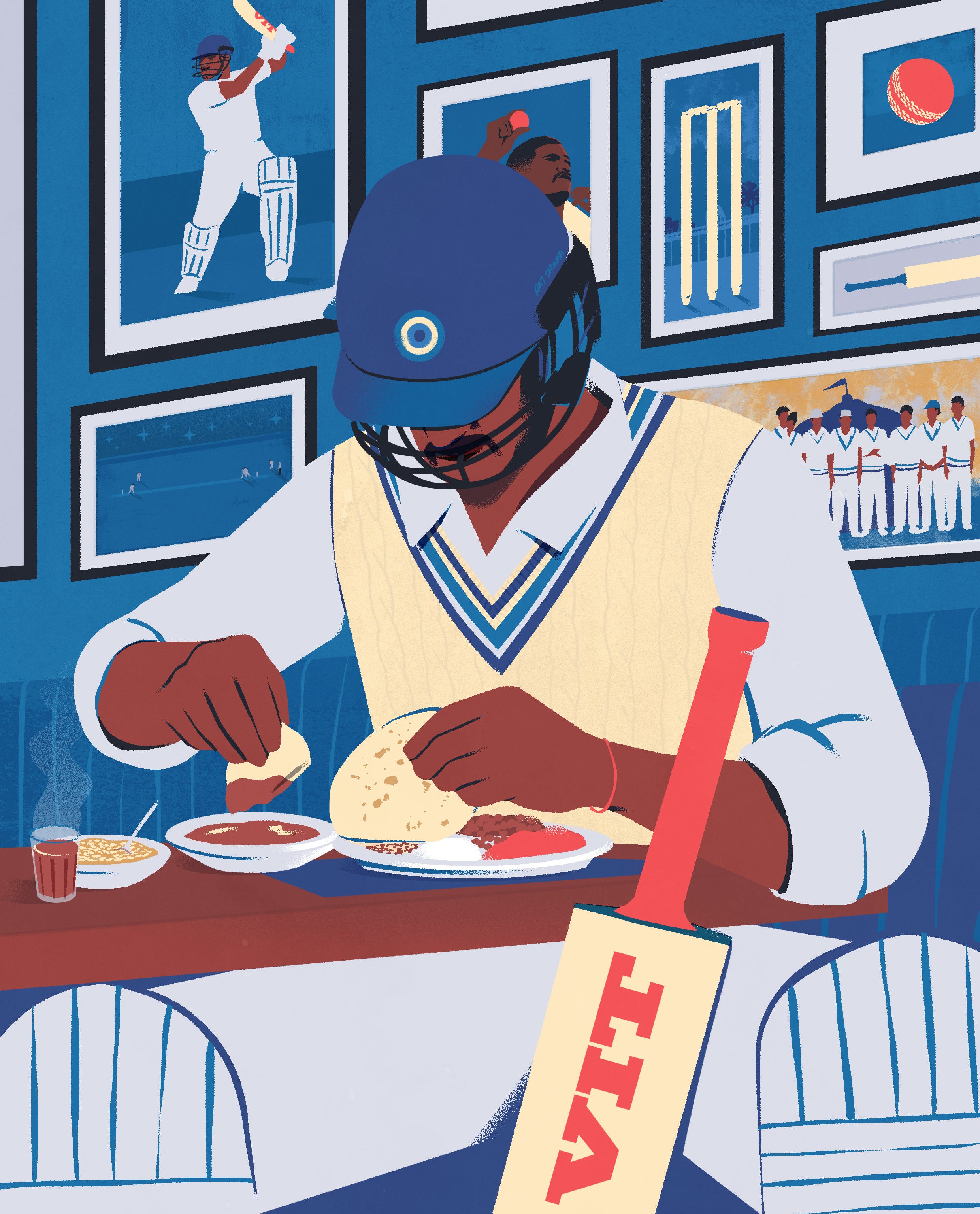
Good morning and welcome back to Vittles. Today’s romp of an essay by David Jesudason is all about the eating habits of South Asian cricketers when they tour in England. In a world where competition between restaurants is as fierce as ever, these meals have become a mini-economy of sorts, with a single visit from the right cricketer able to make or break the fortunes of a restaurant.
A note on subscriptions: a subscription to Vittles costs £7/month or £59/year, although the Substack app - very annoyingly - charges you more. To avoid this, please subscribe via our website and not the app. For those who prefer print, you can also now buy a bundle including our third print issue ** The Influencers** and our second print issue,
Thirty years ago I played cricket in a place called Kirk Hammerton, a tiny village in North Yorkshire. I was a reliable wicketkeeper but a less competent batsman, humiliatingly shunted by the captain to No 11. Often, I didn’t even get the chance to wear the wicketkeeper gloves and would be replaced just before a game by a more senior player who didn’t want to struggle with his hangover in the outfield. We would always have a pretty bland post-match meal in a provincial curry house with flannel-like poppadoms and oily vindaloos. The waiters viewed me with curiosity as the only brown face on the table, while my teammates mocked my southern accent.
This is all to say, I feel the pain of Kerala-born Sanju Samson, who, as a teenager in Yorkshire in 2014, found himself in a similar situation. Today, Samson is a T20 World Cup-winning wicketkeeper and opening batter, but back then he was a reserve player for an India team which had just lost to England in a one-day international at Headingley. Samson, the homesick understudy, was stuck in Leeds for three days with nothing to do. To cure his homesickness, he acted on a tip-off – Tharavadu, a Keralan restaurant in Mill Hill which had only been open for a few weeks. Samson visited Tharavadu for a long dinner and told the waiter he would return the next day with one of his teammates. ‘It was an amazing moment,’ owner Prakash Mendonca told me. ‘He didn’t tell us who he was going to bring.’
Samson’s guest was Virat Kohli, soon-to-be-captain of the Indian team. Mendonca quickly ushered them to a corner table so the other customers wouldn’t disturb them, although one member of staff was so nervous she could barely hold the tray without shaking. Kohli, then in his pre-vegetarian days, dined on chicken, fish and egg dishes, with a particular liking for the curries paired with appams and a side of masala dosa – an order Mendonca reels off without having to think. At the end of the meal, Kohli presented the restaurant with a signed bat.
By Kohli’s next meal at Tharavadu, during the 2019 World Cup, it had become a must-visit restaurant for cricketing royalty, with guests like Ravi Shastri, Michael Holding and Mike Atherton. ‘There’s no space to hang any frames now,’ Mendonca told me. ‘All the walls are full of autographs.’
There is a long lineage of touring cricketers changing the fortunes of England’s South Asian restaurants. In the 1980s, Mumtaz, near Baker Street, and Salloos in Belgravia cemented their status as luxury venues by attracting Pakistani cricketers, with both advertising in the Pakistan team’s official 1987 tour book. In September this year, Colombo Kitchen branded itself ‘Where the cricket team comes for curry in London’ thanks to a visit to its Putney branch from Sri Lankan bowlers Asitha Fernando, Maheesh Theekshana and Kamindu Mendis. The big influencers are still Indian cricketers, whose wealth gained from the Indian Premier League means they are at ease in the preferred spots of the super-rich, and whose celebrity has the power to make servers – and social media managers – weak at the knees.
Where cricketers eat has become a mini economy of sorts, with South Asian restaurants in cities across the UK competing for the online clout that a visit from a touring player can bring. Last year, I set out to discover what effect cricketers were having on these restaurants. I found that for the chosen few, a visit can be a foothold towards fame and money, and as the diets of cricketers have become more proscribed, it can potentially lead to an even bigger prize: being put in charge of a cricket ground’s catering. And while some restaurants try to strategically court cricketers, I learned that, like batting against hostile bowling, it’s vital to have some luck.
Earlier this year, I took the train to Southall in West London to meet the Anand family, led by the avuncular Gulu and his daughter Dipna. Gulu comes from a family of self-professed ‘sports fanatics’. Growing up in Nairobi in the 1960s, his father and brothers would listen to the radio and the crackly commentary whenever they wanted to keep up with the cricket. One of his heroes was Sunil Gavaskar, who opened for India in their famous 1983 World Cup win, and who Gulu had watched bat in Nairobi in the 1970s.
In 1975, soon after Gulu moved to England, he took over a chippy in Southall and reopened it as Brilliant, a thirty-six-white-plastic-seat restaurant serving Punjabi food. The business thrived and, four years later, he was able to afford to buy the butcher’s next door. It was this larger incarnation that started to attract celebrities, including the actors Amitabh Bachchan and Rajesh Khanna and the singer Lata Mangeshkar, whenever they were in London. This was all without strategy and with no PR spend.
Bachchan and Khanna were the biggest movie stars of their time, but the only time Gulu was starstruck was when, one quiet lunchtime, Gavaskar walked through the door. After Gavaskar had finished his meal, Gulu approached him at his table, and the Indian player told him, ‘Your food is really good’. Gulu reels off to me a list of cricketers that have dined at Brilliant since, which unrolls like a cricket hall of fame: Farokh Engineer, Kapil Dev, Sachin Tendulkar, even West Indian legend Viv Richards. The arrival of a cricketer would always excite his staff, sometimes even more than the actors did, and they would give the cricketers extra dishes and make sure the portions were bigger than usual.
By the 2000s, Brilliant had become the go-to restaurant for the Indian cricket team when they were visiting London. When India won the Champions Trophy at the Oval in 2013, the team bus headed towards Southall and many fans followed. By the time the bus reached Brilliant, a large crowd had formed outside the restaurant, some of whom Gulu maintains walked all the way there on foot.
Brilliant is not the only London restaurant that has become a regular haunt for South Asian cricket teams. Aladin Kebabish in Hendon, North-West London, is run by Tanveer Ahmed, who opened a fish and chip shop in 1998 on Edgware Road before moving into the restaurant trade. Throughout the years, Pakistan players have visited the restaurant regularly, something Ahmed ascribes to its strategic position near the M1. Today the restaurant’s walls are covered with photos of visiting sports stars, including cricketers such as Shaheen Afridi, Saleem Malik and the entire Pakistan women’s team (‘Those girls can eat!’ Ahmed told me). One that is missing is Imran Khan: ‘He’s never been but he’s sent people [for takeaways],’ Ahmed claims. ‘He is a nihari lover – even before he became a politician he’s been eating the nihari here.’
In July this year, Aladin hosted the former Pakistani cricket captain Younis Khan in an event advertised on social media. Ahmed tells me this was a personal request from Khan, who wanted to sign autographs and meet his fans in a way that gave everyone a chance to speak to him. ‘It was the first time in twenty-two years that we promoted a visit. We don’t want people bothering them while they are eating: this kind of chaos I don’t want.’ When I asked Ahmed if visits from cricketers made a difference to his business, he smiled coyly. ‘We’re always full.’
As diet becomes more important to modern sports, cricketers – who were once known to eat gulab jamun and chhole bhature at matches – have become much less likely to break ranks and eat the Brilliant butter chicken or Aladin nihari. You’re more likely to get something like Indian cricketer Smriti Mandhana’s 2025 visit to Padharo in Southampton; the restaurant was chosen not because it was vegetarian, but because it met Mandhana’s dietary demands. ‘We didn’t have basic [nutritional knowledge] back then,’ Deep Dasgupta, former Indian international player, tells me. Dasgupta, who works as a commentator today, played for India from 2001 to 2006. Back then, Indian cricket was starting to become more professional, and Adrian Le Roux had just joined the team as a strength and conditioning coach. Dasgupta recalls how food that was once eaten unthinkingly suddenly became out of bounds: ‘At breakfast, I picked up a chocolate-chip muffin, and a guy next to me said, “That’s 450 calories – an hour on the cycle.”’
Today, there are no muffins for breakfast. Last year, I spoke to Andy Kennedy, who has been the sous chef at Lord’s Cricket Ground for fifteen years and has catered for four India v England Test series. Unlike other grounds, Lord’s does its catering in-house. When India are touring, this means tweaking the menus to include Indian dishes, with tutorials from the likes of Peter Joseph from Kahani restaurant in Sloane Square. ‘Every year we’re learning to make better and better curries,’ Kennedy tells me. ‘We stay away from serving duck, as some cricketers have superstitions about that,’ Karl Pearce, executive chef at Lord’s, adds.
Kennedy and Pearce explain to me that the menus at Lord’s are planned months in advance, and the process includes consultation with the cricket boards’ nutritionists. Still, this doesn’t stop last-minute alterations to the menu. The Indian [men’s] cricket team is probably the most demanding in terms of changes,’ says Pearce. ‘There [are] times where they want four to six dals a day and ultimately that’s not achievable with the size of the kitchen and time frame.’
At the Oval, Indian teams are *still *eating food cooked by the Anand family. In 2021, Compass Group – the largest contract food service in the country – approached Gulu’s daughter Dipna (who runs Brilliant’s successor, Brilliant Gastro) about providing a South Asian menu to the team when they play at the ground. Dipna had already worked with Compass – through its subsidiary Levy – on operating food trucks at Edgbaston and Twickenham, but the Oval is a more complex operation. Serving starts on practice days before the Test, which can last up to five days, and has to be prepped in Southall and delivered by Compass. With team sizes enlarged by backroom staff, there are forty people and their specialist diets to consider, as well as the risk of food going to waste if the match is over by day three.
Because of the emphasis on nutrition, Dipna – like Kennedy – has to submit menus well in advance for approval from the back-room staff, which includes the players’ personal trainers. She has to reduce fat, salt and chilli levels, as well as limiting certain types of oils and avoiding allergens, which means the majority of what is served isn’t on the menu at Gastro Brilliant. They provide breakfast at about 8.30am (idli, poha and pongal), followed by lunch, tea (a snack like dhokla or a side of greens) and a post-match dinner like dum biryani, as well as snacks that might be sent on spec to the changing rooms. Instead of wheat rotis, healthier options like bajra or makki are often served. There is a sweet dish, but it normally contains oats (‘Boring cakes’, jokes Dipna). In the last five years, Dipna has learned that the team generally like South Indian food for breakfast, but lunch or post-match food doesn’t necessarily have to be Indian. Most importantly, what the team ‘really crave is a Bombay sandwich’.
When Sachin Tendulkar was on tour in England in 2002, he took the eating competition at the Harry Ramsden’s in Guiseley, West Yorkshire, which consisted of a giant battered fish with chips and salad. ‘Nobody believed this little man could do this [but he] polished it off in no time,’ Boria Majumdar, Tendulkar’s official biographer, tells me, adding that Tendulkar also ‘ordered a couple more dishes’.
It’s hard to imagine a prime Tendulkar striding into Harry Ramsden’s today, not just for health or diet reasons but because social media – and the burgeoning power of Indian diners – has made PRs savvier about who they court to eat in their restaurants. ‘They’re told where to go because there’s PR behind it and a lot of money involved,’ Gulu tells me. Some Michelin-starred Indian restaurants particularly crave a visit from Tendulkar (and, most importantly, a photo with him which they can use to market to rich Indian fans). Last year the executive chef of Jamavar, an upmarket London restaurant owned by LSL Capital, posted a series of pictures of Tendulkar dining there on his LinkedIn; LSL rivals JKS (owners of Gymkhana, Trishna and Brigadiers) meanwhile claims that it never posts pictures of cricketers visiting unless it’s a publicised event, so that famous guests know their privacy will be guarded. ‘If anyone celebrated the fact we had a famous customer in here – unless it was a brand partnership – I’d be absolutely livid,’ Graham Burton, a manager at Brigadiers, tells me.
Nearly all the PRs I spoke to denied that courting Indian cricketers was an active strategy, although I suspect that some restaurants – unlike most modern cricketers – see riches in the longer game. The Three Falcons, a gastropub just off Edgware Road and close to Lord’s Cricket Ground, has housed South African ex-player AB de Villiers and journeyman Australian Dan Christian in rooms above the pub during matches, according to marketing manager Karishma Gupta. Rishabh Pant went for lunch one quiet weekday in 2023, and since then there have been more visits from other cricketers. Gupta believes the key to gaining more cricketers and exposure would be to supply the catering at Lord’s when India play there. ‘We’re in touch with the MCC [Marylebone Cricket Club],’ she says, ‘so fingers crossed that we can crack a deal with them.’
Despite these efforts, ultimately there’s probably little that restaurants can do to game the system. When Kohli walked into Tharavadu over a decade ago, it was a random byproduct of a young cricketer’s boredom that could not have been anticipated. Soon after Kohli’s first visit, Tharavadu began supplying breakfasts of dosas, upma and poha to the Indian men’s team when they were staying nearby. And in 2025 the restaurant struck a deal with Headingley to cater for the Indian men’s team during the Test match that year. That one unplanned, uncurated visit has completely changed the trajectory of the restaurant.
When I visited Mendonca last year, it was at Tharavadu’s new, second restaurant, Uyare, nestled on a rooftop in Leeds city centre, next to a Gaudiesque John Lewis that juts out like a giant armadillo. He was basking in the Yorkshire sunlight, happy to share how successful both venues have become, while still remaining humble. He told me about a plan to expand the restaurant to Manchester which hadn’t gone through. If it had, it could’ve hosted the India team when they played at the city’s Old Trafford stadium last July.
Mendonca will have to wait until 2029 to cater for them again. He will have the private dining room ready, he tells me: it’s called the Virat Kohli room.
David Jesudasonis a freelance journalist who covers race issues for BBC Culture, Pellicle and Vittles. His first book[Desi Pubs]was released in 2023 with Camra Books. You can also sign up to…