by DAVID KIRICHENKOUnder Fire News — Innovate to be free.
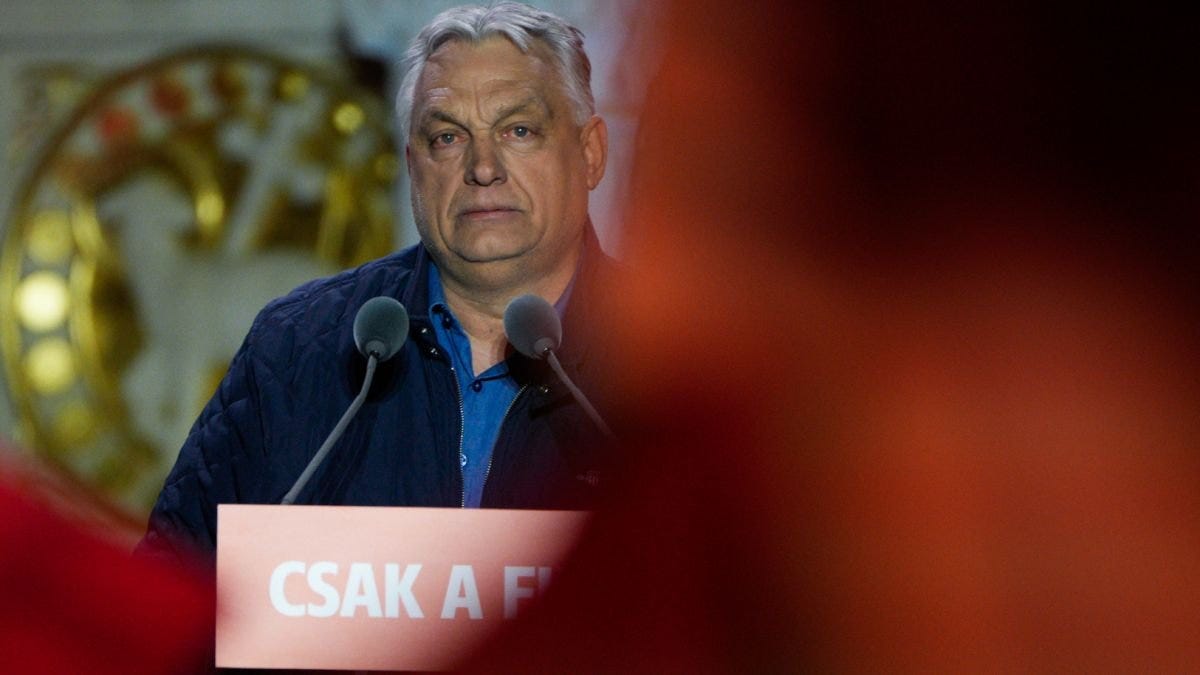
Voters in Hungary have delivered a resounding defeat to Viktor Orbán and his ruling Fidesz party, ending his 16-year hold on power. Though polls had long pointed to victory for the opposition Tisza party, many remained worried. This was an election in which both Moscow and Washington tried to intervene to tilt the balance in favor of Orbán, but both came up short.
Orbán, who conceded defeat, had recently described himself as a mouse serving Putin’s lion.
Indeed, Orbán’s fall is more than a domestic upset. His defeat removes the Kremlin’s most reliable friend inside the European Union.
We publish this newsletter every day at 9:05am NYC time / 4:05pm Kyiv.If you’re not already subscribing, why not do so now?
Corruption itself is a tool of statecraft for Russia.
Hungarian Foreign Minister Péter Szijjártó was revealed in recently leaked transcripts to have privately briefed Russian Foreign Minister Sergey Lavrov during key EU meetings, including a December 2023 summit on Ukraine’s accession. The leaks suggest Hungary shared sensitive EU discussions with Moscow and even offered to pass along internal EU documents. Orbán had also reportedly told Vladimir Putin he was ready to help him “in any way” and compared himself to a mouse serving a lion.
In a May 2025 piece for The National Interest, I argued that “Beijing and Moscow have no issue with Orbán looting the country and turning Hungary into the EU’s most corrupt state,” in part because corruption itself is a tool of statecraft for Russia. By fostering weak institutions, entrenched graft, and energy dependence—particularly through reliance on Russian gas—Moscow can keep neighboring states politically pliable and economically constrained.
Magyar, Hungary’s new PM, has opposed fast-tracking Ukraine’s EU membership and rejected sending weapons to Kyiv.
Simon Ostrovsky, a PBS Special Correspondent commenting on Orbán’s rule, 𝕏wrote on X on 11 April, “Romania—once the poor man of Europe—has overtaken Hungary in almost every metric after 16 years of Orban.”
The recently announced opposition winner, Péter Magyar, whose name literally means “Peter the Hungarian,” campaigned on a promise to clean up corruption and dismantle this system. However, his position on Ukraine remains unclear, leaving open the question of whether a post-Orbán government would fundamentally shift Hungary’s position regarding Russia’s ongoing invasion of its eastern neighbor.
Hungary’s new PM on Russia: “If necessary, we will negotiate, but we won’t become friends.”