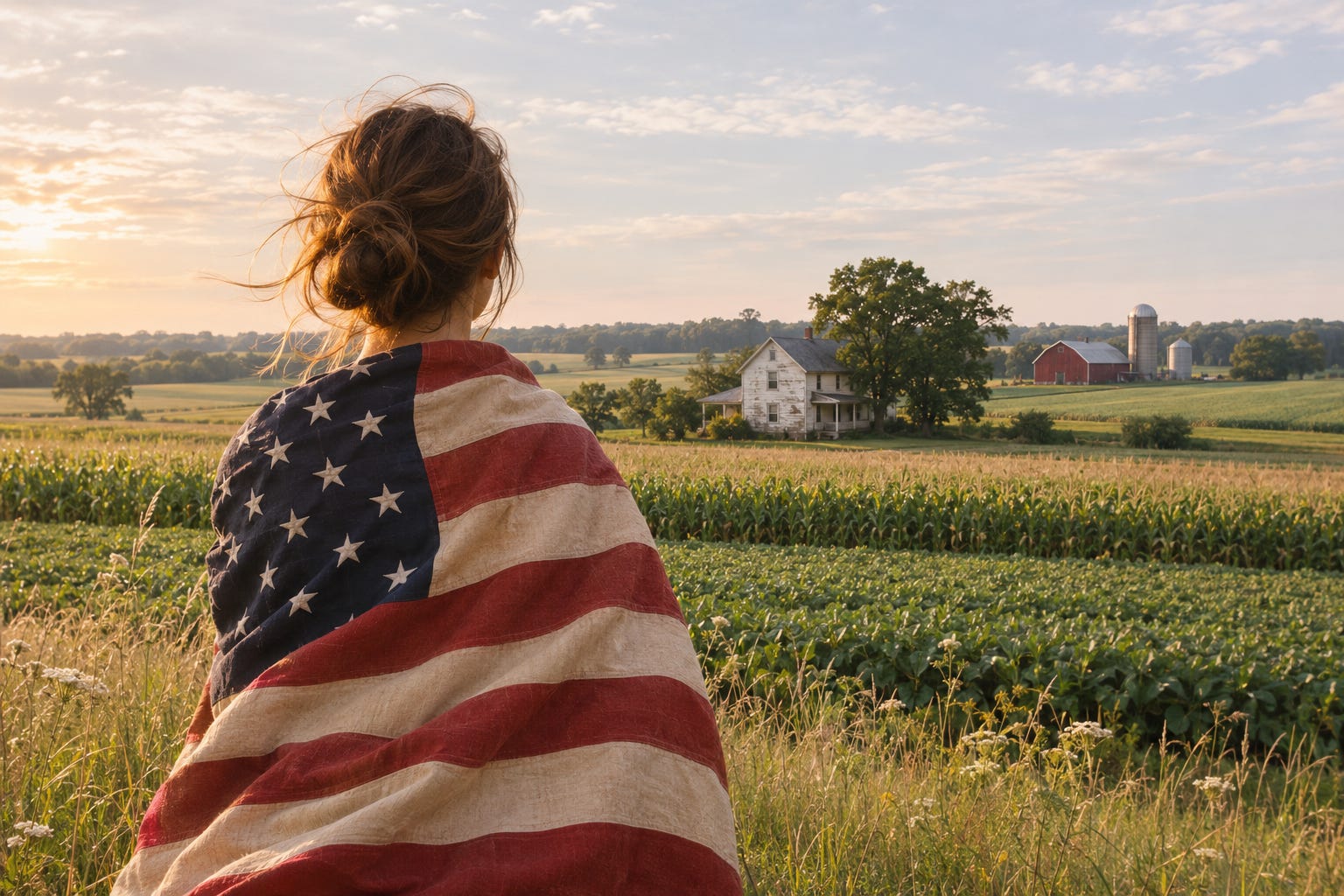
Every morning in elementary school, there was a Xeroxed sheet waiting on my desk with the Pledge of Allegiance and the words to whatever songs we were going to sing that day. I always looked to see which songs we got. Then I’d stand beside my desk, face the American flag at the front of the room, and put my little hand over my heart. Before I’d said a word or sung a note, that heart was already swelling with pride. I was a little Jewish girl in Michigan, and of all the places in the world I could’ve been born, I got to be born here.
Some mornings the music would come over the loudspeaker and we’d sing “The Star-Spangled Banner.” Other mornings it was “This Land Is Your Land” or “She’ll Be Coming ’Round the Mountain.” I loved the surprise of it. I also love, looking back, that somewhere in that school was a grown-up running off copies so every kid in every classroom would have the words. It mattered to somebody that we sang together.
My husband and I watched Young Washington the other night, and I felt that same pride I felt standing beside my desk. I loved seeing George Washington young, with all the decisions we remember him for still ahead of him. We know how the American Revolution ends before we ever open a history book. The people who fought it had to decide what they were willing to risk while the king of England still had every reason to expect he’d win. I kept thinking about the wives and mothers who watched somebody they loved leave home to go fight the British. Imagine how long a day could be when you were waiting for word.
I look at what those families risked and what came of it, and I think this country is a miracle. People who’d spent their lives as subjects of a king decided they could govern themselves. Here I am, generations later, a Jewish woman in Florida who can criticize a president, walk away from the political party I belonged to most of my life and publish every word of it under my own name. The American experiment is still working well enough for me to do that. I know what a privilege that is, and I’m grateful for it.
Washington still comes in second to Abraham Lincoln, though. In elementary school I read a book I remember as Young Abraham Lincoln, and I decided he was my most favorite president. There was something about that boy I could relate to. I wish I remembered what it was, because I’d love to go back and read the page that did it. What’s stayed with me is that I have a favorite president. Somebody put a book in my hands, I met a kid named Abraham, and I’ve been loyal to him ever since.
We memorized parts of speeches. We learned the Preamble to the Constitution, and a whole lot of us still hear the Schoolhouse Rock! tune whenever somebody says “We the People.” On Saturday mornings, a little rolled-up bill sat on the Capitol steps and explained what it would take for him to become a law. Between the books at school and the cartoons at home, there were grown-ups all over the place who thought American children ought to know how their country worked. They even figured out how to get us to sing about Congress on our day off.
And for any kid who thinks the Founding Fathers were eye-roll boooorringgg, somebody please hand them Ben Franklin’s letter advising a young man to get married. In the event that the fellow intended to ignore him, Franklin provided eight reasons for choosing an older woman as his mistress. Eight. Tell a roomful of teenagers that Ben Franklin put his thoughts about cougars in writing and see if anybody wants to read an original document. We’ve got enough material for a Netflix drama, and somehow we’ve convinced kids these people were epically lame.
What I loved about learning American history was getting to know the people who made it. That’s also what I mean when I say I want children taught all of it. George Washington enslaved people. A child learning about the fight for independence is old enough to understand what it meant for a family at Mount Vernon to hear people talk about liberty while somebody else owned their children. That belongs in the story we tell about Washington. So does the day he stood before Congress after the war, resigned his commission and went home to Virginia. A people who’d just fought to get out from under a king had to find out what the man in command of their army would do with his power. He gave it up.
I want my grandchildren to know enough about slavery to understand what Frederick Douglass meant when he asked what the Fourth of July meant to an enslaved person. I want them to know enough about America to understand why he asked his fellow Americans that question. He expected an answer from a country that had put its promise of equality in writing. There’s a great deal for a child to learn from an American who knew exactly where his country had failed and spent his life insisting it could do better. That belongs to my grandchildren, too.
What I find incredulous is how easily teaching a child about the wrongs Americans committed can turn into teaching her that there’s something wrong with her. She’s supposed to be ashamed of being American, ashamed of being white, ashamed that she grew up with opportunities somebody else didn’t have. What do we want that child to understand about her own family? I’m third-generation American on some sides of mine and fourth on others. I had family who lived through the Depression, lost everything and had to build a life all over again. If they could see how comfortably their children and grandchildren live today, I think they’d be proud enough to explode. This is what they worked for. Who are we to turn it into something their grandchildren should apologize for?
Picture a sixteen-year-old pulling into the school parking lot in the car she got for her birthday. Maybe it came brand-new off the lot. Maybe it’s new to her and her mother’s still reminding her to check the gas gauge. She has a parent’s credit card in her wallet and a $2,500 phone she’s trying to hide from her teacher. She can order something from the front seat of that car and come home to find it at the door. She can text a friend in France in seconds. Text, naturally. God forbid anybody should talk on the phone.
I raised five children. I understand the pleasure of handing your kid something you worked hard to give them. I also know how easy it is for kids to take for granted everything that’s been there all their lives. The car and the phone are the things they can see. Harder to notice is the freedom to use that phone to denounce their government in public, under their own name, and go home fully expecting to sleep in their own bed that night. There are parents in this world who would give up everything they own so their child could go to bed with that expectation. I’d like our children to get to know some of those families before they decide there’s nothing here worth keeping.
When I hear a young American say they want to see this country burn, I want to hear what they think happens the next morning. Who’s in charge? Do you still get a vote? What reason do you have to believe the people who take power will extend you the same freedom you just used to help bring down the last government? I’d ask those questions in Canada, Britain and Australia, too. Across the West, the kids old enough to say “burn it down” today will soon be teaching in our classrooms, writing our laws and raising children of their own. What they believe about their countries will matter to everyone who lives in them.
And where did they learn it? The generation teaching this one sat in somebody’s classroom, too. A girl who learns to be embarrassed by her own patriotism can grow up to be the teacher at the front of the room when another little girl puts her hand over her heart. Children pay attention to the look on a grown-up’s face. They know when something they feel with their whole heart is about to get a laugh, and they learn pretty quickly to keep it to themselves. Give that another generation and who’s left to tell the kids why anybody stood up in the first place?
I’ve heard the argument that I was indoctrinated because I stood beside my desk and pledged allegiance to the flag. I meant that pledge. I’ve had a lifetime since elementary school to read the history, question the people in office, cast my votes and make up my own mind. I am a loyal, patriotic American. I was proud to be one as a child, and I have a much longer list of reasons now. And I still mean that pledge.
We need patriotism back in our schools, in the books we give our children and in the conversations they hear at home. Let them hear us say what we love about this place as freely as they hear us complain about an election. Tell them who in their own family went without, who started over, who got to do something their parents could only dream of. Give them enough history to recognize an injustice and enough faith in their fellow Americans to believe they can do something about it together. If all we hand them is a list of what’s wrong with America, we can hardly act surprised when they grow up willing to lose it.
I still love this country the way I did when I stood beside that desk in Michigan. And I want to have faith in the people I share it with, including the ones who disagree with just about everything I write. I couldn’t have told you how the families of the kids in my classroom voted. I could’ve told you what we sounded like when we sang together. I want to believe we still have that in us.
I’ve written a few songs of my own. My favorite is We All Bleed Red, White, and Blue. All these years later, that little girl who used to look down at her desk to see what she’d get to sing about America grew up and wrote a song of her own. I’d like you to hear it.
One of these days I want to sit down with my two grandchildren and read Young Abraham Lincoln again. I’m curious whether I’ll recognize the page that won me over. And I think I’ll make two copies of “This Land Is Your Land,” one for each of them, the way somebody once made a copy for me. I want them to hear the word your coming from their grandmother. I can still remember how proud I was to sing these songs out loud with the rest of my classmates who felt the same as I did.