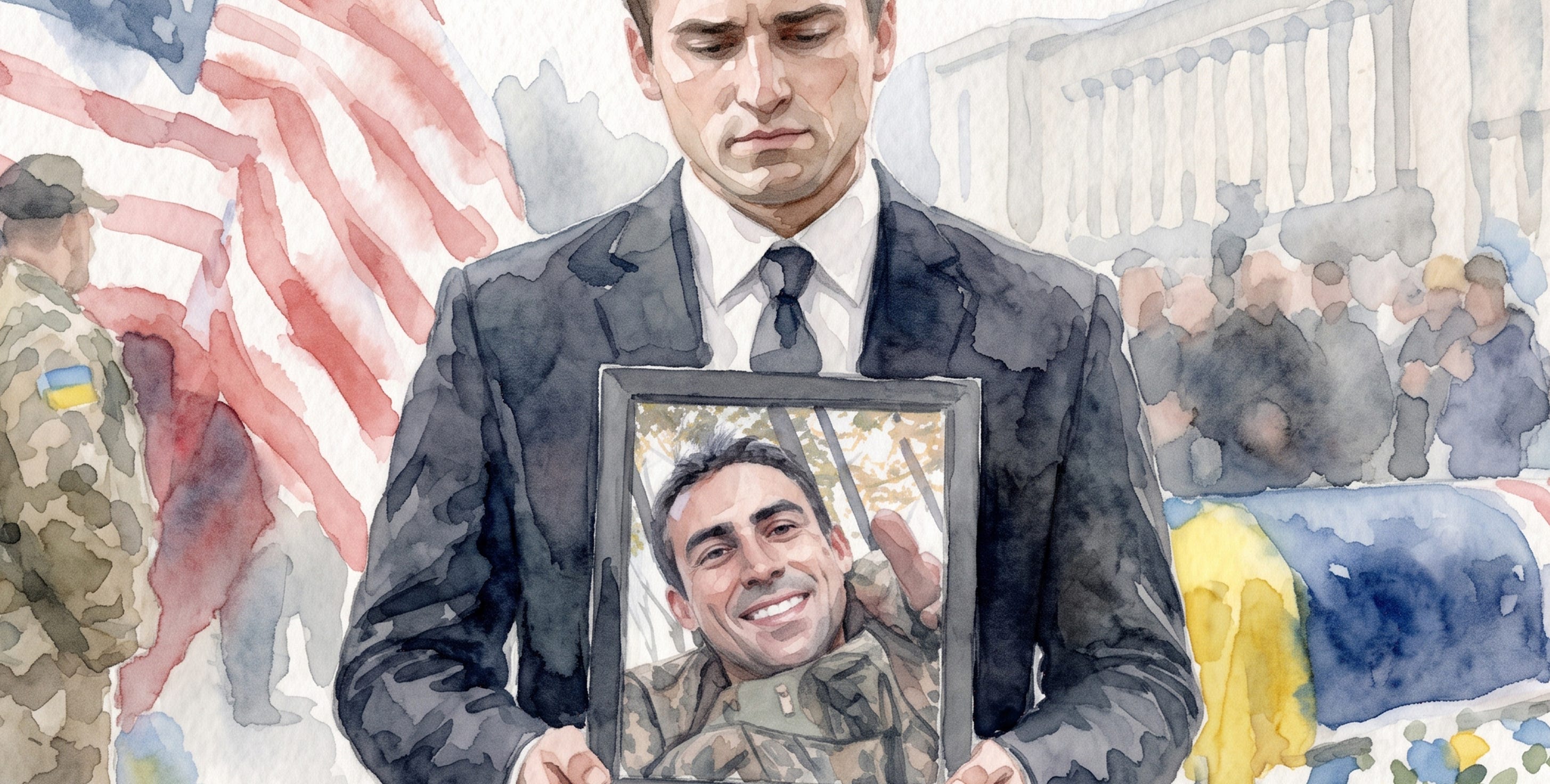
Welcome to Voices of the Fight— a Saturday Q&A series featuring the warriors, innovators, advocates, and volunteers standing under fire for free people.
My name is Alex Meek. My brother Spencer fought with the 3rd Assault Brigade in the Ukrainian army. He lost his life on May 25, 2026, during the initial stages of Operation Vivaldi.
He went to Ukraine in early September 2025. Before that, he had spent some time in the French Foreign Legion and then served with the U.S. Army’s 82nd Airborne Division. Later, he spent roughly a year living off the grid, camping with his dog in the Arizona high desert. That was Spencer. He could survive just about anything.
After his dog died, he felt there was nothing holding him back from going.
People ask why he volunteered. Only my brother could fully answer that, but when I found out, it didn’t surprise me in the least. He saw Putin wrecking people’s lives, and he wasn’t someone who would just stand by if he could do something about it.
We publish this newsletter every day at 9:05am NYC time / 4:05pm Kyiv.Your subscription fuels our work.
There were three of us boys growing up, and we were all incredibly different. When I told people about Spencer, they would say, “Your brother sounds wild. He’s living a life I couldn’t even imagine.” And I would say, “Yeah, that’s Spencer.”
I’m still figuring out what my own mission looks like. I’m an accountant, I haven’t experienced combat. I’m speaking as the brother of someone who did.
But I want other families with a loved one fighting in Ukraine to know there are people who understand what they’re going through. Before this, I never really knew anybody like Spencer. Then I met families of other Americans and foreign volunteers who had gone over there. Hearing their stories helped me grieve.
A lot of us are willing to talk. Talking to each other helps us, too.
On Spencer’s first day in Ukraine, he arrived in Kyiv by bus from Poland. There was an air raid alert, and he was sent down into the subway to shelter before he had even figured out where he was supposed to go.
On his first FaceTime call with our mom, he described being underground with all these women and children.
He had spent so much time on his own before that. Suddenly, he was surrounded by people whose language he barely spoke, but he could still understand what they were going through.
I think his opposition to what Putin was doing got him to Ukraine. But those women and children were what kept him there. When he was fighting, those were the people he was fighting for.
After he died, my dad and I traveled to Ukraine for his military ceremony. The R.T. Weatherman Foundation organized the trip with other families of Americans who had been killed.
We found out on June 3 that Spencer might have been killed. My younger brother’s wedding was June 6. It was quite an emotional week. When the opportunity to travel came up, my mom wasn’t ready to go, and she was worried about us going into a war zone. The foundation’s arrangements made it possible. My dad decided on Wednesday, and we left on Friday.
From the moment we met the other families, I realized this would be one of the most emotional trips of their lives, too. We were there to honor Spencer and eight other men.
The military ceremony and the Mass in Kyiv were things I wasn’t emotionally prepared for. Members of his brigade were there. The gratitude people showed us was unbelievable. They didn’t just say they were grateful. You could feel how much they meant it.
We also visited ** Superhumans Center** near Lviv, where people who had lost limbs were receiving care. Seeing those injuries firsthand was sobering. Then you would learn that some of these men and women wanted to
Almost every conversation on that trip meant something to me. The Ukrainians, the foundation’s team, the other families—we couldn’t be more grateful for what they did for us.
It’s a hard question to answer right now. This is still pretty fresh, and I’m thinking about it every day.
Coming home and trying to do your job the way you did before takes a different kind of effort. I keep thinking that I’m not doing enough here in America compared with someone like my brother, who went over and gave his life.
What I keep coming back to is: What can I do? How can I use my own experience to help?
Right now, one thing I can do is talk to other families and point them toward the ** R.T. Weatherman Foundation**. I know that part firsthand. As I figure out something
Something else from the trip has stayed with me. Someone asked whether I felt safe in Kyiv. The foundation had arranged security, experienced drivers, and a good hotel. I honestly did feel safe.
But I didn’t have family down the street. I didn’t have friends living across the city. When I heard an explosion, I didn’t have that immediate reaction: Where did that come from? Do I know somebody who lives there?
For Ukrainians, that worry is constant. I can’t imagine how emotionally draining it is to know your friends and family are unsafe, too.
I don’t have all the answers about what comes next. But the trip has awakened something in me, and I want to do what I can.
4 | How can people support your work?
I don’t have an organization of my own. Right now, I would point people toward the ** R.T. Weatherman Foundation**.
They help American families, Ukrainian families, and families from other countries, too. They help recover belongings, navigate paperwork, and bring loved ones home. Without them, I honestly don’t know whether we would have Spencer’s ashes right now.
They have wonderful Ukrainians on their team, and we’re incredibly grateful to them. Unfortunately, they keep gaining experience because families keep losing people.
I would also tell Americans to think about this when they vote.
At Spencer’s ceremony, my dad and I both spoke. I looked at the men and women he had served with and told them, “America’s with you.”
Then I came home, read what some of our leaders are saying, and thought: You’ve made me look like a fool. I had just stood in front of these people and assured them we were with them.
I know the people at that ceremony probably don’t remember my exact words. But I remember saying them.
Some Americans say it isn’t our fight or our war. The world is smaller than they think. What happens in Ukraine can have an enormous effect on people’s lives here, too. And I find myself wondering: If our leaders can’t empathize with Ukrainians going through this, will they empathize with us when we’re struggling?
That’s part of why I feel so strongly about doing something myself.
5 | Where can people follow you?
I’m really just a regular guy. I don’t do much on social media, and I’m still deciding how public I want this part of my life to be.
But if talking to me helps somebody, I’m open to that. If you have a family member fighting in Ukraine, or you want to talk about what it’s like to lose a sibling there, you can message me on Instagram at ** @al_meek**.
People still ask, “Why did he go over there? Why would an American fight for Ukraine?”
If you knew Spencer, you wouldn’t ask that question. This was something he would do.
I think people asking that sometimes need to ask themselves why somebody else’s decision troubles them so much. It was his life. He chose what to do with it, and I fully supported him.
I believe he went for a noble cause.
Nikolaus Muchitsch is chief of staff and strategy at Under Fire News.
Your subscription fuels our work.
What else we’re watching today:
**Trump Waives New Russia Sanctions Before They Take Effect—**President Donald Trump hassigned an executive order waiving key Russia-related sanctions and tariffsunder legislation he approved in September, intervening just before the measures were due to take effect. The law, named after the late Senator Lindsey Graham, sought to restrict financing for Russia’s war through penalties targeting officials, oligarchs, financial institutions, and countries buying Russian energy.
Trump invoked a national-interest waiver permitted by the legislation, with the exemption remaining effective until his administration decides further action is appropriate. The waived provisions included tariffs of up to 100% affecting major buyers of Russian oil and gas, including China and India. The decision follows Washington’s controversial Russian diesel agreement and comes as rising fuel costs threaten Republicans ahead of November’s midterm elections. Democratic Representative Don Beyer condemned the waiver as a betrayal of Ukraine and Congress’s intent, while Putin’s investment envoy Kirill Dmitriev welcomed it as a historic moment.**Starshield Dispute Deepens Washington’s Rift With Kyiv—**The dispute over restrictions on Ukraine’s military satellite communications hasdeepened the crisis between Washington and Kyiv, CNN reports, as President Donald Trump pressures Ukraine to stop attacking Russian oil refineries. CNN’s analysis connects the confrontation to Trump’s effort to lower energy prices ahead of November’s midterm elections, arguing that the economic consequences of the Iran war are shaping his approach to Ukraine. President Volodymyr Zelenskyy has vowed to resume refinery strikes despite Washington’s objections. RUSI analyst Tom Keatinge told CNN that Trump was placing his electoral interests ahead of Ukrainian security and lives.
Separately, Reuters reported that the order to restrict Starshield originated inside the White House, although its sources did not identify who issued it. A senior U.S. official denied that Trump personally requested the restrictions.**Europe Rallies Around Ukraine Amid Satellite Restrictions and Missile Shortages—**President Volodymyr Zelenskyythanked Europe’s “real leaders” at the Brussels summit, emphasizing their support as relations with Washington deteriorated over Russian energy exports and restrictions on Ukraine’s military satellite communications. Ukraine resumed refinery strikes after a three-day pause, saying Russia had continued attacking throughout the proposed energy ceasefire. Zelenskyy said Starshield service was improving but remained below its previous capabilities, disrupting logistics and civilian protection; Trump denied responsibility for any restrictions.
The Ukrainian president also warned that Patriot interceptors were increasingly going to the Middle East, while a source told CNN that Ukraine had exhausted its stocks. Asked whether Trump was scapegoating Ukraine for high fuel prices and the Iran war, Zelenskyy paused for 15 seconds before saying, “This is my answer.” He nevertheless thanked the White House and said contacts with U.S. negotiators continued.**Iran’s Precision Strikes Expose Gulf Infrastructure Vulnerabilities—**Iran and its proxies havesystematically targeted critical Gulf infrastructure, disabling essential equipment and triggering wider disruptions, a Reuters investigation found. The agency identified at least 135 drone and missile attacks on 84 infrastructure sites across seven countries since the U.S. and Israel began bombing Iran on February 28. Strikes disrupted oil-routing equipment at the UAE’s Fujairah port, damaged gas-liquefaction equipment at Qatar’s Ras Laffan complex, and hit pumping stations along Saudi Arabia’s East-West Pipeline. Attacks on Fujairah and the pipeline impaired important alternatives to shipping through the Strait of Hormuz, compounding Iran’s blockade. Russia has also reportedly supplied Iran with satellite imagery to support targeting and agreed to provide 2,500 shoulder-fired air-defense missiles, with deliveries scheduled for 2027–2029.**SkyForce Tests Autonomous Interception of High-Speed Drones—**Ukrainian defense company SkyForce istesting SFERA, a platform designed to automate drone interception, including engagements against high-speed and jet-powered targets. The system combines drone control, optical navigation, and autonomous interception technology, with the goal of supporting different unmanned aircraft and interceptor models. According to SkyForce, an operator selects the drone for an engagement, after which the platform controls its flight automatically. The operator can cancel the mission in flight, prompting the aircraft to land in a safe area. SFERA currently supports several interceptor types operating from locations separate from the control center, using radio or internet connections, including Starlink. During field trials, developers are testing an approach intended to engage each target in a single sortie, with the option of assigning a backup interceptor if the primary aircraft encounters problems.
underfire.news | PayPal | X | Instagram | LinkedIn | Youtube | Facebook