This piece includes a paid sponsorship from Ground News.
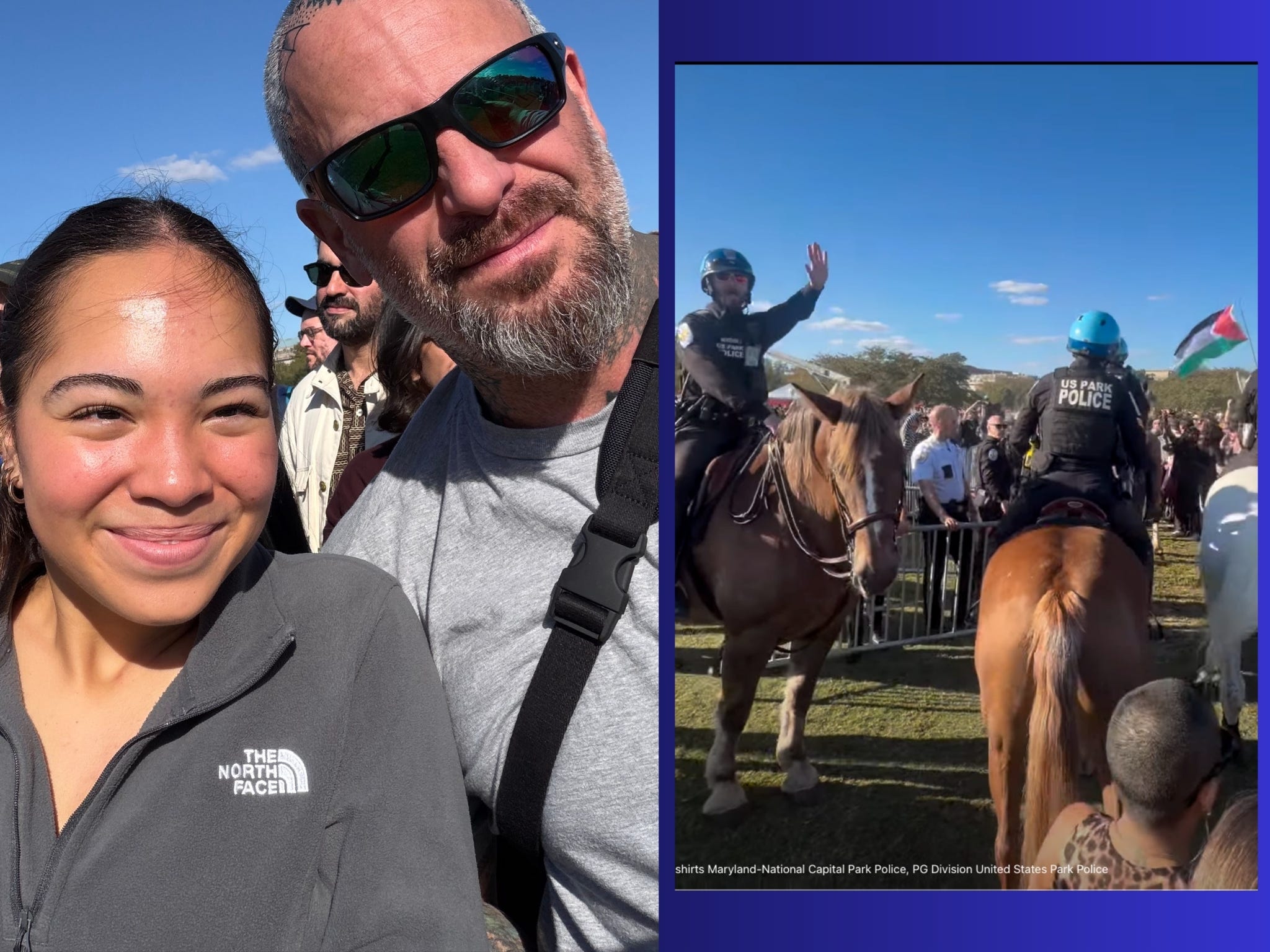
On Saturday afternoon, October 24, I took my daughter Piper to see Turnstile on the National Mall. The Washington Monument was behind us. Friends and families were out together. Parents had kids on their shoulders. People were moshing and crowd-surfing—the entirely predictable behavior of an audience at a hardcore show.
I know the guys in Turnstile well. They’re a Grammy-winning band from Baltimore and this free concert was raising money for humanitarian relief in Palestine, Sudan, and Lebanon. It was an opportunity to hear some great fuckin’ music, spend quality time with my daughter, and support people who desperately need help.
Then United States Park Police moved horses into the crowd.
I could hear officers saying they were responding to moshing and crowd-surfing. I saw no fight in the area where we were. What I did see was a mounted officer hemmed in by people, a horse backing into the audience, and people screaming and scrambling toward the fences.
A father nearby had his young daughter on his shoulders. Piper was beside me. Instead of watching the band, we were trying not to get trampled.
I started yelling at the officers to stop.
The danger was right there at ground level. From a saddle, an officer can look over the people around him. Down in the audience, your view is blocked by other people. You cannot necessarily see the route the rider expects you to take. You cannot make a fence disappear or move every person behind you out of the way.
I could see people trying to retreat as the horse backed toward them. There were screams, bodies moving, and people trying to avoid the fencing. The father carrying his daughter had to contend with that movement while keeping her above the crowd. I had Piper beside me. Those were the people whose safety should have governed the officers’ decisions.
There is a difference between asking an audience to give you space and using a horse to take space that people cannot safely surrender. Once that pressure starts, it reaches beyond whoever is directly beside the animal. People farther back have to react to the people being pushed toward them.
That is why I was yelling. I wanted the officers to stop what they were doing before somebody went down. From where I stood, their intervention was creating the emergency we were all having to respond to.
They needed somewhere to go.
The Washington Post reported an organizer estimate of about 60,000 people at the show. A crowd that large requires a plan built around the people who will actually attend. At a Turnstile concert, that means accounting for moshing, crowd-surfing, families, and people who want to stand and listen.
A police officer on horseback can tell someone to move. The command does not create an escape route.
The people below that rider have bodies around them, fencing nearby, and limited room to react. If someone backs into the person behind them, the danger spreads. People farther away may have no idea a horse is coming. They hear screaming, feel the crowd shift, and struggle to keep their footing.
Someone who falls can be trampled by a horse or crushed by people trying to get away. Children are especially vulnerable in that confusion. People could have been killed.
That is a foreseeable consequence that belongs in the decision before an officer moves a horse into a packed audience. From where I stood, the police intervention made the situation more dangerous.
The first clip you see can determine what you think happened. That’s one reason I value Ground News, the subscriber-supported media-literacy tool sponsoring this piece.
On its app and website, you can compare headlines and reporting from different outlets side by side. Its Blindspot Feed highlights stories receiving disproportionate coverage from one side of the political spectrum, helping you notice what your usual news sources might leave out.
I want readers to examine the evidence, including evidence that challenges their first impression. Ground News gives you a practical way to broaden that reading before settling on a conclusion.
Go to groundnews.com/fanone to subscribe for 40% off the Vantage plan. Support this publication’s sponsor and give yourself more ways to examine the stories shaping your understanding of the world.
Some people threw water bottles toward the mounted officers after the horses moved into the crowd. Throwing objects can injure people and animals. I’m not encouraging it or excusing it.
But the order of events matters.
An image of a bottle in the air cannot establish that an earlier police intervention was necessary. To assess that decision, you need to see what happened before the bottle was thrown: where the officers were, what they were saying, how much room people had, and what changed when the horses moved in.
Most people around me were remarkably restrained. They were trying to get away. That fact belongs in the account as much as any image of an angry reaction.
I expect an explanation about officers responding to a fight. If that is the explanation, the agency needs to identify the fight, establish when it began, and explain how moving horses through the surrounding audience helped resolve it safely.
I saw no fight where this happened. I heard officers talking about moshing and crowd-surfing. Park Police needs to address that directly, with evidence.
A general description of an unruly crowd would leave out the central issue: what the police themselves did to change the situation. An officer’s account of feeling surrounded also needs to explain how the officer entered that space. A description of people running needs to include what they were running from.
Otherwise, you end up with a familiar and deeply dishonest account of police action: officers escalate a situation, people react to the danger, and that reaction becomes the justification for the escalation.
That is bullshit. The public deserves the whole sequence.
I also reject the assumption that what happened can be dismissed as a horse getting confused and backing up accidentally.
What I saw looked like a deliberate use of the horse to push people back. In my assessment, they brought a riot-control response to a concert audience. That assessment should be examined alongside the deployment orders and full recordings. I am not claiming to have seen an order I have not seen.
But using an animal’s body to force people to retreat is a serious tactical choice. Having a crowd-dispersal maneuver available does not make it appropriate for every crowd an officer wants to move.
The father with his daughter on his shoulders should have been part of that calculation. So should Piper, and the other families around us. Their safety was the responsibility of the officers working that event.
The horse was owed better judgment, too. It did not choose to be put in that position. Responsibility belongs to the people directing it.
And an officer hearing someone yell should consider what that person is trying to communicate. A raised voice does not automatically identify the source of a problem. Sometimes it is the person on the ground trying to stop an officer from making the danger worse.
I saw police tactics at this benefit concert that were more aggressive than a lot of what I witnessed from police on January 6. I know how that comparison sounds. I was there for both, and I am talking about how officers chose to use force against the people in front of them.
On January 6, a violent mob was attacking the Capitol to stop the transfer of power. On the Mall, I was standing with my daughter at a benefit concert. These officers were treating the audience like a riot at a political rally. The conduct I saw around me did not justify that response.
The fact that the concert raised money for Palestine did not turn the people attending it into a threat. Neither did the music, the moshing, or the crowd-surfing. An officer’s job was to assess what people were actually doing and make decisions that kept them safe. What I saw was a response wildly out of proportion to the situation in front of them.
That is what I was trying to do.
I want the concert recordings, audience videos, police recordings, radio traffic, and supervisory instructions preserved. Examine the decisions and their consequences together. Do not let a few seconds selected after the confrontation substitute for a complete account of how it began.
I am staying measured because I want the facts to be impossible to dismiss. I know what I heard. I know what I saw in the area around me. And I know what it felt like to have my daughter beside me while people tried to get out of the way.
The experience also deepened my concern about federal policing under this administration. I increasingly see agencies treating compliance as the first priority and the public’s safety as something to consider afterward. That is my judgment about the direction of federal policing; this encounter reinforced it.
A badge creates an obligation to protect the people in front of you. That includes people raising money for Palestine, enjoying music, or behaving in ways an officer finds irritating. Moshing does not erase that obligation. Crowd-surfing does not erase it. An angry reaction after a dangerous intervention does not erase what happened first.
We went to the Mall to enjoy a free concert together. Families should not have had to spend part of that afternoon trying to escape getting trampled by police on horseback.
The job was to get those families home safely. Every decision should be judged against that responsibility.