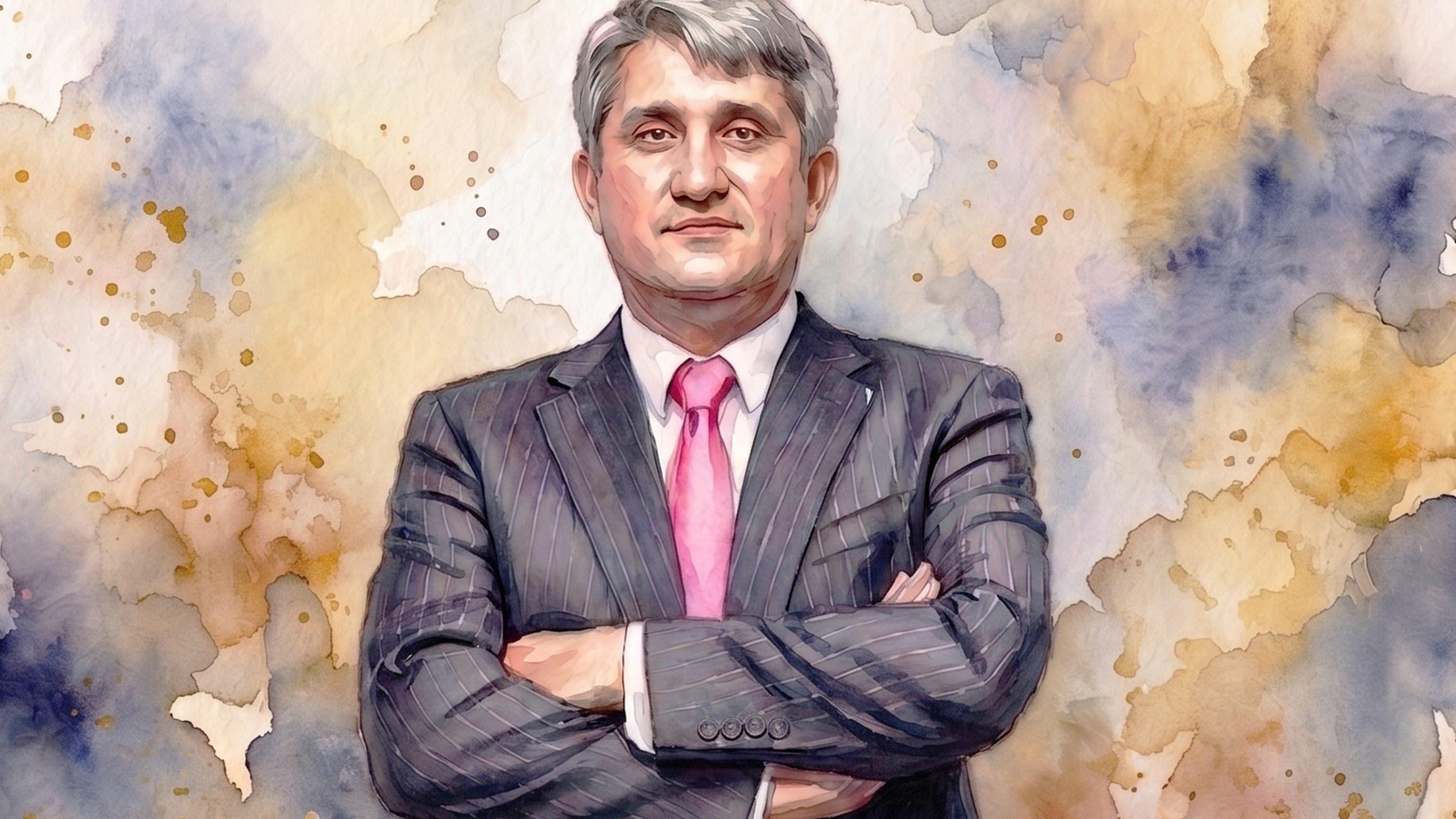
Welcome to Voices of the Fight— a Saturday Q&A series featuring the warriors, innovators, advocates, and volunteers standing under fire for free people.
My name is Roman Sulzhyk and I am a Kyiv native. Early in life, I was fortunate to attend one of Ukraine’s best physics and mathematics schools. At one point, I ranked second in the country in mathematics. It was an unusual childhood: you were surrounded by some of the brightest students in the Soviet Union, and every day revolved around solving mathematical or physics problems and competing with one another.
We publish this newsletter every day at 9:05am NYC time / 4:05pm Kyiv.Your subscription fuels our work.
After the Soviet Union collapsed, I had the opportunity to study in Britain and later move to New York. Because I was a high-level programmer, I was able to build a career in the West. I joined J.P. Morgan as a software engineer, eventually became a trader, and was sitting on a trading desk during the 2008 financial crisis—so I sometimes joke that I helped blow up the world economy. I later worked as an exotic rates trader at Deutsche Bank.
But throughout that career, I wanted to return to Ukraine and help change the country. I had effectively won a genetic lottery: I was good at mathematics, could move West, and could make a comfortable living in New York or London. It did not feel right to leave everyone else behind while the people who had seized Ukraine’s assets during the 1990s continued to control the country.
I returned after 2014 and eventually served on the supervisory board of PrivatBank, Ukraine’s largest bank, where I became involved in its legal fight to recover billions from its former owners.
When the full-scale war began, I told the people around me that we needed to build a fund capable of turning the volunteer defense movement into a permanent military technology industry. We wanted to ensure that these engineers would not simply return to their old IT jobs after the war. Ukraine needed an industry comparable to Israel’s: one that would remain, export technology, and employ people returning from the front.
I never imagined, when we started in 2023, that the sector would grow this quickly or attract this much international capital.
My broader mission is to help replace the oligarchic capital that dominated Ukraine for 30 years with a new generation of entrepreneurs who have different principles and values, who can draw on Western capital, and who can build a Ukraine I would be proud of.
When I consider an investment, some of the questions I ask myself are: Do I want this founder to become a multimillionaire? Would I want this person running a major company—or perhaps even the country—in 20 years? Would I want my son to work for him?
We are making investments with an impact. Of course, we want strong returns, but we also want to empower the right people: founders who create genuine value, do not pay kickbacks to obtain contracts, and intend to keep that value in Ukraine. I want the people who become wealthy through this new defense industry to remember the price others paid for the country—the soldiers who were killed, the amputees, and their families—and to accept responsibility for them.
For most of Ukraine’s recent history, anyone wishing to make a large investment had to deal with people who acquired state assets during the 1990s. Unsurprisingly, many foreign investors concluded that Ukrainians were crooks. But they were encountering a very particular class of Ukrainians: the people who had captured the economy.
Clean Western capital gives a new generation something else to rely on. I want Resist.UA to be one of the institutions directing that capital toward the bright young people who should build Ukraine’s future.
This is the story that explains why I started the fund.
I attended the BRAVE1 investor days from the very beginning, when they were still small gatherings outside Boryspil where the first drone manufacturers met investors and military personnel.
At one of these events, I noticed a young engineer who said he was trying to build an inexpensive missile capable of intercepting Shahed drones. He was starting with the solid rocket fuel and building the system from there. I immediately knew that I had to meet him.
I visited his team in a garage and asked how the project had begun. He told me that he believed missiles would become important, had around $200,000, and had used the money to assemble a group of students and start developing one.
One of the team members had pink hair and looked like a punk. She told me that she had repeatedly won Ukrainian chemistry competitions and graduated from university with honors. Before joining the project, she had been planning to work at McDonald’s because nobody needed chemists. Then this founder found her and asked her to help develop solid rocket fuel.
Another young engineer noticed that the fuel was not polymerizing properly. He wrote a program modeling how the materials interacted at the molecular level, identified the problem, and proposed a change to the manufacturing process. Work that would once have required a supercomputer was being done by a group of young Ukrainians in a garage.
My reaction was: Please, take my money.
I asked the founder where he had found $200,000 at 20 years of age. He replied, “I’m 31.”
I told him that did not change my question.
It turned out that he had put his entire life savings into the company. Since then, the team has attracted multimillion-euro financing and become one of the most sought-after projects in Ukraine’s missile sector.
When I met him, several Western funds were already interested. They had sent him 200-page questionnaires, asked for a three-year business plan, and told him to register a company in Estonia.
I gave him a different offer: “I will negotiate hard with you over the valuation. But once we shake hands, the money will be in your account next week, and we can deal with the paperwork afterward.”
That is the advantage of being local and operating on the ground. At an early stage, when a company is primarily conducting research and development, you need to give the Ukrainian entity money and let the engineers work. Once it becomes a €100 million company, it can establish structures in Britain, Estonia, or Delaware. But forcing founders to build an elaborate international structure before they can test their technology only slows them down.
Today, the Western funds that once demanded those 200-page questionnaires are willing to invest in the Ukrainian company because they want to be part of the story.
The technology is important, but the founder matters just as much. Could this person become a Ukrainian Elon Musk? Could he build a billion-euro company manufacturing air-defense systems for Ukraine and its allies? And, if he succeeds, is he the kind of person I would trust with that influence?
In this case, the answer was yes.
My ability to operate under pressure came primarily from trading.
Software development is creative work. You can sit with a problem, think about it, and develop a solution. Trading is different. When someone asks for a product, you must quote a price. You cannot say, “I need a few days to think about it.” When your boss asks where the market is going, you cannot simply answer, “I don’t know.” They can hire a monkey to say that.
As a trader, you always need a view. You spend years constantly interpreting the market, making decisions, and accepting responsibility for them. Eventually, you stop feeling the pressure in the same way. You become a decision-making machine: you make the best decision possible with the information available at that moment, then move on to the next one. You do not agonize endlessly over whether the previous decision was correct.
That ability is also essential in executive life. The environment may be noisy, uncertain, and stressful, but you still have to separate the decision from the noise.
The same principle applies during the war. Recently, my wife and I woke up as missiles were striking Kyiv. We had to decide whether to take our son to the shelter or move him into the bathroom. While we were discussing it, the explosions stopped, and we went back to sleep.
These are not decisions anyone should have to make, but this is the level of risk with which we live. You accept it and continue doing what you are doing. That is how people lived in London during the Blitz.
We know that any of us could become a statistic during one of these attacks. But Ukraine now has an army, and Europe and the United States are standing with us. For the first time in centuries, we have a genuine opportunity to become permanently free from Russia.
Before the full-scale war, if you had asked me about the probability of Ukraine joining the European Union by 2040, I might have said 10 percent. Today, I would say 90 percent. I may actually live to see Ukraine inside the EU.
Even after the war, however, Russia will attempt to regain influence. People are often surprised by how quickly historical memory fades and how much money Moscow is willing to spend poisoning another country’s political and cultural life.
That is another reason Western capital matters. If the only significant pools of capital in Ukraine remain the old oligarchic networks, many of which have historical connections to Russia, those networks will continue to shape the country. Clean Western investment gives people with different values, principles, and ambitions something on which to build.
Ukraine will only be completely secure when Russia itself changes—when Russian society accepts responsibility for what it has done, repents, pays reparations, and treats Ukrainians as a separate people with the right to exist. I do not expect to live long enough to see that..
4 | How can people support your work?
First, I want to emphasize how grateful I am for everything Europe and the United States have done. Without Western financial and military support, Ukraine could not continue fighting, and much of our defense technology industry would not exist. Western taxpayers and voters are part of this struggle, just as we are.
But there is also an opportunity to move beyond being a donor and become a participant in Ukraine’s success.
We have launched Resist 2.0, an Estonian-based fund targeting up to €50 million. It is intended for qualified investors rather than retail investors, and the minimum commitment is several hundred thousand euros.
Anyone who qualifies and is interested can contact me or the fund through LinkedIn. I am always happy to explain what we are building.
Because we are a boutique fund, investors can also engage directly with the ecosystem. They can come to Ukraine, meet the founders, and see the technologies being developed. Meeting the young engineers behind these companies can be a transformative experience. You are no longer reading abstract reports about Ukrainian innovation—you are standing in the workshop with the people building it.
That is how people can help most directly: by becoming part of the new Western capital base Ukraine needs and helping us build a generation of entrepreneurs and future leaders whom both Ukrainians and their investors can be proud of.
5 | Where can people follow you?
LinkedIn is the main platform I use professionally. People can follow my personal account as well as the Resist.UA company page. I still use Facebook occasionally, mainly to publish longer essays, but I am much less active there.
For now, LinkedIn and the Resist.UA website are the best places to follow our work.
Website: resist.uaRoman Sulzhyk on LinkedIn: linkedin.com/in/roman-sulzhyk-a662b7Resist.UA on LinkedIn: linkedin.com/company/resist-ua
What else we’re watching today:
**Ukraine urged to counter Russia’s Rassvet satellite network now—**Russia is deploying Rassvet, a low-Earth-orbit satellite constellation by Bureau 1440 that could give its drones and cruise missiles secure, beyond-line-of-sight control — mirroring how Ukraine uses Starlink to strike air defenses and logistics. Two batches of 16 satellites launched in 2026 already provide brief daily coverage windows over Ukraine, with continuous coverage expected as the fleet grows toward commercial use in 2027.
Experts warn jamming the Ku/Ka-band signals is technically hard, and Ukraine must act before Russia deploys the network at scale.
**US and Ukraine to upgrade S-300s as Patriot missiles run short—**The US is running low on Patriots — down from ~2,330 missiles before the war to about 800, drained largely by defending Gulf allies against Iran. Production sits at ~600 a year, and a $58B ramp-up to 2,000/year won’t be fully delivered until 2032. Ukraine has received only ~600 Patriots the whole war.To help plug the gap, a joint US-Ukraine project will modernize old S-300 missiles starting late this year — though only a hundred or two annually. France’s SAMP/T batteries are another stopgap. Experts warn none of it is a quick fix.
**Ukraine’s FP-7 Nears the Battlefield—**Fire Point says its FP-7 ballistic missile isundergoingmilitary codification after roughly 15 test launches, with the first combat deployment expected in early autumn. The missile is designed to carry a 200-kilogram warhead up to 300 kilometers, placing Russian airfields, logistics hubs, command posts, and missile launch areas within reach of a Ukrainian weapon that is faster and harder to intercept than conventional long-range drones.
A larger FP-9, carrying 800 kilograms over 850 kilometers, is planned for late autumn. If those schedules hold, Ukraine would gain something Western partners have supplied only sparingly and with political restrictions: a sovereign ballistic strike capability.**Why a Battlefield Robot Needs Wi-Fi—**Ukrainian manufacturer Roboneers hasaddedWi-Fi control to its Lynx Pro and Lynx+ ground robots after soldiers requested another option for areas where LTE, Starlink, or conventional radio links fail. An operator can now connect through a relay at distances of up to 60 meters, supplementing the platforms’ existing digital mesh, satellite, and cellular communications.The upgrade sounds modest beside the Lynx+’s 80-kilometer range, but ground robots become expensive obstacles the moment terrain or electronic warfare severs control, so a short-range fallback can help crews recover, service, or maneuver a vehicle locally without exposing themselves unnecessarily.
**Sweden Will Build Ukraine’s Battlefield Evacuation Robot—**Ukraine’s AIDRONESUA and Sweden’s NJORD Technology plan tomanufacturethe MAUL casualty-evacuation robot in Sweden, targeting annual production of 400 to 500 platforms for the Ukrainian military. Developed with frontline medics, the 4×4 vehicle uses an internal-combustion engine rather than batteries, giving it up to 100 kilometers of off-road range, a rough-terrain speed of 40 kilometers per hour, and capacity to carry 200 kilograms—enough for a wounded soldier and equipment.The design is already codified and operationally used in Ukraine, while AIDRONESUA will retain its intellectual property and continue upgrading it from battlefield feedback.
**Ukrainian ballistic missile hit its target in testing—**Former Defense Minister Mykhailo Fedorov says a domestically produced ballistic missile struck its target during testing without veering off course, though the trials aren’t finished. He revealed this in an interview with St…