I was oblivious. So were most of us.
On the morning of September 11, 2001, we got up and went about our lives. Made coffee. Got the kids ready. Drove to work. Complained about traffic. Turned up the radio.
I dropped my kids off, one at kindergarten and the other at daycare. I was newly divorced, raising two little kids and driving a green Honda Civic they had named Franklin after the cartoon. I wore a black suit and white top. Music blasting. Singing on my way to work.
I remember all of that. I can’t remember the song I had been singing along to.
My cell phone rang. It was my mom. I talked to her every single morning after I dropped my kids off.
“Did you hear the news?” She sounded breathless, scared.
No. What news?
She told me a plane had hit the World Trade Center. While we were talking, she screamed.
The second plane had hit.
By the time I got to work, everything I had ever believed changed.
I worked in a popular jewelry store. We had a little sitting area where customers normally waited while we cleaned a ring or took something back for repair. A few chairs. A flat-screen television on the wall. There were no customers that day, just the employees gathered around that television.
We watched people running through streets covered in ash. We watched firefighters go in while everyone else tried to get out. We watched people jump because fire was behind them and open air was in front of them. We watched the towers come down.
I remember how close we stood to each other. We worked together every day and had never stood that close. Nobody said anything about it. We were practically touching, building a force field around us as we stared at the television, terrified of what might come next.
Twenty-five years later, we know the story. Four planes. New York. Washington. Shanksville. Nearly 3,000 murdered. That morning we knew nothing.
We didn’t know there were only four planes. We didn’t know whether another was headed for Chicago, Los Angeles, Detroit, or every city in the country. We didn’t know whether bombs had been planted. We didn’t know whether this was the attack or the beginning of something much larger.
For most of us Americans, Islamist terrorism wasn’t part of everyday life. The World Trade Center had been bombed in 1993, but we still went about our lives believing America was different. Wars and suicide bombers belonged somewhere else. We were the land of the free and the home of the brave.
We didn’t have the information machine we carry in our pockets today either. There was an internet, but no X, Facebook, TikTok, or smartphones feeding us videos and manifestos from every corner of the world. Most of us had no idea how deep the hatred of the West ran.
September 11 brought America to its knees.
My workplace stayed open because the owners apparently thought the collapse of the World Trade Center shouldn’t preclude the possibility that someone might need a tennis bracelet. Nobody did. People wanted their children. Their spouses. Gasoline. A way home. In Michigan, gas reached $5 a gallon in some places as panic and price gouging took over. Lines stretched down main roads.
I wanted my babies. I wanted my Mommy. That morning I’d dropped them off and driven to work singing. By afternoon I was wondering what kind of country they would wake up in the next morning and how I was supposed to protect them from something I didn’t understand.
I lived in metro Detroit, and something else happened that day that has never left me. La Shish was in the same mall where I worked. My family ate there. We loved it. The restaurant closed that day, and I remember learning that people there were dancing and celebrating while America was under attack.
On one side of that mall, my coworkers and I were practically touching as we watched Americans jump from burning buildings. On the other, people were celebrating.
Suddenly, “somewhere else” was across the parking lot.
When the planes were grounded, the skies went silent. No contrails. No blinking lights moving across the night sky. No familiar rumble overhead. I had never noticed how much airplanes were part of the background noise of American life until they disappeared.
For days and weeks, we couldn’t turn off the television. We were glued to the screen, watching every scrap of footage. Every new angle. Every rescue. Every recovery. Firefighters covered in dust and grime. People running through clouds of ash. Papers floating through Manhattan. Photographs of the missing taped to walls.
Those images stayed, burned in our collective memory. Some of us can still talk about that morning as if it happened yesterday. Where we were. Who called. What we were wearing. Who was standing beside us. I can still see that television on the wall and my coworkers standing too close.
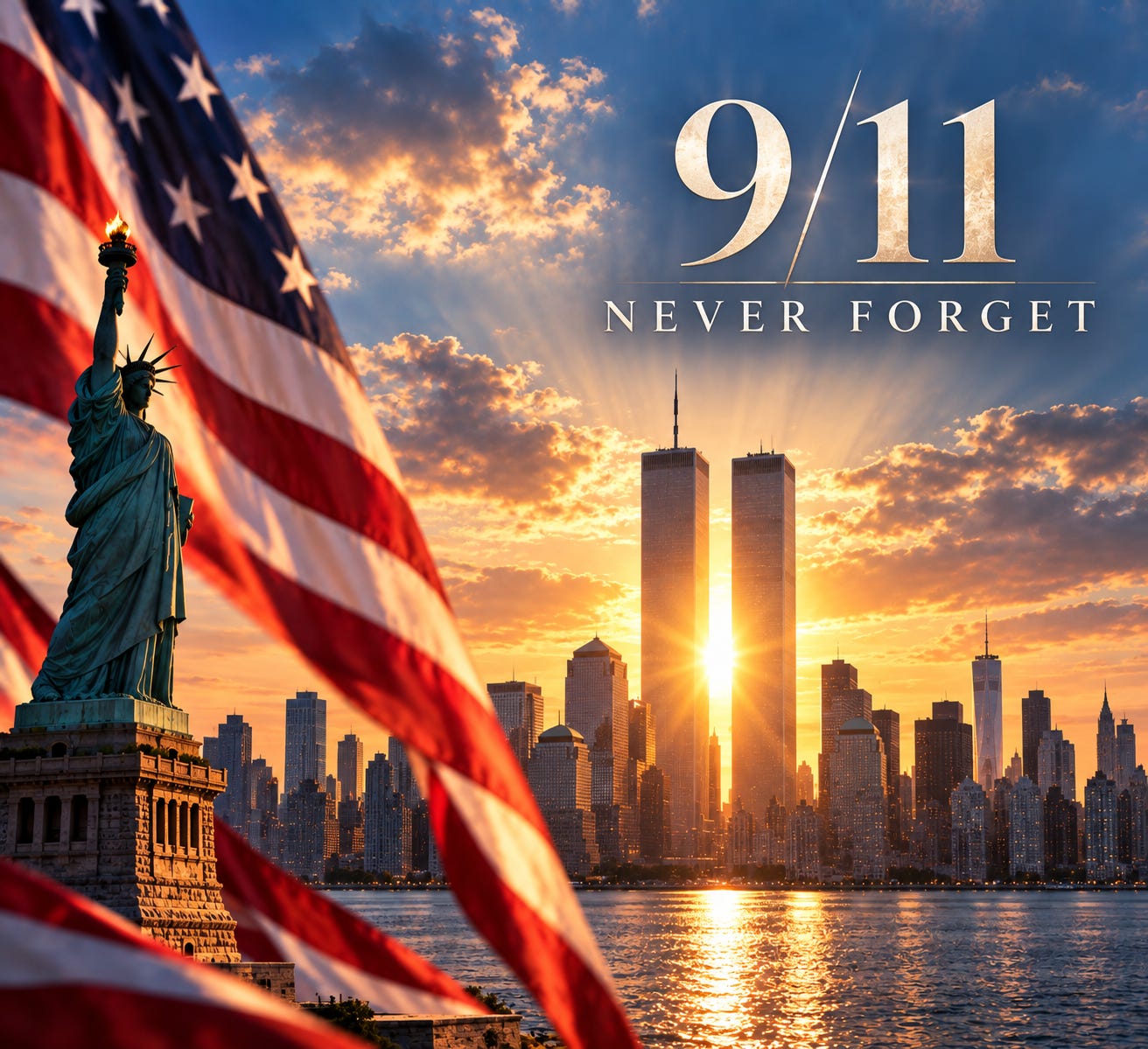
Even the date became an image: 9/11. Maybe this is the marketer in me, but look at it. The two ones standing there like the Twin Towers. Two massive buildings reduced to two strokes on a calendar. Twenty-five years later, 9/11 doesn’t need a year attached to it.
Afterward, we made ourselves a promise.
Never Forget.
It was everywhere. Flags, bumper stickers, T-shirts, firehouses, signs hanging from overpasses. We said it at memorials. We taught it to our children. We weren’t only promising to remember the towers. We needed to remember why they fell.
Nineteen men boarded four airplanes knowing they were going to die for the sickness they believed to be their truth. They turned passenger jets full of innocent people into weapons. They had embraced an Islamist ideology that made murdering thousands of strangers righteous. Al-Qaeda had told us what it believed. Osama bin Laden had publicly called for Americans to be killed years before September 11.
The hatred was already there. On September 11, America finally witnessed it.
Twenty-five years later, too many people have put the blinders back on. Hasan Piker once said America “deserved 9/11.”
Nobody deserved September 11. The people sitting at their desks didn’t deserve it. The passengers on those airplanes didn’t deserve it. The firefighters running into those buildings didn’t deserve it. Their children didn’t deserve to grow up without them.
Nobody deserved October 7 either. A girl dancing at a music festival didn’t deserve it. A family eating breakfast in a kibbutz didn’t deserve it. A baby didn’t deserve it. Nobody deserves to become the human consequence of someone else’s murderous ideology.
“They deserved it” is how people learn to live with someone else’s murder.
In 2001, we could say we didn’t know. Today, we do. We’ve seen New York, Washington, London, Paris, Madrid, Mumbai, and October 7. The obliviousness of September 10, 2001 was pure innocence. We don’t have that luxury, that innocence anymore.
Today will end with another call to remember. Tonight at sundown Rosh Hashanah begins.
All morning, America will read the names of people who got up on a Tuesday expecting to come home. At sundown, Jews will begin asking to be written into the Book of Life.
Judaism doesn’t give us much room to forget. Our calendar brings us back. Our holidays make us tell the stories again. Our prayers make us say the names.
Zachor. Remember.
Tonight I’ll probably livestream Rosh Hashanah services from home. I’ll hear the familiar prayers, dip an apple in honey, and ask to be written into the Book of Life for another year.
It feels especially meaningful tonight. Today I’ll be remembering people who woke up all those years ago expecting an ordinary Tuesday and never came home. At sundown, the Jewish calendar will turn, and we’ll begin again, asking for life, sweetness, and another year.
Judaism has never asked us to begin again by forgetting what came before. Zachor. Remember.
Twenty-five years ago this morning, I drove a little green Honda Civic named Franklin to work. Black suit. White top. Music blasting. My children were safe at kindergarten and daycare, and I thought we were safe here.
I was oblivious. So were millions of us. We didn’t know what was coming or understand the hatred behind it.
Now we do.
Some people still have the blinders on. Some still find ways to explain why the dead had it coming. I don’t have the innocence I had that morning anymore. None of us should.
Tonight I’ll dip that apple in honey and hope for sweetness anyway. I’ll remember the people who never got another year and be grateful that I did.
Twenty-five years ago, we promised we would never forget.
We need to keep our promise.