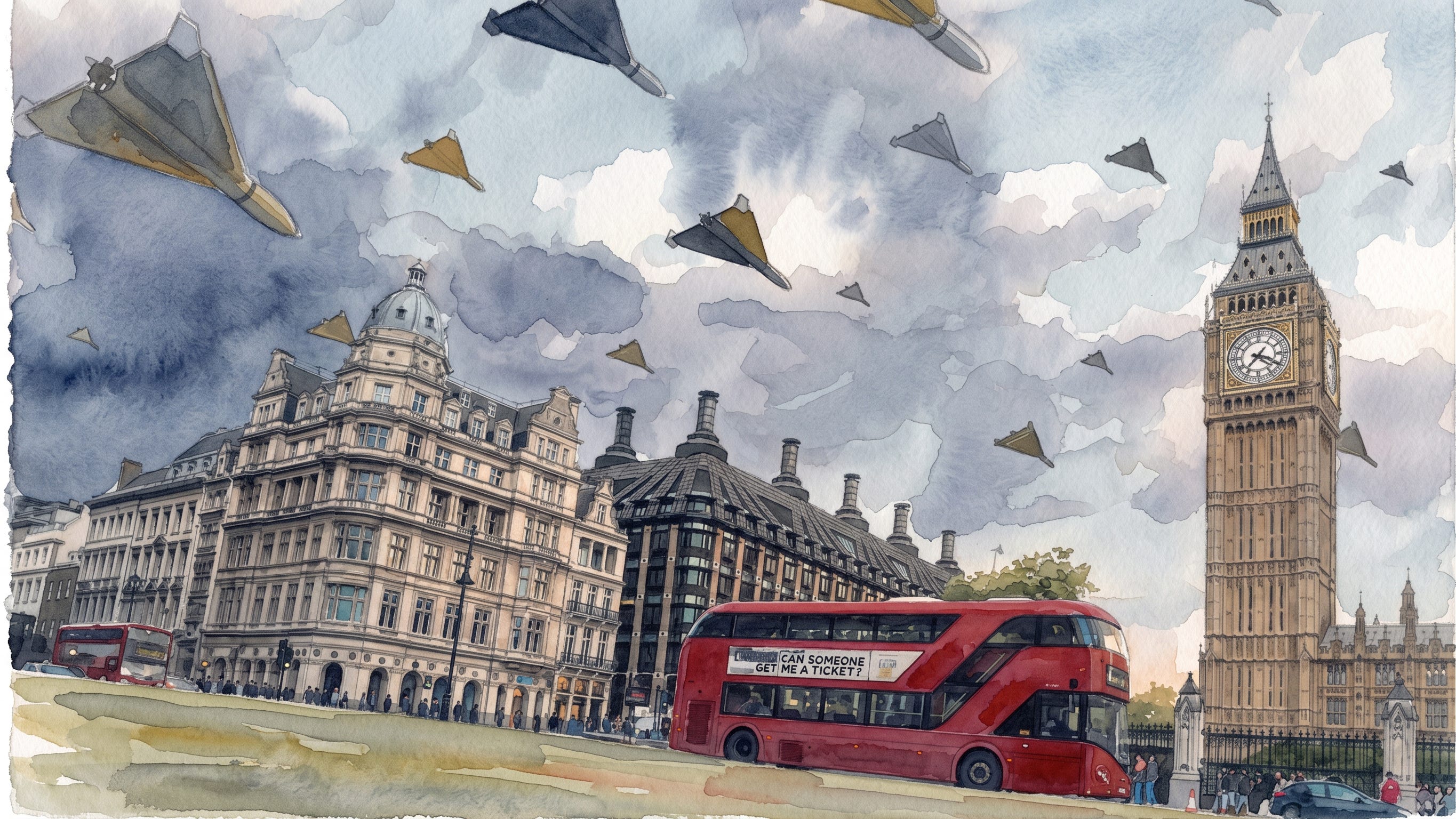
ODESA—Curtis Yarvin, an influential voice to the likes of Peter Thiel and J.D. Vance, finally named his red line for Russia. It was not the Dnipro, the Polish border, or even the Rhine. The United States, he suggested, should become seriously concerned only when Vladimir Putin reaches the English Channel.
We publish this newsletter every day at 9:05am NYC time / 4:05pm Kyiv.Your subscription fuels our work.
He was not speaking metaphorically. The Channel Islands, Yarvin clarified, should remain off-limits. The rest of continental Europe could apparently take its chances under the Russian yoke.
The remark came during a ▶July 31 discussion with John Herbst on Break the Rules, a YouTube channel hosted by Lev Polyakov, a pro-Ukraine podcaster who is adept at bringing together opposing voices. Yarvin delivered his comments with his usual mixture of provocation, historical references, and irony. Beneath the performance, however, was this proposition: America can tolerate Russian domination of Europe because an ocean still separates the United States from the consequences.
Ukrainians are not defending their country because Washington ordered them to do so.
They are fighting because surrender would place their families, institutions, and national future in the hands of the state that invaded them.
Herbst’s response was equally clear: America has tried variations of that theory before. Both world wars demonstrated what happens when an aggressive power is allowed to accumulate Europe’s people, industry, technology, and military strength. The Atlantic is an obstacle. It is not a strategy.
Putin’s Russia already identifies the United States as its principal enemy. It attacks Western infrastructure, interferes in Western politics, conducts sabotage operations, and helps construct an anti-Western, and anti-US, coalition with China and Iran. Allowing Moscow to become stronger would not buy peace. It would simply ensure that the next confrontation begins on terms more favorable to Russia.
Western support did not create Ukraine’s will to resist.
For years, Ukraine’s supporters have relied heavily on moral arguments. Russia invaded a sovereign country. Ukrainians have a right to defend themselves. The atrocities committed under occupation cannot be rewarded. All of that is true. But the colder strategic case is just as powerful. Supporting Ukraine allows the West to contain and degrade a hostile imperial power without sending its own soldiers into battle.
No American brigade is fighting in Ukraine, and none needs to. Western governments provide weapons, money, intelligence, and training. Ukrainians provide the soldiers. That is precisely what separates Ukraine from the disastrous interventions that produced the current backlash against American foreign policy.
In Afghanistan and Iraq, Washington deployed its own forces in pursuit of sprawling political projects it could neither clearly define nor sustainably achieve. Ukraine is not Afghanistan with better public relations. The objective is narrow and comprehensible. Russia must be prevented from conquering a European country whose people are prepared to defend it.
Yarvin attempted to reduce the Ukrainian decision to a
cold equation. Ukrainians, he argued, could have accepted life as a province of Moscow or chosen the death and destruction caused by resistance.