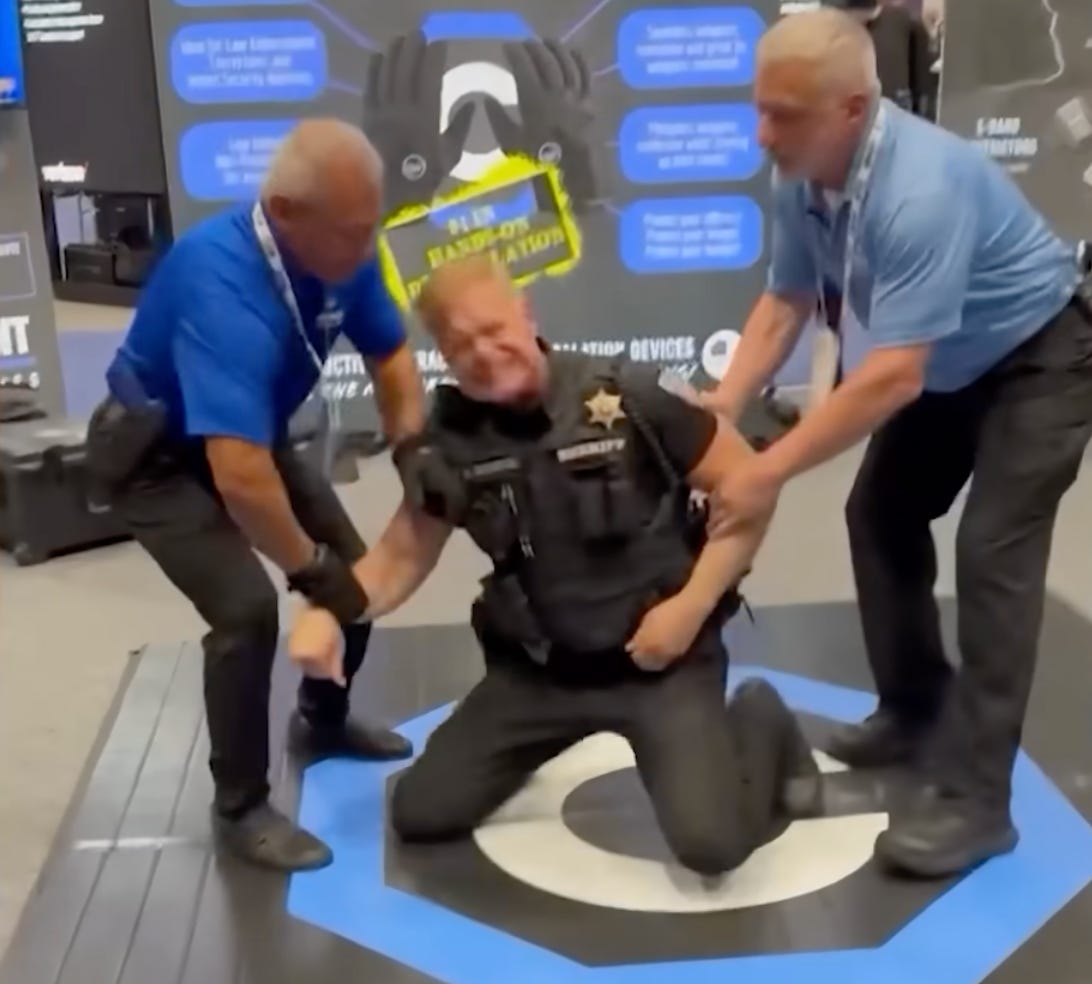
ICE’s purchase of gloves capable of incapacitating suspects with an electric shock is a desperate attempt to repair the agency’s dismal public image.
The manufacturer, Compliant Technology, calls the gloves "low optics." That's a coy way of saying the shock is hard to make out. The target drops after being touched, but in a chaotic altercation it would be difficult to tell a shock caused it — even if the incident was caught on video.
And why might ICE be concerned about how its officers look on video? The answer is Minneapolis. The agency’s killing of Renee Good and Alex Pretti in January and associated protests galvanized public opinion against ICE and gutted its reputation. ICE’s own employees recognized almost immediately how devastating that was, as I’ve previously reported.
Faced with a force of poorly vetted, poorly trained ICE officers, Washington is doing what Washington does: buying them fancy toys. Up to $20 million of them, federal procurement show.
Consistent with the customs of national security, the device has an acronym: G.L.O.V.E., for “Generated Low Output Voltage Emitter.” Despite the name, the voltage is enough to make a former Navy SEAL drop to the ground in pain, as ▶demonstrated here.
Coverage of ICE’s purchase of the device focuses almost exclusively on the potential for abuse. But ICE already has thousands of electrified weapons called TASERs, and its agents already have itchy trigger fingers. What’s new here, by the manufacturer’s own account, is the optics.
A taser fires barbed probes — fish hooks, essentially — into the skin from up to 45 feet. Tasers leave punctures, burns, and probes that have to be pulled out of a person. The GLOVE, by contrast, leaves nothing.
As Compliant Technology CEO Jeff Niklaus explained in a recent ▶interview promoting the device:
“With a GLOVE, there are no burns, marks, or scars, and when it’s done, it’s done. The advantage of the electrified glove is it requires skin contact. It is worn, not drawn. It is switched on with a button at the wrist that nobody watching can see. And when it comes off, there is nothing on the body to photograph.”
In the same interview, then-Assistant Chief of the Cape Girardeau, Missouri, Police Department, Adam Glueck, explains why that’s important:
“Everybody has a cell phone, so the suspect’s filming, witnesses are filming, you’ve got surveillance cameras, and the officers themselves are filming with their body cams or their mobile car videos. So I think the glove is low optic and it looks better on video.”
Looks better on video. That’s what this is all about: appearances. And it’s obvious why ICE is worried about that.
Poll after poll shows ICE’s public standing collapsing this year. After Pretti’s death, a Quinnipiac poll found that 63 percent of voters disapproved of the way ICE was enforcing immigration laws, up from 57 percent in mid-January; a separate NPR/PBS News/Marist survey found that 65 percent said the agency had gone too far, up 11 points since June. The shift extended beyond Democrats: 71 percent of independents and 27 percent of Republicans said ICE had gone too far, both increases from last summer.
That’s the hole ICE is trying to climb out of with its new pair of shock gloves — which seem more desperate than diabolical. And ICE didn’t dig that hole alone. They had “help” from a public that kept showing up to protest them — not just in freezing Minneapolis, but across the country. And over time, those demonstrations persuaded people, and the numbers moved. So much so that even Trump, who infamously refuses to admit defeat, started firing people involved in the ICE-led deployments.
The sheer number of official heads that have rolled is astonishing, including:
Kristi Noem, secretary of homeland security, who labeled Alex Pretti a domestic terrorist within hours. Fired March 5, two days after Senate Republicans took turns telling her to her face that her tenure was a disaster.
Greg Bovino, who ran Metro Surge and stood at a podium in Minneapolis accusing Pretti of wanting to “massacre” his agents. Stripped of his command within days, sent back to El Centro, and ultimately retired. Last I saw, he’s been goofing off on X/Twitter, “liking” random MAGA moms’ tweets of support for him.
Todd Lyons, acting ICE director. Resignation announced April 16 — the same day he spent the morning in front of Congress.
Tricia McLaughlin, the Department of Homeland Security’s spokesperson, announced she’d be leaving on February 17.
Corey Lewandowski, Noem’s shadow chief of staff, out with her in late March.
Madison Sheahan, ICE’s deputy director, out January 15.
Mike Banks, Border Patrol chief, resigned in May, saying: “It’s just time.”
Marc Rosenblum, a decade at DHS, who built its statistics office. He quit July 24 and, alone on this list, left swinging: “the war on immigrants, the war on feds, and the war on facts.”
**Operation Metro Surge, **the ICE-led operation itself was terminated less than a month after Good and Pretti were killed.
That’s over half a dozen high-ranking officials gone in the wake of the public outcry over Minneapolis. How often, if ever, does that happen? Yet the number has never been reported as far as I can tell. Nor has the public’s victory been acknowledged in any serious way.
The media rarely credits the public, instead viewing politics as palace intrigue: who’s up and who’s down with Trump, who’s an adult and who’s a child, the drama between Kristi Noem and her now-ex husband, and on and on. The public is practically invisible in all of this, even though it clearly has a lot of power. More than the voltage of these stupid gloves.
I see the people’s power. And given its desperation for “low optics,” so does ICE.
— Edited by William M. Arkin