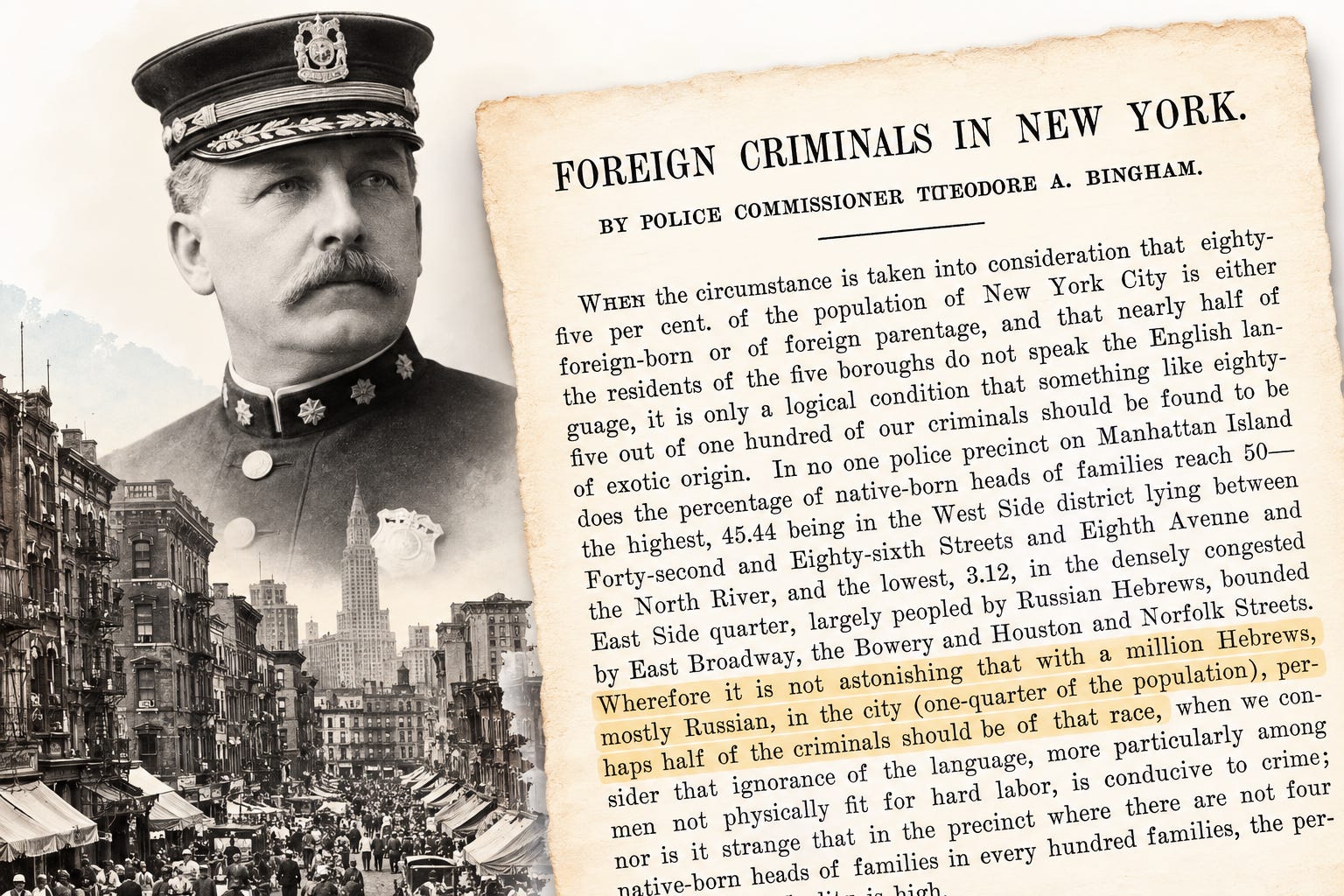
In September 1908, New York City Police Commissioner Theodore A. Bingham published an article called “Foreign Criminals in New York” in the * North American Review*.
New York was packed with immigrants. Germans and Irish had been there for generations. Italians were arriving in huge numbers, and hundreds of thousands of Jews from Russia and Eastern Europe had settled in the city. New York’s population grew from about 3.4 million in 1900 to 4.8 million by 1910. More than 40 percent of the people living there were foreign-born.
Bingham wrote about Italians, Jews, and other immigrants and the crimes he associated with them. When he got to the Jews, he estimated that about one million lived in New York, most of them Russian.
They represented about one-quarter of the city’s population, he wrote, but “perhaps half” of its criminals.
Bingham described Jewish burglars, arsonists, pickpockets, highway robbers, and thieves. He claimed some Jewish boys were already pickpockets before they were ten years old.
The North American Review hadn’t checked his statistics. Its editors later explained that they considered Bingham “the highest authority on the subject” because he was the police commissioner.
They took his word for it.
Bingham’s article didn’t introduce the idea of the Jewish immigrant as a criminal threat to New York.
In 1897, former police commissioner Frank Moss published The American Metropolis. Writing about Russian and Polish Jews, Moss referred to the “criminal instincts” he believed were “so often found naturally” among them.
Three years later, Felix Adler addressed an anti-vice meeting at the Eldridge Street Synagogue and told the audience about a conversation with New York Police Chief William Devery. According to Adler, Devery had asked him,
“Do you know who is responsible for the bad moral condition of the city? It’s just you Jews.”
Crime among Jewish immigrants was real. It was a thing among every population in New York. But individual crimes were repeatedly turned into claims about Jews as a group. Pickpocketing became associated with Russian Jews. Prostitution and the panic over “white slavery” became another area where Jewish immigrants came under scrutiny. Bigamy…it did too.
In 1905, the New York Daily Tribune published an article with the headline “Ten Thousand Bigamists in New York Today.” It focused on the East Side and blamed much of the supposed problem on Jewish immigrants who had obtained a religious get but not a civil divorce before remarrying. The article claimed that 90 percent of the estimated 10,000 cases resulted from ignorance of the civil requirement.
By the time Bingham sat down to write about New York’s “foreign criminals” in 1908, Russian and Eastern European Jews had already spent years being thrown around in connection with all sorts of crime.
Bingham put a much bigger number on it.
Bingham wasn’t writing only about Jews. His article ran for twelve pages and treated New York’s immigrant population as a policing problem.
He opened by claiming that 85 percent of the city’s population was either foreign-born or had foreign-born parents and concluded that it was only “logical” that about 85 percent of its criminals would also be foreign in origin.
From there he moved through different immigrant groups. Italians received some of his harshest treatment. He wrote about the Mafia and Camorra, murder, kidnapping, bombs, blackmail, and what he called the “riff-raff of desperate scoundrels, ex-convicts and jailbirds” who had come from southern Italy. He also discussed Armenian revolutionaries, Chinese tongs, foreign anarchists, and prostitution.
The Jews got their own category of crime.
“The crimes committed by the Russian Hebrews are generally those against property,” Bingham wrote. He listed burglars, arsonists, pickpockets, and highway robbers and claimed that pickpocketing was the crime to which Russian Jews seemed to take “most naturally.”
He lumped Jewish and Italian criminals as working together. The Jew supposedly was the one to reach into the victim’s pocket while his Italian partner created a distraction.
He didn’t even spare the kids. Bingham claimed Jewish boys under sixteen were the city’s most skilled street thieves. And many were already “old offenders” at ten. He wrote that 40 percent of the boys at the House of Refuge and 27 percent of those brought before Children’s Court were Jewish.
It was presented to the public with his whole chest. It appeared under the name of the New York City police commissioner in the North American Review, complete with percentages and descriptions that made it sound as though the NYPD had carefully measured the criminal habits of the city’s immigrant populations.
When the questions started, that confidence became much harder to defend.