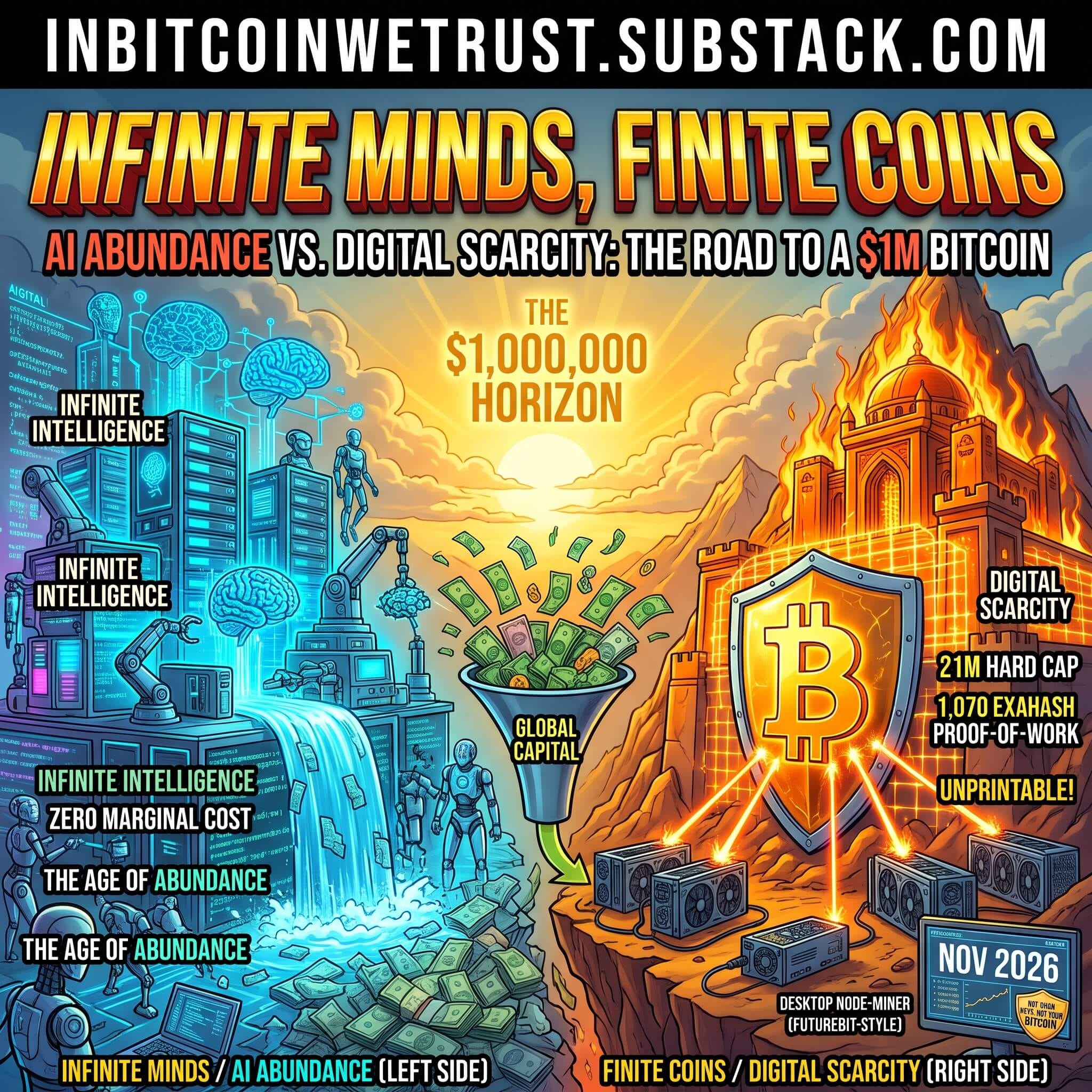
Step back from the daily noise of the five-minute candlestick charts in this first week of November 2026 and observe the two colossal tectonic plates grinding against each other beneath the global economy.
On one side of the planet’s industrial ledger, humanity has just uncorked an era of infinite cognitive abundance.
Inside gigawatt-scale data centers stretching from Virginia to Oman, tens of millions of interconnected accelerators are collapsing the marginal cost of intelligence toward the price of raw electricity. Tasks that required an elite team of software architects, corporate attorneys, quantitative analysts, or biomedical researchers six months of billable hours in 2022 are now executed in twenty-seven seconds by autonomous reasoning agents. Just two weeks ago, the cybersecurity world watched in stunned silence as a single frontier AI system audited 391 open-source repositories in roughly twenty-seven hours and uncovered nearly five thousand verifiable vulnerabilities—forcing Bitcoin Core itself to rewrite its fifteen-year security disclosure policy overnight.
On the other side of the ledger sits absolute mathematical scarcity.
On Friday morning, November 6, in the wake of the U.S. midterm elections and just seven days after ** state-sponsored hackers drained $6.36 billion from Binance’s centralized hot wallets** in the largest heist in financial history, Bitcoin is calmly trading near $78,500. Beneath the surface turbulence of a $1.58 billion derivatives liquidation cascade, long-term balance sheets haven’t blinked. Strategy just added another 811 coins to bring its corporate treasury to 849,327 Bitcoin, acquired at an average cost basis of $75,451, while
To a conventional Wall Street strategist trained in twentieth-century Keynesian textbooks, artificial intelligence and Bitcoin look like two completely unrelated technology trades—one a bet on silicon productivity, the other a volatile hedge against sovereign currency debasement.
As an economic observer analyzing these shifts from first principles, however, a far deeper truth becomes unmistakable. Artificial intelligence and Bitcoin are not competing narratives. They are thermodynamic opposites—two halves of the same macroeconomic equation.
Whenever a civilization invents a technology that drives the marginal cost of producing information, software, and cognitive labor toward zero, the purchasing power of everything reproducible collapses in relative terms. And when the supply of intelligence becomes infinite, the global capital pool is forced by an iron law of economics to seek refuge in the only monetary asset on Earth whose supply cannot be expanded by either a central bank printing press or a superintelligent machine.
To understand why the explosion of machine intelligence makes a $1 million Bitcoin horizon not a speculative fantasy, but a mathematical inevitability of monetary physics, we have to examine what happens when infinite abundance collides with a 21 million hard cap.
Congress has 37 days left on the clock—how two years of rolling government shutdowns and fiscal brinkmanship will turn “safe” government bonds into the riskiest asset in your portfolio.
For the past three hundred years, every major economic boom was governed by a simple bottleneck: human cognition.
When James Watt perfected the steam engine in the late eighteenth century, and when Henry Ford electrified the assembly line in the early twentieth, humanity automated physical muscle. A single diesel excavator could move more earth in an afternoon than five hundred men with shovels, and an automated textile loom could weave more cotton than an entire medieval village. Yet every time machines made physical manufacturing cheaper, the economic surplus flowed straight into the one factor of production that could not be mass-produced in a factory: the trained human brain.
Because you could not stamp out new civil engineers, C++ developers, radiologists, tax accountants, or contract lawyers on an assembly line, cognitive labor became the ultimate scarce asset of the modern economy. For half a century, the highest-margin businesses on the stock market—from enterprise software giants to global management consultancies—built trillions of dollars of market capitalization around that single bottleneck. If you wanted to build a global financial application or audit a multinational supply chain, you had to rent thousands of scarce, expensive human minds.
In late 2026, that three-hundred-year bottleneck has shattered.
When we look at the real-world economics of frontier machine intelligence today, we are no longer talking about chatbots that summarize emails or generate marketing copy. We are watching autonomous agentic workflows turn cognitive labor into a commodity priced in kilowatt-hours and token inference fees.
Consider what happens to the classical supply curve when intelligence becomes reproducible on demand:
**Software Commoditization:**The multi-billion-dollar enterprise SaaS moat—built on charging corporations thousands of dollars per seat for glorified database interfaces—is evaporating as internal AI agents write, test, patch, and maintain bespoke corporate software in hours.**Deflationary Discovery:**In pharmaceuticals, materials science, and semiconductor layout verification, machine learning models explore trillions of molecular and circuit permutations before a human engineer finishes their morning coffee.**Infinite Digital Supply:**Every form of digital content, synthetic media, financial modeling, and algorithmic trading strategy is multiplying at an exponential clip, driving the scarcity value of raw information toward zero.**Labor Arbitrage Collapse:**When a $200-per-month rack of specialized inference silicon can outperform a junior analyst team working eighty hours a week, the marginal cost of cognitive production decouples permanently from human biological survival costs.
In Austrian economics, price is determined at the margin. When the supply of any good expands faster than the monetary unit used to measure it, its real price must fall. That is why a gigabyte of solid-state storage that cost ten thousand dollars in the 1990s costs pennies today, and why a transatlantic phone call that once cost a week’s wages is now free.
Machine intelligence is applying that exact same deflationary gravity to the entire global service and knowledge economy simultaneously. Within the next decade, the real cost of producing medical diagnostics, architectural blueprints, legal contracts, codebases, and manufactured goods will plummet by orders of magnitude.
On a purely physical level, this is the greatest windfall in human history. Abundance means that ordinary families can access world-class healthcare, personalized education, and high-quality goods for a fraction of the human toil required in past generations.
Yet inside our current financial architecture, this technological miracle triggers a systemic crisis. Because we do not live under a sound monetary standard—we live inside a fiat debt panopticon that treats deflation as a mortal enemy.
Ask yourself a foundational question that every central banker in Washington, Frankfurt, and Tokyo loses sleep over:
What happens when you drop a hyper-deflationary technology like artificial intelligence into the middle of a $350 trillion global debt pyramid?