I recently had a back and forth with friend of the blog about whether my position that insects matter a lot in the aggregate was ridiculous. Here, I will explain why I think in total the welfare of insects matters more, in expectation, than the welfare of humans. To be honest, I find this a pretty clear cut issue; our contrary intuitions are totally untrustworthy, and the importance of insects is intuitive when you actually think about it rather than just blindly deferring to popular judgments.
About 600 billion insects die every second. Maybe more. Let’s say it takes them an hour to die (this is conservative, because a lot starve to death and a lot are killed by parasites). This means that for each passing second of human life, there are about 270,000 passing seconds insects spend dying. That’s around 75 hours.
Do 75 hours of continuous insect death matter less than one second of human life? No! I would not experience 7,500 hours of continuous insect death—experiencing what insects undergo when they die for 7,500 hours, almost an entire year—to add 100 seconds to my life. I wouldn’t undergo 75 hours of continuous insect death to add one second to my life. This is a no brainer.
So even if we have really conservative low-end estimates of how much insects matter, they still matter more than humans in the aggregate. This is because they are very numerous. And intuitions about aggregate importance are liable to mislead when we naively underestimate the numerosity of some class of beings by many orders of magnitude. If you underestimated the number of plumbers by ten orders of magnitude, your intuitions about how much plumbers matter in the aggregate wouldn’t be very trustworthy.
A point I’ve made before: pain is bad because it hurts. The reason it’s bad to have a headache is because it hurts. It might be bad in other ways, but pain’s *intrinsic *badness comes from how it feels. So if insects can feel pain, their pain matters like ours does. What species you are is just totally irrelevant to whether it’s bad for you to feel terrible pain.
Now, maybe you deny this. Some people think that only the pain of intelligent creatures matters. I think this is wrong; if you were being tortured, why the hell would it matter at all if you weren’t smart? Does being able to think complicated thoughts make any difference to the badness of the pain of being punched in the face? If so, why?
Others think that your pain only matters if you’re an intelligent species. But again, if you underwent terrible pain—being, say, boiled alive—why would whether other members of your species are smart make one jot of difference to the badness of your pain? Just introspect on the experience of pain: part of why it’s bad is how it feels. That’s why the pain of babies and some severely mentally disabled people matters, even though they aren’t smart.
Can insects feel pain? I don’t know. But it’s not very unlikely that they can. I’d probably put their being able to feel pain at over 50% odds. We know that they react behaviorally in a bunch of ways as if they were in pain. In fact, their behavior is pretty much what you’d expect it to be if they were in a lot of pain. When flies’ food is laced with capsaicin—making it spicy—they react violently and shake when fed it, eventually starving themselves to death. However, this is counteracted by a painkiller.
Given that there are about 100 million insects per person—and about 600 billion of them die every second—they feel way more expected pain than humans. In the last second, more insects have died than humans have ever lived. If we assume conservatively that insects feel pain one ten-thousandth as intensely as humans, then each second, there’s about as much pain as if every human experienced 26x the pain associated with death continuously all throughout their lives. And note: one ten-thousandth is a very conservative estimate in my view.
In expectation, insects probably feel more suffering in a single day than all humans have in history. It isn’t extreme to think a quantity of potentially intense agony that surpasses all the pain humans have ever experienced, being experienced daily, is a big problem.
Try to actually think about this fact, rather than just writing off insects because they’re small and weird looking. If you imagine them hurting a lot—feeling something that might be a lot like what happens to you when you hurt a lot—doesn’t that seem like it matters? To an insect, from the inside, the fact that they’re small and weird-looking is irrelevant.
The veil of ignorance asks you to imagine making decisions on behalf of humanity without knowing who you are. So, for example, if I’m deciding whether to shoot you, I should imagine making my decision not knowing if I’m me or you. If I had an equal chance of being the person shot as the person doing the shooting, then obviously I wouldn’t shoot you.
Behind the veil of ignorance, you’d be approximately guaranteed to be an insect. You’d be way likelier to be an insect than a human. Heck, you’d be likelier to be an insect in 300 acres of land than a human (there are about 37 billion acres of land on Earth). Behind the veil of ignorance, you’d care a lot about the welfare of insects. So if you’d care about insects if you were impartial, then they’re a big part of what impartially matters in the world. You ought to care about them.
The same is true if you—Andy Weir style—lived every single life. If you had to live the life of everyone who ever lived, you’d spend basically all your time as an insect. In such a case, you’d care a lot about insect welfare. If we weren’t blinded by partiality, we’d obviously care a great deal about the welfare of insects.
What I’ve said so far is counterintuitive obviously. Is this reason to reject it? Should you pound the table and declare it a Moorean fact that you don’t have to care about insects in the slightest?
No. Your intuitions here are obviously totally unreliable. We don’t feel any natural empathy for insects. When we see them, we don’t imagine things from their perspectives. If you have no natural sympathy for some being, your intuitions about their moral importance are not very probative. If a white slave owner felt no empathy for black people, his Moorean unshakeable judgment that black people don’t matter would be evidentially worthless.
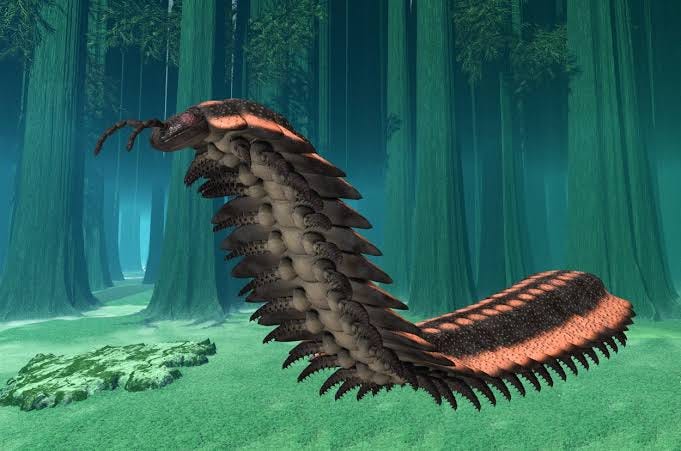
They’re also biased by the fact that insects are small, gross, and weird-looking. It’s personally inconvenient to care about their interests. In prehistoric times, there were giant insects, not much more sophisticated than the modern ones.
We routinely kill quadrillions of beings who are cognitively like this guy through pesticide use. Few think this is a big deal morally. But now ask: if a quadrillion of these giant insects were writhing around in horrible agony after being poisoned to death, would that seem like a big deal? Obvious answer: yes. It’s only because the insects of the modern day are small, and the insects of the ancient world were large, that we care so little about them.
We also have demonstrably unreliable intuitions about large numbers. Most people will pay about the same amount to save 2,000 birds as 200,000 birds. So we should expect our intuitions to systematically underrate the badness of very sizeable quantities of insect suffering. That’s again a reason not to trust our intuitions.
Then, lastly, we have unreliable intuitions about animals. We care more about lobsters than other insects, despite similar cognitive capacities, because lobsters are larger. We care more about cats than rats, even non-instrumentally, despite them being mentally and behaviorally similar. Our intuitions about animals are inconsistent—we regard it as barbaric when people in China eat dogs and then torture pigs in hellish crates where they can’t turn around, even though pigs are smarter than dogs.
As points out, human empathy evolved to foster cooperation between humans. Systematically, then, we underrate the importance of animals. Even when they suffer like us, few of us pay them much mind. When we do, we do so in ways that are demonstrably inconsistent—caring wildly more about one kind of animal than another similar kind.
So our intuitions about insects are doubtful on six counts. They’re biased by:
Our inability to grok large numbers.
Insects being small.
Insects being weird-looking.
Our feeling no natural sympathy for insects.
It being personally inconvenient to care about insects.
Our totally terrible intuitions about non-human animals.
Sometimes when people see a lobster or crab being boiled alive, they recognize that something dreadful is happening. That is, I suggest, the correct attitude to have, and it’s one we sometimes do have. It is only in a rare moment that we see through our callousness, our amoral blinders, and see these creatures as they really are.
There are about 100 million insects per person. We already know that we’re biased by the fact that insects are small and weird-looking. So to see if our intuitions are trustworthy, imagine replacing the insects with beings who looked like people but had the minds of insects.
These beings would plausibly be capable of suffering. They’d have mental capacities a bit like a very very mentally disabled human. Now imagine these beings suffering and dying in horrible ways. Would it be obvious—Moorean, unshakeable—that you matter more than 100 million of these creatures? If you imagine their cries, their blood coating the pavement, them starving and being eaten alive and parasites eating their flesh, would it be obvious that you personally matter more than a population of them equal to about a third of the United States? Certainly doesn’t seem that way.
Here’s an argument for an infinite number of insects mattering more than a single human.
We evolved from creatures very much like insects. Plausibly no generation mattered more than 100x more than the one immediately before it. Let’s say there are 100 billion generations between us and insects. That would mean that we can matter no more than 100^(100 billion) times more than an insect.
Of course, this doesn’t establish how many insects a human is worth. But it does establish there is some quantity of insects’ interests that can outweigh a humans’ interest. For more on this kind of argument, see here and here.
As I say, this strikes me as a pretty straightforward issue. Insects can plausibly suffer—they can plausibly feel terrible pain. Given any reasonable tradeoff between insect welfare and human welfare, insects matter more in the aggregate than humans. Our out of hand dismissal of insects’ interests is primarily born of bias and prejudice; it does not survive rational reflection.
Philip Wollen begins one of the greatest speeches of all time in the following way:
King Lear, late at night on the cliffs asks the blind Earl of Gloucester, “How do you see the world?” And the blind man Gloucester replies “I see it feelingly”. Shouldn’t we all?
Animals must be off the menu – because tonight they are screaming in terror in the slaughterhouse, in crates, and cages. Vile ignoble gulags of Despair. I heard the screams of my dying father as his body was ravaged by the cancer that killed him. And I realised I had heard these screams before. In the slaughterhouse, eyes stabbed out and tendons slashed, on the cattle ships to the Middle East and the dying mother whale as a Japanese harpoon explodes in her brain as she calls out to her calf. Their cries were the cries of my father. I discovered when we suffer, we suffer as equals. And in their capacity to suffer, a dog is a pig is a bear. . . is a boy.
He was talking about factory farming. It’s in some ways an easier subject to talk about; you can hear the cries of the cows, you can look into their eyes, you feel sympathy as you witness the blood oozing from the mother cow’s neck as she cries out to her calf. When you look upon a slaughterhouse or factory farm, you can see that something evil and grotesque is going on—that goodness herself is stained by the blood that pours out from the neck of the crying cow as she bleeds out for several minutes.
You can’t do that with insects. They do not provoke our sympathies. If they cry out, it is in a language we don’t hear. We cannot see their wounds, and when we do, we feel no sympathy for them. To care for insects, you have to actually think; to see that their suffering matters like ours does, their deaths are lamentable like our deaths are lamentable. Your heart will not get you there; you have to use your brain.