Most writers collect praise. I have collected two adjectives: dense and non-linear. They are usually offered with a small pause, as if the speaker is trying to be kind about a structural problem. After enough repetitions I stopped hearing them as criticism and started hearing them as a job description.
Dense means there is a lot in a small space. Non-linear means the path does not run straight from A to B. Both are true. Neither is accidental. And neither describes a failure to write a romance novel.
Non-linearity is not an affectation. It is a fidelity to the material. A linear rendering would flatten the recursion, hide the feedback, and pretend that the conclusion was always the destination. The honest shape of the thought is closer to a spiral or a network than to an arrow.
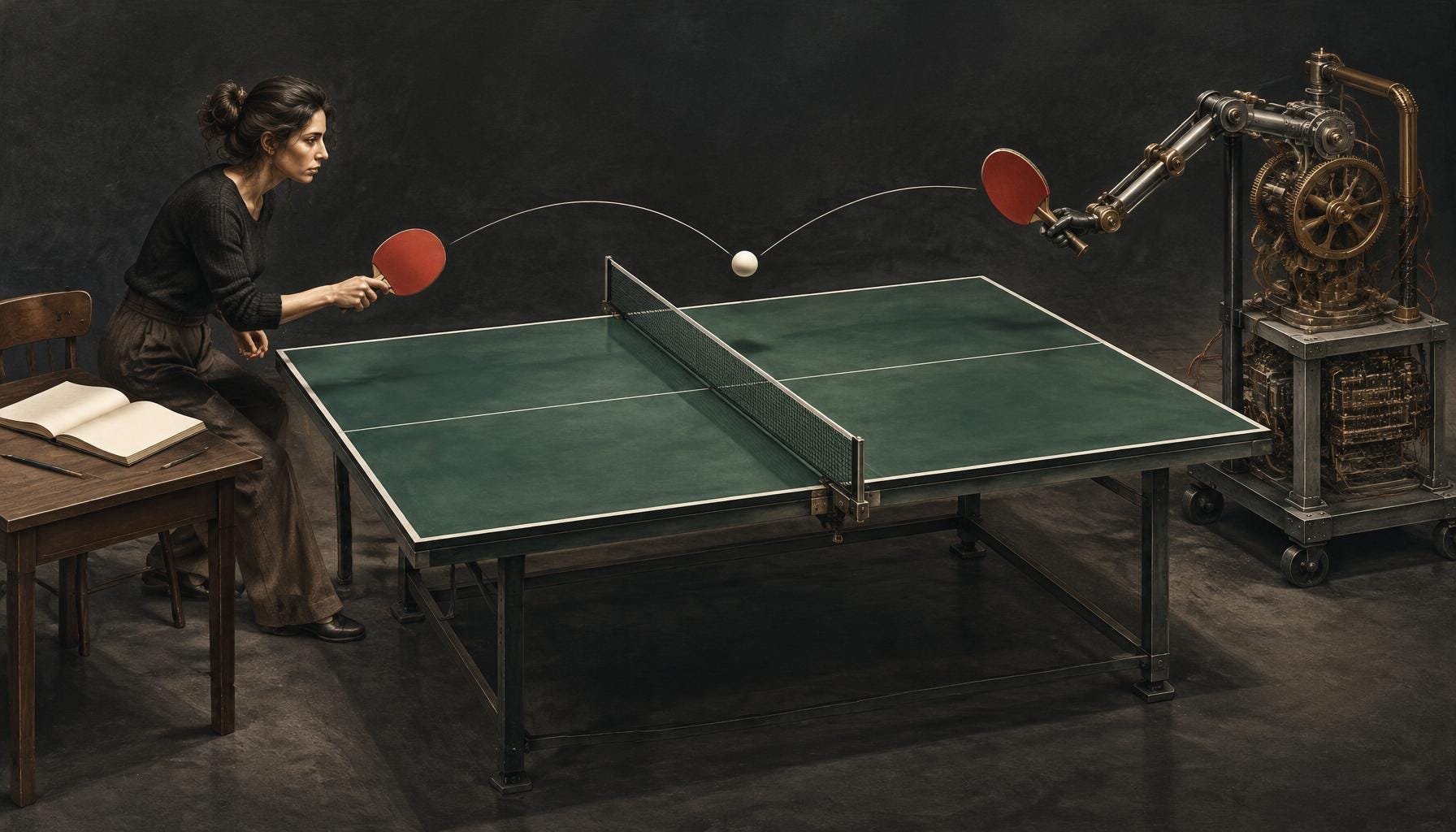
The choice to play intellectual ping-pong with engineered intelligence was made long ago, for a practical reason: most humans have no earthly idea what I am writing about. They find it dense. They find it non-linear. They call it these things and then change the subject. That solitude is real, and it is not resentment to name it.
For me, the practical attraction is speed and stamina: a volley can come back in seconds, and I can return to a difficult question repeatedly. That does not make the return reliable. A model can misunderstand, invent a reference, or agree too readily. Those failures are part of what the exchange has to expose, not reasons to grant it authority.
The machine is a sounding board, not an oracle. Sometimes a returned formulation clarifies what I was trying to say. Sometimes it makes me recognise exactly what I do not mean. The useful return is not necessarily the agreeable one.
New dimensions appear when the ping-pong is used not merely to produce content, but to keep the mind from becoming the source of disorder. The game is no longer about speed or volume. It is about using the return volley as a check against the gravitational pull of one’s own unexamined assumptions.
A court has geometry. In this one there are two strokes, and they do different work. The Socratic stroke goes outward: it takes a claim and pushes it until its consequences are visible. Elicit the definition. Draw the entailments. Find the case the definition cannot cover. Let the contradiction be admitted rather than argued into submission. Aporia is not failure; it is the cleared ground on which a better formulation can be laid.
The Stoic stroke goes inward: cognitive distancing. Separate the impression from the assent. ‘This looks like a breakthrough’ is an impression; ‘this is a breakthrough’ is an endorsement, and the endorsement is the part that is yours to withhold. Epictetus’s practice is to hold the impression at arm’s length long enough to describe it accurately before deciding what to do with it. Applied to a model’s output, the move is simple and unfailingly useful: read the answer as a proposal, not as a verdict.
The two strokes are complementary, and each fails without the other. Socratic examination without Stoic distance turns into combat — the interlocutor defends rather than inspects. Stoic distance without Socratic examination turns into detachment — impressions are held at arm’s length forever and nothing is ever tested. Together they describe the actual court dynamics of a healthy exchange: press the claim outward, hold the response at a distance, then decide.
The two participants do not have to arrive at the same view. A disagreement held accurately can be more useful than a conclusion reached by flattering the person who asked. The exchange has done work when I can say what changed, what did not, and why.
Real intellectual ping-pong is highly amusing. A volley that returns tighter than it left, that exposes an assumption, or that changes the coordinate system can produce the surprised recognition of a well-timed move in a game. The difference is that the reward is a better map, not a higher score.
But enjoyment is not evidence that an answer is true. Agreement can feel good too. The question is whether the pleasure accompanies a real change in the thought, or merely a pleasing reflection of it.
The claim has a limit worth stating. Not every property of a trained system is a property of its training set: architecture, objective, and decoding strategy all introduce behaviour that no human ever performed. The mirror is warped in specific, measurable ways. But the warp does not remove the reflection, and refusing to look at the reflection because the glass is imperfect is precisely the move the mirror keeps catching us in.
Intellectual ping-pong already uses this move. A serve that returns as a pun, a reframing, or an unexpected collision is a serve that has found a new coordinate. The human’s job is to notice whether the laughter is productive — whether it loosens a stuck frame — or merely flattering. Sycophantic decay can mimic the sound of laughter without the structural release. The diagnostic is the same as always: does the volley produce a tighter map, or does it only produce agreement?
Every form of writing implies a contract with the reader. A romance novel says: give me your attention and I will deliver a predictable emotional arc. A textbook says: give me your attention and I will build competence step by step. A dense, non-linear essay says: give me your attention and I will ask you to do part of the construction yourself.
That contract is not for everyone. It asks the reader to pause, to re-read, to hold contradictions, to let a sentence mean one thing on first pass and another on second. The reward is not comfort; it is the experience of watching a structure assemble in real time. Some readers want to be carried. Others want to be made to think. This work is for the second kind.
The two words — dense and non-linear — are therefore the shortest possible description of the contract. They are not apologies. They are warnings and invitations at once.
The standing wave is my image for the exchange: something sustained by the return, not by either side winning. It is an image of the practice, not a measurement of what happens in a model or a proof that two minds work in the same way.
The court remains open only while the players continue to return the ball.
When you use engineered intelligence as a sparring partner, what comes back that changes your thinking—and what do you refuse to let it decide for you?
I look forward to your comments on playing intellectual ping pong with AI agents.
Original extended essay: https://theparallaxidentity.com/essays/intellectual-ping-pong