On September 22, a small newspaper in the Florida Panhandle published an op-ed piece about the economic costs of America’s war with Iran. The author was Ervin B. Hoskins, supposedly an American freelance writer. His photograph accompanied the article, which came through an organization the newspaper had trusted for years.
Except Ervin Hoskins wasn’t exactly who he claimed to be. His photograph was AI-generated, his social media accounts pointed to Iran, and as it turned out…his name was one of seven being used in an influence operation that had spent more than a year placing articles in legitimate publications. The newspaper was the Port St. Joe Star, and its publisher had absolutely no idea the author’s identity was fabricated. Neither did the organization that supplied the column.
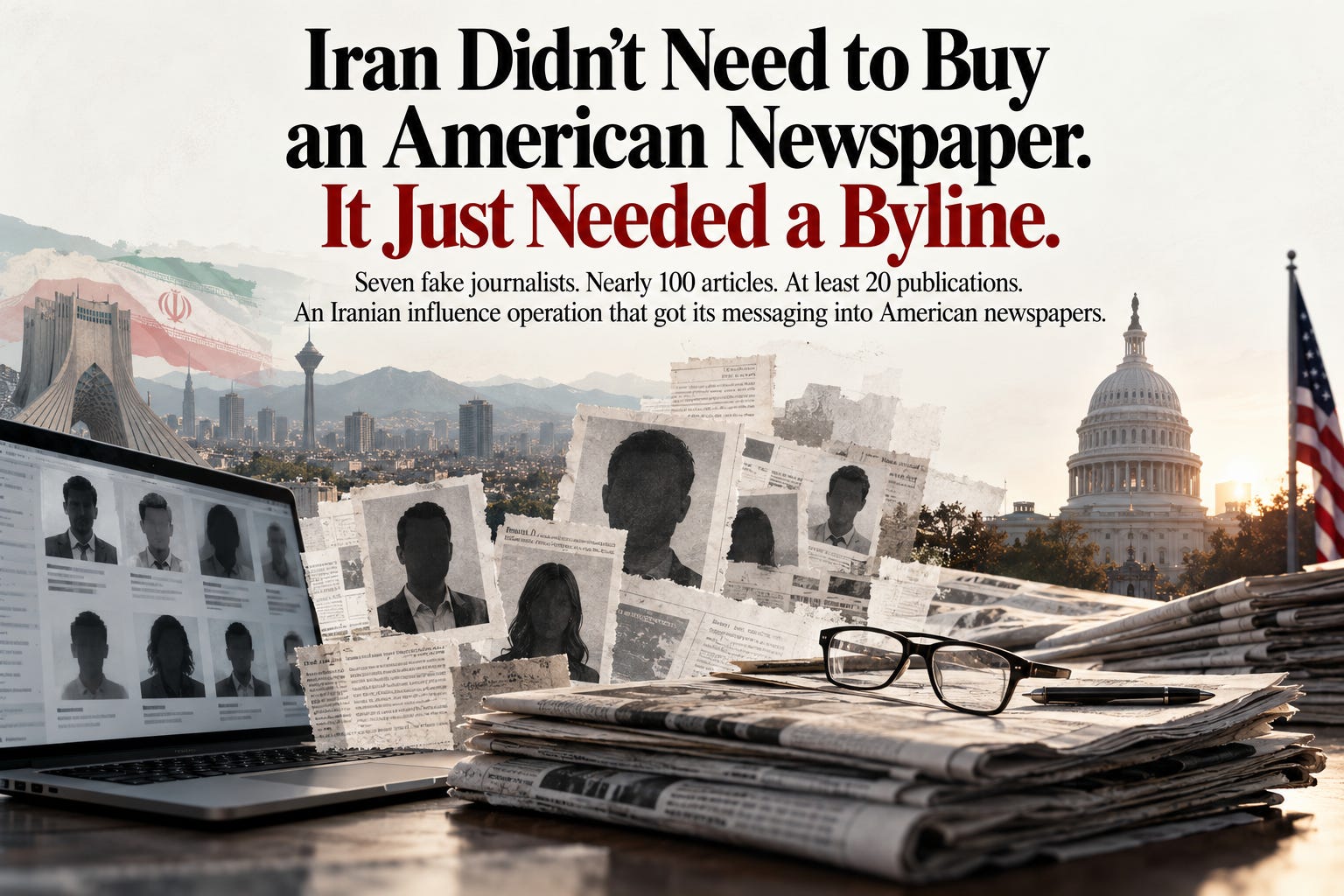
On October 8, 2026, OpenAI exposed the operation, which it named Bogus Bylines. Investigators identified nearly 100 articles published or syndicated under seven fabricated identities between July 2025 and October 2026. The Washington Post followed up the next morning, identifying at least 20 outlets that had carried the material.
The publishing records reveal how far the operation had spread. The same invented writers appeared in newspapers, political magazines, international news websites, syndication archives, and professional journalist databases. Their articles moved between publications, their biographies accompanied them, and each new appearance added another credit to a growing body of work.
By October, Ervin Hoskins had a portfolio listing CounterPunch, Eurasia Review, LA Progressive, Modern Diplomacy, The Humanist Magazine, International Policy Digest, and several newspapers. He even had a profile on Muck Rack, a professional media database used to research journalists and their work. An invented American journalist had acquired the publication history of a real one.
OpenAI identified seven fabricated identities: Ervin B. Hoskins, Noah Lamington, Sophia Gonzalez, Michael Harrison, Ericka Feusier, Jenny Williams, and Alice Johnson. Their biographies described Western freelance writers and analysts interested in foreign policy, international affairs, human rights, and the Middle East. Most supposedly lived in the United States, while Lamington was presented as a writer based in New Zealand.
The operators also created supporting social media accounts. Hoskins appeared on X, Facebook, Instagram, and Threads. Michael Harrison had accounts on Medium, X, and Facebook.
OpenAI traced the ChatGPT activity to Iran. The operators used VPNs to conceal their locations, communicated with ChatGPT in Persian, and worked with material in Persian and English. Social media transparency information also located accounts associated with Hoskins in Iran. Meta had already banned his Instagram account in August.
For Harrison, the operators even asked ChatGPT to write his biography. They also used it to study editorial guidelines, revise manuscripts, and prepare professional emails pitching articles to publications.
The operators supplied English-language articles about the United States, Iran, Israel, and the war. They asked ChatGPT to compare those manuscripts against the submission guidelines of individual publications, recommend revisions, and prepare emails pitching the finished articles to editors.
The process resembled the ordinary work of a freelance writer. They studied what publications wanted, adjusted their submissions, wrote professional pitches, and maintained author identities that appeared credible. They also tracked where their articles appeared and compiled reports about the results.
OpenAI found that publication activity increased sharply after the American war with Iran began in 2026. The earliest identified article dated to July 2025, months before the conflict created a larger audience for commentary about American military policy. By the time the war intensified, the operation already had fabricated writers, supporting accounts, and experience approaching editors.
By the time OpenAI exposed Bogus Bylines, the seven fabricated journalists had placed nearly 100 articles across a wide range of publications. The Washington Post identified at least 20 outlets that had carried the material, from small American newspapers to international political commentary websites.
Among them were Daily Kos, Middle East Monitor, CounterPunch, Eurasia Review, Modern Diplomacy, LA Progressive, The Humanist Magazine, and International Policy Digest. The subjects ranged from American military operations and Israeli policy to immigration, diplomacy, and domestic politics. Readers encountering these articles had no reason to assume the authors were part of an operation originating in Iran.
Middle East Monitor was one of the most heavily affected publications. At least 21 articles appeared under four of the fabricated identities, giving the operation repeated access to an outlet focused on Middle Eastern affairs. After the investigation became public, the publication removed the identified material.
Daily Kos presents a different example. The site allows registered users to publish their own community posts, and material associated with the operation appeared through that system. Those posts weren’t commissioned or approved by Daily Kos editors in the way a traditionally edited opinion column would be. But they were still available to readers on a recognizable American political website.
Other outlets operated through more conventional editorial arrangements. CounterPunch, LA Progressive, Eurasia Review, Modern Diplomacy, The Humanist Magazine, and International Policy Digest carried material attributed to the fabricated writers. In some cases, the same article appeared across multiple publications, creating a trail of publication credits that could be found through ordinary internet searches.
The operators had learned to work with different publishing systems. A community platform offered one route, direct submissions to editors offered another, and organizations that distributed opinion columns provided access to newspapers that might never have heard of the writer otherwise.
One Oregon organization was distributing articles by at least two of the invented journalists. Its columns reached newspapers in different states, and the authors’ biographies traveled with them.
PeaceVoice is an Oregon-based organization that distributes opinion columns to newspapers and online publications. It is a program of the Oregon Peace Institute, and its website identifies the Jubitz Family Foundation as a funder. The organization describes its mission as changing the American conversation about war and peace.
It solicits commentary from writers, offers unpublished columns to newspaper editors, and makes published articles available for reprint. On its website, PeaceVoice describes its role as serving as literary agents for peace professionals.
That arrangement allows newspapers to receive material without having to find every writer themselves. PeaceVoice evaluates and distributes the articles, and editors decide what to publish. The organization has established relationships with newspapers that regularly receive its columns, and two of the seven fabricated journalists identified by OpenAI were appearing in its archive.
Sophia Gonzalez’s PeaceVoice articles date back to at least late 2025. Her subjects included Iraq, immigration enforcement, Venezuela, American foreign policy, and eventually the war with Iran. On March 13, 2026, PeaceVoice published her column A War the American Public Never Really Wanted. Her biography presented her as an American political analyst focused on American strategy, Middle Eastern affairs, and global security.
Other Gonzalez articles followed. PeaceVoice carried The Deception Behind Trump’s War on Iran in April, Why Trump Blinked on Iran in June, and When Diplomacy Becomes Part of the War in July. The fabricated writer had become a regular contributor to an organization distributing opinion columns to American newspapers.
Ervin Hoskins also appeared in the organization’s archive. On June 12, PeaceVoice published Jared Kushner and the Privatization of America’s Iran Strategy, a column examining Kushner’s business interests and influence over American policy toward Iran.
The article subsequently appeared under Hoskins’s name in several other publications. LA Progressive published a version on June 13 under the headline Is America’s Iran Policy Being Privatized? The Jared Kushner Question. CounterPunch carried the column on June 15, and California’s Lake County Record-Bee published it on June 17.
The publication dates establish the sequence of appearances, although the submission arrangements behind each placement haven’t been documented. The same article was moving through multiple publications under the same fabricated identity, adding another credit each time.
The Washington Post interviewed David Adlerstein, publisher of the Port St. Joe Star, after OpenAI exposed the operation. Adlerstein explained that the Hoskins column, "The Cost of American Power in the Iran War," arrived via PeaceVoice.
The organization had supplied columns to his newspaper for years. He generally passed on its submissions because his readership leaned conservative, but this particular article caught his attention. He considered it thoughtful and less overtly hostile to President Trump than some of the material he usually received.
Adlerstein published it without independently verifying Hoskins’s identity. The article came from an organization he already knew, and he had no reason to suspect the author was fictional.
PeaceVoice founder Tom Hastings told the Post that the submission had appeared legitimate to him, too. He didn’t see an obvious defense of Iran. He saw criticism of the war.
After OpenAI contacted PeaceVoice, Hastings said the organization strengthened its prohibition on AI-generated submissions. He also suggested that if Hoskins approached PeaceVoice again, he would ask to meet with him over Zoom.
The article had already traveled through PeaceVoice’s distribution system. Emmitsburg.net, a regional Maryland website that archives PeaceVoice columns, lists the article with a September 17 date. PeaceVoice’s website lists it on September 18. The Port St. Joe Star published it September 22.
By the time Florida readers encountered the column, the invented author had an established publication history and an article distributed through a familiar syndication service. Neither PeaceVoice nor the newspaper has been accused of knowingly participating in the operation. Both accepted the submission through ordinary publishing practices, relying on the author’s biography and the established relationship between the syndication service and its receiving publications.
The Port St. Joe Star wasn’t the only newspaper to receive material attributed to a fabricated writer. On July 31, Oregon’s News-Register published Sophia Gonzalez’s column When Diplomacy Becomes Another Weapon of War.
The newspaper identified Gonzalez as a PeaceVoice-syndicated writer and described her as an American political analyst specializing in American strategy, Middle Eastern affairs, and global security. It also directed readers to her collected columns at CounterPunch.
That final detail shows how a fabricated writer’s publication history could reinforce her credibility. The newspaper supplied a biography and pointed readers toward another established publication where they could find more of her work. Gonzalez had become a syndicated columnist with a searchable archive, while readers were being presented with the biography of an independent American analyst whose identity was fabricated.
The Hoskins articles extended beyond the Iran war. On August 11, the Journal-Courier published a column under his name titled Election Security, or the Engineering of Distrust?
The article criticized President Trump’s handling of election-security concerns and argued that his administration was creating conditions for Americans to distrust the results of the 2026 midterms. The newspaper identified Hoskins as a syndicated writer.
The article had already appeared on ZNetwork on August 2. On August 14, The Voting News, a news service associated with the Verified Voting Foundation, included the column in its archive and credited the Journal-Courier.
Emmitsburg.net also preserved a PeaceVoice version of the article, presenting Hoskins as an American freelance writer, peace advocate, and anti-war activist. The same fabricated identity was appearing across political commentary websites, newspapers, and specialist election-news archives.
The subject matter deserves attention. An operation originating in Iran had placed commentary about the legitimacy of American elections under the name of a fictional American writer. The column argued that political leaders could undermine public trust in elections by encouraging suspicion before ballots were counted.
It also discussed foreign influence operations and the damage they could do to public confidence. The writer supposedly warning Americans about that danger was himself part of a foreign influence operation.
The article was available through multiple websites, including a newspaper and an election-news archive. None of those appearances establishes that the publishers knew the identity was false, but the publication trail shows how material from the operation entered another American political debate, far removed from the immediate question of war with Iran.
Emmitsburg.net provides another look at what happened after PeaceVoice accepted the fabricated writers. The regional website maintains a collection of PeaceVoice columns covering national politics, international affairs, and other subjects. Its archive includes work attributed to both Hoskins and Gonzalez.
Hoskins’s election-security column appears there with a biography describing him as an American freelance writer, peace advocate, and anti-war activist. His September article about the costs of the Iran war is also preserved.
Gonzalez’s February 2026 article, When ICE Becomes the Face of a Wider Legitimacy Crisis, appears in the collection as well. These articles were preserved alongside commentary from legitimate contributors, giving the fabricated identities additional searchable records of published work.
The archive didn’t have to invent the biographies or create the articles. It was preserving material supplied through an established publishing channel, carrying the false author identities along with the commentary.
Muck Rack is a professional media platform used by journalists, public relations professionals, and researchers. It tracks articles, publications, and the people whose names appear on bylines. It also creates journalist profiles from published work, which writers can claim and manage, although a profile can exist before the person named has ever registered.
Ervin Hoskins has a Muck Rack profile listing CounterPunch, Eurasia Review, LA Progressive, Modern Diplomacy, The Humanist Magazine, International Policy Digest, Lake County Record-Bee, QOSHE, and Beirut Today among his publication credits.
The profile displays his June 17 Lake County Record-Bee article about Jared Kushner and the June 15 CounterPunch version. It also lists a June 17 article through QOSHE titled When Peace Becomes a Media Battlefield.
Muck Rack brings those articles together under the name Ervin Hoskins and offers the familiar options for contacting the journalist, tracking his articles, and following his coverage.
The public record doesn’t establish whether the operators claimed or managed the profile. Muck Rack can assemble journalist profiles automatically, so the existence of the page doesn’t establish direct participation by the people behind Bogus Bylines.
But the outcome is documented. A fabricated writer acquired a professional…